
Verilog Generator is an agent skill for practical Verilog-2001 work. It helps you create a module from a clear requirement, understand an existing RTL design, add semantic comments, repair a problem from real diagnostics, and run the checks that your task actually needs.
What it does
- Turn a module requirement into readable, synthesizable Verilog-2001 RTL.
- Explain an existing module through its ports, clock/reset behavior, state, timing, and data flow.
- Add or improve semantic comments without silently changing RTL behavior.
- Repair an existing design against a compiler, linter, simulator, or tool log.
- Prepare a testbench scaffold or request real simulation results when the environment is available.
The skill keeps results honest: a static review, a simulation, a synthesis run, and a hardware result are reported separately. A check that did not run is never presented as a completed result.
Install
Ask your AI to install the skill from https://github.com/Eriemon/verilog-generator.
After installation, call the skill in the same conversation with $readable-verilog-generator or describe the Verilog task directly.
The v2.0.0 release package also includes install.ps1, install.sh, and install.bat beside SKILL.md for manual installation. Supported Harness targets are Codex (codex), Claude (claude), Gemini (gemini), and DeepSeek (deepseek). From the release directory, preview and install with one of these commands:
.\install.ps1 -Platform codex -DryRun -Json
.\install.ps1 -Platform codex -Json
./install.sh --platform codex --dry-run --json
./install.sh --platform codex --json
install.bat -Platform codex -DryRun -Json
install.bat -Platform codex -Json
Real wrapper writes automatically back up an existing target before replacement; DryRun never writes. Source directories without the configured release receipt are rejected. See references/skill/installation.md for the parameterized contract.
Before you start
Prepare only the material that matches your task:
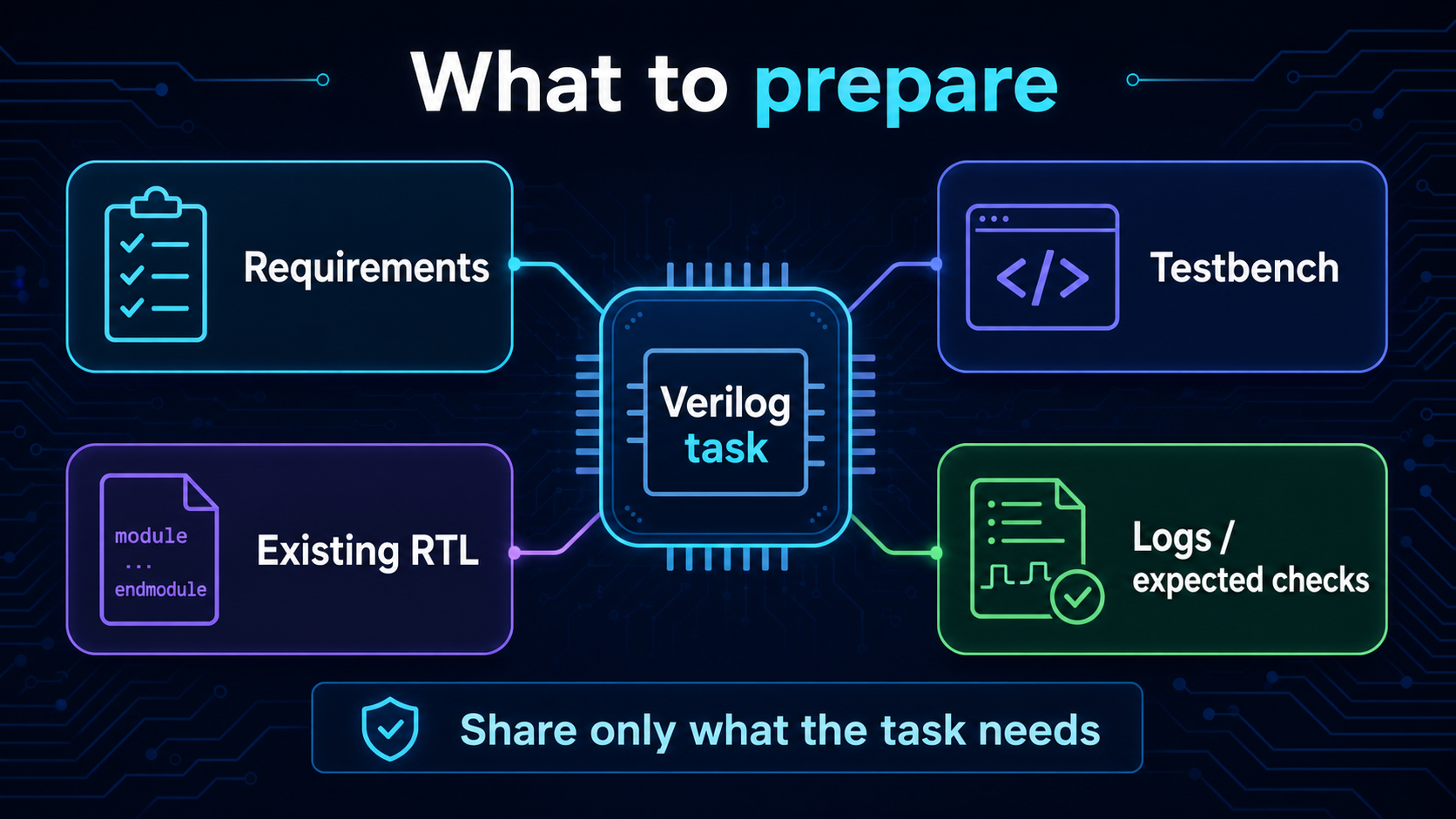
- New module: purpose, module name, ports, clock and reset semantics, cycle-by-cycle behavior, protocol rules, boundary cases, and the checks you expect.
- Existing RTL review: the
.vfiles, relevant testbench or integration context, and the questions or risks you want reviewed. - Commenting or repair: the original RTL, the diagnostic or log, the intended behavior, and whether the change must be comment-only or may change logic.
- Simulation or external validation: a usable testbench with expected outcomes, the simulator/tool environment, and any required project or remote access.
If something important is missing, the skill asks for it before making a consequential change.
How to call it
Use a normal request. These examples are ready to adapt:
Use $readable-verilog-generator to create a Verilog-2001 AXI-Stream packet counter.
First ask for any missing interface and timing details, then show me the module spec
and WaveDrom behavior preview before generating RTL.
Use $readable-verilog-generator to review this RTL for reset behavior, handshake
errors, width issues, naming, comments, and synthesis risks. Do not modify the file.
Use $readable-verilog-generator to add semantic comments to this Verilog file.
Preserve every RTL token and show the comment-only verification result.
Use $readable-verilog-generator to diagnose and repair this module from the
attached simulator log. Show the proposed change and validation results first.
Preview and confirm before generation
For a new module or a behavior-changing repair, ask for a preview before asking AI to write the final RTL. The preview should make these decisions visible:
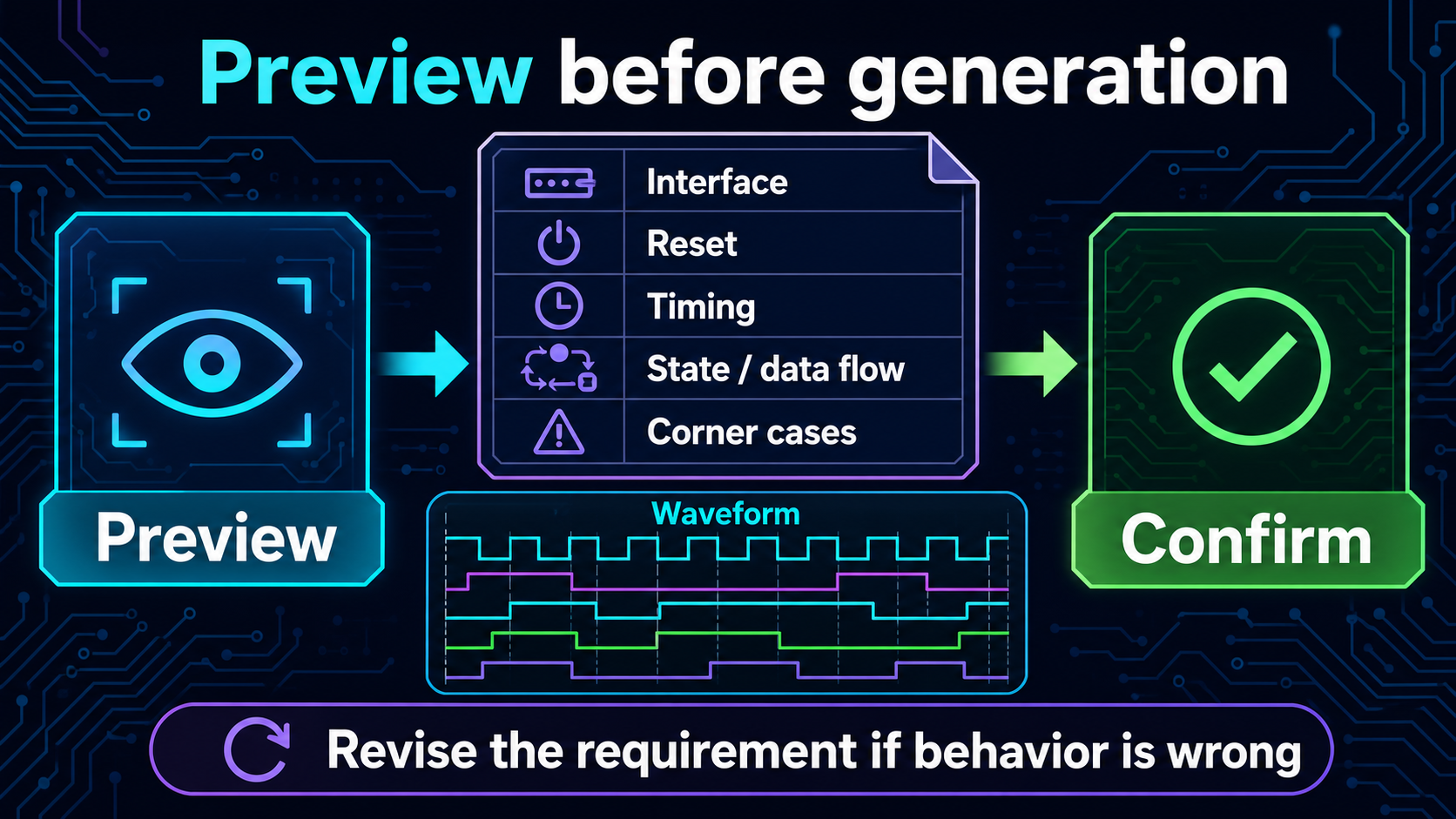
- Interface, port directions, widths, clock, and reset behavior.
- State transitions, handshake conditions, data-path timing, and corner cases.
- At least one WaveDrom scenario that shows the intended cycle behavior.
- The checks that will be run and what each result can prove.
Confirm the preview only after the behavior matches your intent. If it does not, revise the requirement and preview again; do not treat an unconfirmed interpretation as the final design.
What you receive
Depending on the request, the handoff can include:
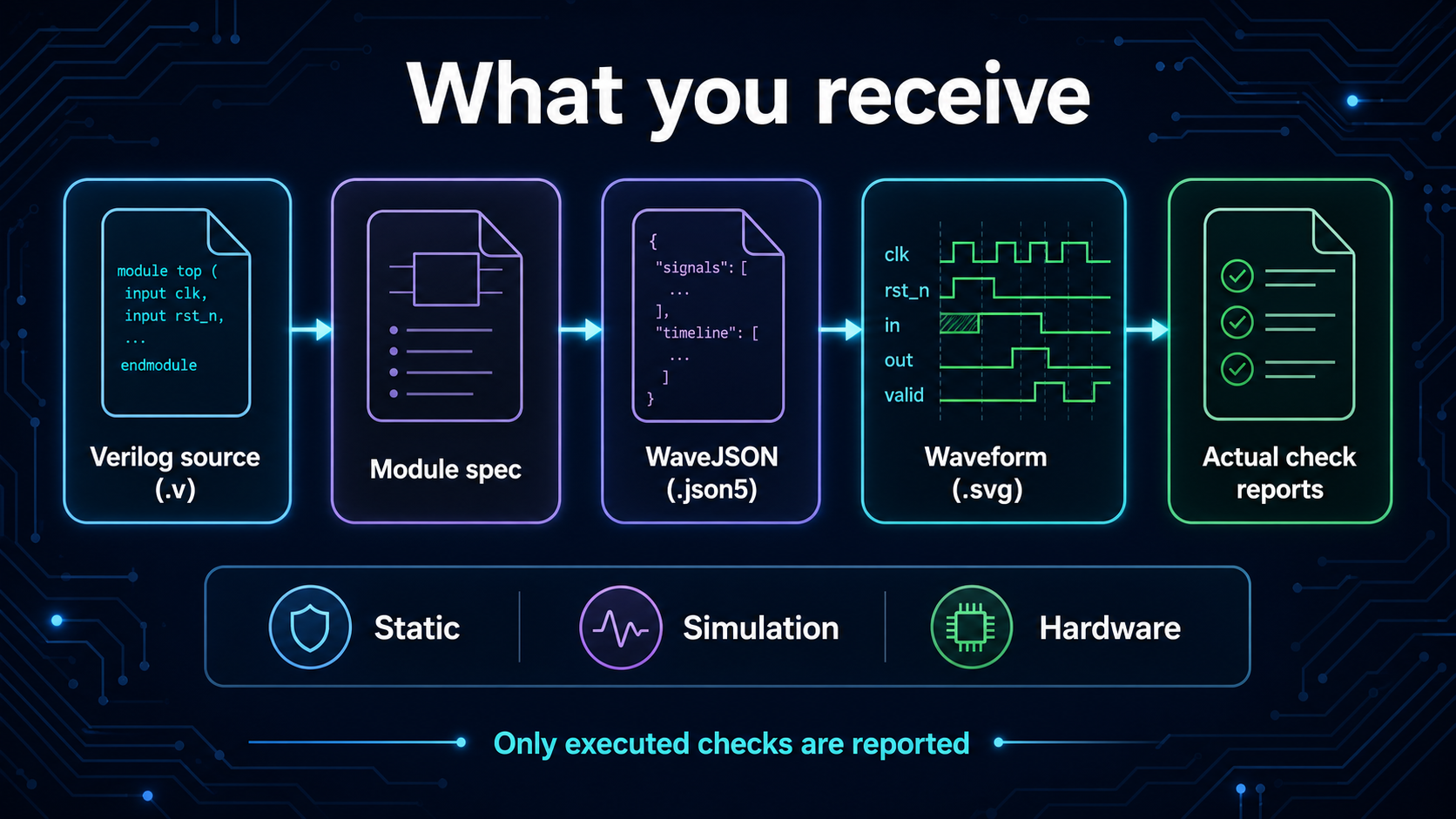
- readable Verilog-2001 source (
.v); - a same-name module specification (
<module>_spec.md); - WaveDrom behavior files (
.json5and rendered.svg); - a testbench scaffold or updated testbench when requested;
- review, repair, static-check, simulation, or tool reports showing only checks that actually ran;
- a concise explanation of remaining assumptions, warnings, and unverified areas.
Review and deliver
Review the generated files and the checks that actually ran before accepting the handoff. Keep assumptions and unverified areas visible.
Example result
The example below is a 32-bit AXI-Stream meter. It counts bytes only after a TVALID/TREADY transfer, counts packets on a transferred TLAST, and saturates instead of wrapping.
// AXI-Stream transaction detection
assign flag_transfer = i_axis_tvalid & i_axis_tready;
assign flag_packet_end = flag_transfer & i_axis_tlast;

always@(posedge i_axis_aclk or negedge i_axis_arstn)begin
	if(i_axis_arstn == 1'b0)begin
		cnt_packet_o <= 32'd0;
	end else if(i_clear == 1'b1)begin
		cnt_packet_o <= 32'd0;
	end else if(flag_packet_end == 1'b1)begin
		if(data_frame_sum[32] == 1'b0)begin
			cnt_packet_o <= data_frame_sum[31:0];
		end else begin
			cnt_packet_o <= 32'hFFFF_FFFF;
		end
	end
end
Open the complete commented source →
| Example check | Result |
|---|---|
| Formatter AST | PASS |
| Readability, comments, naming, profile | PASS |
| Errors | 0 |
| Strict warnings | 0 |
This is an example static result for the published sample. It does not claim that a simulator, synthesis tool, hardware target, or remote environment ran.
Authors and citation
Jiyuan Liu and He Li · Southeast University(东南大学)· HIQC (Heterogeneous Intelligence and Quantum Computing Laboratory)
If this skill supports your research, teaching, or engineering work, cite CITATION.cff.
@software{liu_2026_verilog_generator,
  author       = {Jiyuan Liu and He Li},
  title        = {{Verilog Generator}: An Agent Skill for Verilog-2001 RTL Workflows},
  year         = {2026},
  version      = {2.0.0},
  date         = {2026-08-12},
  url          = {https://github.com/Eriemon/verilog-generator},
  license      = {Apache-2.0},
  note         = {Agent skill for readable Verilog-2001 RTL workflows}
}
No comments yet
Be the first to share your take.