
Wenshan.skill / 文山.skill
English · 简体中文
Turn a Markdown writing collection into a personal knowledge mountain range that always leads back to the source.





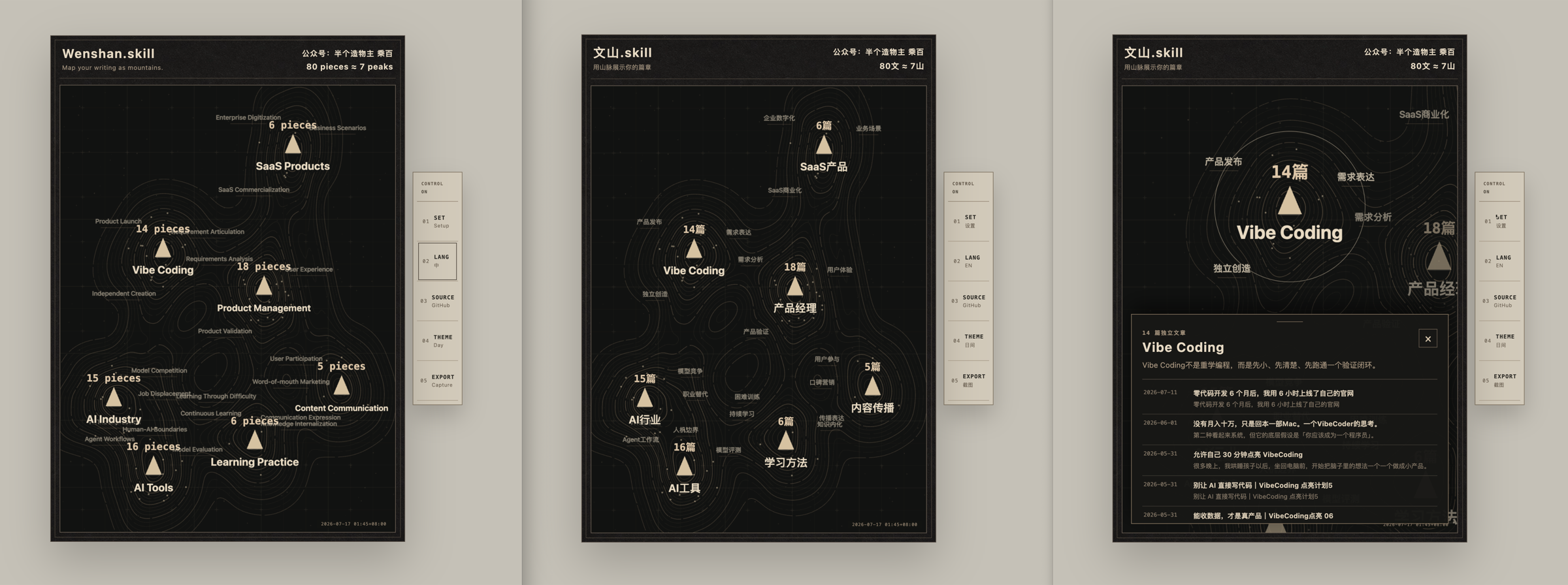
Wenshan reviews authorship and document quality, resolves draft/final versions, and then identifies recurring scenes, industries, roles, and practices as mountains. Every visible mountain must pass an evidence gate; every count, evidence point, and synthesized answer can be traced to the original article.
It is not a folder chart or an embedding cluster map. A mountain name is a recurring concrete problem space, its article count is accumulated writing volume, and its subtitle is the author's current answer in that area.
Beta 1.0 (
1.0.0-beta.1) is a public field test. The analysis contract and renderer are usable; schemas and host-specific adapters may still change before a stable release.
Install in one minute
Requirements: Node.js, Python 3.10+, and a local-file-capable Agent.
npx skills add pakco77/wenshan-skill --skill knowledge-peak-map -g
Check that the repository exposes the Skill:
npx skills add pakco77/wenshan-skill --list
# Codex
npx skills add pakco77/wenshan-skill \
  --skill knowledge-peak-map \
  --agent codex \
  --global \
  --yes

# Claude Code
npx skills add pakco77/wenshan-skill \
  --skill knowledge-peak-map \
  --agent claude-code \
  --global \
  --yes

# Every compatible Agent detected on this machine
npx skills add pakco77/wenshan-skill \
  --skill knowledge-peak-map \
  --agent '*' \
  --global \
  --yes
For CodeWhale, CodeBuddy, WorkBuddy, and manual installation, read the Agent compatibility guide.
First run
Send this to your Agent and replace the path and nickname:
Use $knowledge-peak-map to analyze:
/absolute/path/to/my-writing

Author nickname: Pakco
Interface language: English
Goal: Generate a Wenshan map
If your host does not use $skill-name syntax, say: “Use the knowledge-peak-map Skill to analyze this directory.”
Wenshan needs only:
- an author nickname;
- a user-selected Markdown or Obsidian writing directory;
- an interface language: English or Chinese.
It does not scan the whole vault by default, edit source articles, or upload writing to a remote service.
No Markdown yet?
Use huashu-md-html to convert PDF, DOCX, PPTX, XLSX, HTML, web pages, EPUB, images, audio, or ZIP archives into clean Markdown first:
npx skills add alchaincyf/huashu-md-html --skill huashu-md-html -g
Then ask your Agent:
Use $huashu-md-html to convert these source files into a clean Markdown collection.
After I review the converted files, use $knowledge-peak-map to generate Wenshan.
The two Skills remain separate on purpose: huashu-md-html prepares the corpus; Wenshan reviews evidence, resolves versions, audits mountain boundaries, and renders the map.
What you receive
writing/
└── Cognitive Map/
    └── Agent Atlas/
        ├── cards/                 # auditable semantic card per article
        ├── runs/                  # analysis and review records
        ├── review.md              # boundary cases and human decisions
        ├── wenshan-terrain.json   # mountains, counts, evidence, relations
        ├── Wenshan.md             # readable analysis summary
        └── Wenshan.html           # zoomable, clickable, shareable map
The generated HTML supports:
- English and Chinese interface switching while preserving original article titles;
- wheel and keyboard zoom plus pointer panning;
- peak focus and a reverse-chronological source-article drawer;
- daylight parchment and night atlas themes;
- 3:4 share-image export;
- links back to Markdown or Obsidian source notes.
When Wenshan is useful
- You have many articles but cannot clearly name what you keep returning to.
- Drafts, finals, and rewrites are mixed together, so ordinary counts are inflated.
- You do not want folders, tags, word frequency, or vector similarity to decide your knowledge structure.
- You want a personal writing asset that is explainable, auditable, and visually shareable.
Wenshan can analyze public-account articles, essays, research notes, project retrospectives, decision records, reading notes, and portfolios. Obsidian is a recommended container, not a requirement; an ordinary Markdown directory is enough.
How Wenshan decides that a mountain exists
Wenshan uses Evidence-Gated Longitudinal Framework Analysis (EGLFA). EGLFA is a Wenshan-defined engineering specification that combines established qualitative research practices; it is not the established name of a published research method.
flowchart LR
    A["Select the author's own writing"] --> B["Exclude templates, prompts, references, and fragments"]
    B --> C["Resolve draft / final / rewrite versions"]
    C --> D["Code scenes, industries, roles, practices, and claims"]
    D --> E["Form MECE candidate mountains on one classification axis"]
    E --> F{"At least 3 independent canonical articles?"}
    F -- "No" --> G["Render no mountain"]
    F -- "Yes" --> H["Audit boundaries, synthesize claims, review relations"]
    H --> I["Deterministic contour map"]
Core rules:
- one version-resolved canonical article is one independent analysis unit;
- one article adds altitude to only one primary mountain;
- a main mountain is a noun phrase strongly anchored to a scene, industry, role, or practice;
- main mountains should be MECE on one declared classification axis;
- a contained medium, format, tool, or method becomes a subpeak, not a peer mountain;
- a mountain requires at least three independent articles; no evidence means no mountain;
- mountain proximity comes from explicit semantic review, not embedding distance;
- article count represents accumulated writing volume, not expertise, authority, or correctness.
Read the complete English EGLFA method specification.
How to read the map
| Map element | Meaning |
|---|---|
| Mountain name | A recurring concrete problem space, such as AI Tools, Product Management, or CNC |
16 pieces |
16 independent canonical articles; accumulated volume, not a capability score |
| Solid triangle | Peak summit and interaction target |
| Subtitle | The Agent's synthesis of the author's current answer in this area |
| Peripheral evidence labels | Recurring scenes or practices supported by articles inside the mountain |
| Article dots | Real source articles that open titles, dates, summaries, and original paths |
| Mountain proximity | Reviewed semantic relations, shared practices, or longitudinal transitions |
| Contours and ridges | One continuous mountain range, not a set of disconnected rings |
| Bottom-right timestamp | Analysis and render time |
How it differs from common approaches
| Approach | What it usually answers | Wenshan's treatment |
|---|---|---|
| Folder or tag chart | Where a file was stored | Re-reads article meaning instead of copying the directory |
| Word frequency or word cloud | Which words appear often | A frequent brand or term does not automatically become a mountain |
| Topic model | Which statistical topics may exist | Final topics must pass evidence and human-interpretability gates |
| Embedding clustering | Which texts are close in vector space | Mountain relations are explicit, explainable, and editable |
| Generic knowledge graph | Which entities are connected | Wenshan also represents accumulated writing, claim evolution, and mountain boundaries |
Real classification case
A collection of 102 Markdown files was reviewed:
- 87 independent canonical articles;
- 80 articles entered the map;
- 7 remained below the evidence gate as outliers;
- 7 main mountains were produced.
Two important boundary corrections:
| Incorrect peer mountain | Reviewed result |
|---|---|
HTML Expression · 5 articles |
Moved under AI Tools as a subpeak |
AI Cognition · 9 articles |
Moved under AI Industry as the Human–AI Boundaries subpeak |
This was not an attempt to force a fixed mountain count. It prevented parent and child topics from appearing as peers. Read the compact MECE case.
Use with Obsidian
Select a directory that primarily contains the author's own drafts and finals:
writing/
├── drafts/
└── published/
Ask your Agent:
Use $knowledge-peak-map to analyze this Obsidian writing collection:
/absolute/path/to/writing

Author: Pakco
Language: English
Exclude non-author work, resolve versions, and then generate Wenshan.
Derived files are written only to Cognitive Map/Agent Atlas/ inside the selected collection. Rendering never rewrites source Markdown or semantic cards.
If reviewed cards and wenshan-terrain.json already exist, run only the deterministic renderer:
python3 knowledge-peak-map/scripts/render_territory_demo.py \
  --scope "/absolute/path/to/collection" \
  --nickname "Pakco" \
  --language en \
  --theme obsidian-atlas \
  --output-name "Wenshan"
Visual themes
A visual theme may change paper, lines, typography, grid, selection treatment, and controls. It must never change mountain names, counts, evidence points, reviewed relations, or terrain coordinates.
| Theme | Direction | Status |
|---|---|---|
survey-parchment |
Parchment × surveying instrument × restrained monochrome lines | Implemented |
obsidian-atlas |
Black archival paper × warm gray-sepia contours × evidence stardust | Implemented |
mythic-parchment |
Ancient speculative cartography × hand-cut contours × restrained slope marks | Design specification |
archive-engraving |
Nineteenth-century geographic atlas × copper engraving × museum archive | Design specification |
Safety and trust boundaries
- Read only the user-selected collection.
- Never scan the whole vault by default.
- Never edit source articles.
- Require no vector database or embedding service.
- Never publish private article bodies or absolute local paths.
- Only unique source paths with both
include: trueandcanonical: trueadd altitude. - Do not claim longitudinal analysis when reliable dates are unavailable.
- Send ambiguous article assignments and mountain boundaries to
review.mdinstead of silently guessing.
Development and validation
git clone https://github.com/pakco77/wenshan-skill.git
cd wenshan-skill
python3 knowledge-peak-map/scripts/self_check.py
Repository structure:
wenshan-skill/
├── README.md
├── README.zh-CN.md
├── VERSION
├── LICENSE
├── assets/
├── docs/
└── knowledge-peak-map/
    ├── SKILL.md
    ├── agents/
    ├── assets/
    ├── references/
    └── scripts/
The renderer and self-check use only the Python standard library. Contributions are welcome for corpus cases, host adapters, validation rules, and visual themes, provided that visual changes preserve the same semantic data.
License
MIT © 2026 Pakco
If Wenshan helps you see your writing as an accumulated body of work, consider starring the repository. If you find a wrong mountain boundary or a new use case, open an Issue or PR.
No comments yet
Be the first to share your take.