
Telegram Rich Content Skill
Turn a rough idea, voice note, article, document, podcast, or video into a source-grounded Telegram post in your approved voice — from plain copy to a true Rich Message with headings, tables, expandable sections, footnotes, media, and slideshows.



Русская версия · 60-second setup · Showcase · Security
Not another “AI post generator”
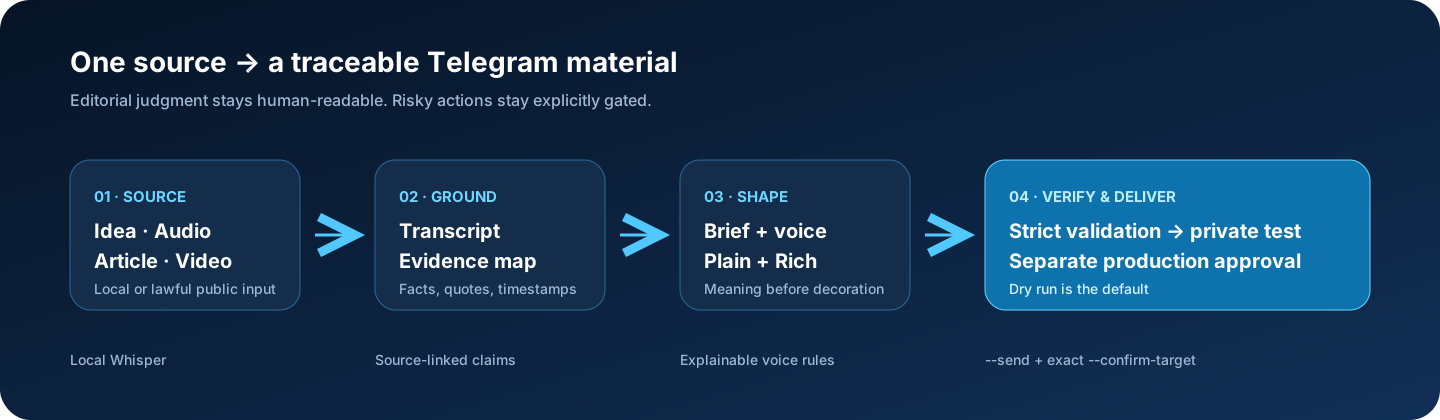
Most content tools start at the blank page and stop at generated copy. This skill gives Codex or Claude Code a complete editorial workflow:
- start from text, audio, a URL, a document, YouTube, or several sources;
- transcribe locally with open Whisper runtimes — no paid speech-to-text API;
- build an evidence map before drafting, so claims stay traceable;
- onboard your tone of voice from approved examples without inventing a personality profile;
- choose the lightest useful format: plain post, manual Article, classic album, or Rich Message;
- validate Telegram Rich HTML against a strict allowlist before any network call;
- preview locally, test privately, and keep production behind a separate approval gate.
Who it is for
- creators and founders who think in voice notes but publish structured long-form posts;
- editors and content teams turning interviews, articles, and videos into original Telegram materials;
- agencies that need repeatable, reviewable client workflows;
- developers experimenting with Telegram Bot API Rich Messages;
- Codex and Claude Code users who want a reusable editorial agent, not a one-off prompt.
It is not a bulk spammer, a copyright bypass, or an autonomous production publisher.
What comes in the box
| Capability | What it does | Network by default? |
|---|---|---|
| Agent skill | Editorial routing, source grounding, onboarding, safety gates | No |
| Material package | Source → transcript → evidence → brief → post variants → QA | No |
| YouTube helper | Public metadata, original thumbnail, captions, or audio via yt-dlp |
Yes |
| Local transcription | TXT, Markdown, SRT, VTT, JSON; checkpoints and word timestamps | Model download once |
| Voice guardrails | Explainable phrase, length, emoji, and CTA checks | No |
| Rich validator | Tags, attributes, URLs, limits, nesting, entities, media IDs | No |
| Local preview | Approximate browser rendering for faster iteration | No |
| Publishers | Rich Message, plain post, or 2–10 item photo/video album | Only with --send |
| Doctor | Installation checks; optional read-only Telegram diagnostics | No unless requested |
60-second setup
Codex
git clone https://github.com/shromarketing/telegram-rich-content-skill.git \
  ~/.codex/skills/telegram-rich-content
Claude Code
git clone https://github.com/shromarketing/telegram-rich-content-skill.git \
  ~/.claude/skills/telegram-rich-content
Restart the agent, then try:
Use $telegram-rich-content. Turn this material into a detailed Telegram post in
my approved voice. Preserve the evidence, prepare plain and rich variants, validate
everything, and do not publish.
Codex and Claude Code both discover the repository through its root SKILL.md.
Project-local installation and Windows commands are in
references/installation.md.
Optional tools: install only what you need
Helper scripts require Python 3.11+. Inspect the plan, apply it, and run the doctor
(replace python3 with python3.12, for example, when the system interpreter is older):
python3 scripts/bootstrap.py --features all
python3 scripts/bootstrap.py --features all --apply
.venv/bin/python scripts/doctor.py
Feature groups are publisher, youtube, transcription, and optional Apple Silicon
apple. The installer creates an isolated .venv, never overwrites an existing .env,
and does not contact Telegram. Add --init-env only when publisher configuration is
needed. You can also install each requirements-*.txt manually.
Start from anything useful
A raw thought or voice note
The agent separates thesis from repetition, asks only questions that can change meaning, and preserves useful depth instead of blindly shortening the source.
An article or document
The agent separates source claims from your commentary, keeps links and attribution, and creates a transformative post rather than copying the original.
A YouTube video
python scripts/prepare_youtube.py 'https://youtu.be/VIDEO_ID' \
  --thumbnail --captions --language 'ru.*,en.*' --output-dir output/video
If captions are missing, acquire only audio and transcribe it locally:
python scripts/prepare_youtube.py URL --audio --output-dir output/video
python scripts/transcribe_audio.py output/video/VIDEO_ID.mp3 \
  --language ru --out output/video/transcript.md \
  --checkpoint output/video/progress.jsonl
Choose txt, md, srt, vtt, or json. faster-whisper is portable; optional
mlx-whisper accelerates Apple Silicon. No OpenAI API key or per-minute fee is required.
The first run may download model weights. See
references/youtube-workflow.md.
Make it sound like you — without a fake “voice score”
Give the agent 3–5 approved posts and ask it to draft a project-local voice profile. You review the observable rules: audience, rhythm, vocabulary, directness, humor, formatting, CTA, evidence habits, and anti-patterns. The profile stays editable.
For objective guardrails only:
python scripts/check_voice.py post-plain.md --profile style-check.json
The checker names every triggered rule. It never claims to measure authenticity,
personality, or writing quality. Start with
assets/voice-profile.template.md and
assets/style-check.template.json.
One auditable folder per material
python scripts/init_material.py "launch interview"
This creates:
materials/launch-interview/
├── source.md                 # origin, rights, raw material
├── transcript.md             # timestamps and speaker labels
├── evidence-map.md           # claim → source → confidence
├── brief.md                  # audience, goal, CTA, constraints
├── voice-profile-used.md     # profile version and examples
├── post-plain.md             # compatible fallback
├── post-rich.html            # Telegram Rich Message
├── media/                    # explicit assets
└── validation-report.md      # technical and human acceptance
The complete synthetic example is in
examples/source-to-post.
Validate and preview — nothing is sent
python scripts/validate_rich.py examples/source-to-post/post-rich.html
python scripts/preview_rich.py examples/source-to-post/post-rich.html \
  --out output/preview.html
The validator targets Telegram Bot API 10.3 and rejects unsupported tags/attributes, event handlers, inline styles, unsafe URL schemes, malformed nesting, unsupported named entities, documented limit overflows, and media-ID mismatches. The local preview is explicitly approximate; Telegram Desktop and mobile remain authoritative.
Safe Telegram delivery
Create a dedicated bot with @BotFather, add it only to a private test channel first,
and grant only Post Messages. Put secrets in a local .env; never paste them into an
agent prompt or commit them.
Dry run:
python scripts/publish_rich.py draft.html --photo cover=cover.jpg
python scripts/publish_fallback.py post-plain.md --mode plain
An actual test send requires two independent gates:
python scripts/publish_rich.py draft.html --photo cover=cover.jpg \
  --send --confirm-target=-1001234567890
Production additionally requires --environment production, but still cannot bypass
--send or exact target confirmation. A successful test is never permission to publish
to production. Full BotFather steps: references/botfather-setup.md.
Rich, when Rich earns its place
Rich Messages can provide headings, checklists, tables, quotations, expandable details, footnotes, math, maps, documents, collages, and true swipe slideshows. Older clients may not render them, so the workflow always considers a normal post or album fallback.
<h1>A decision readers can scan</h1>
<aside><b>The key takeaway.</b></aside>
<table bordered compact>
  <tr><th>Option</th><th>Use when</th></tr>
  <tr><td>Plain</td><td>Compatibility matters most</td></tr>
  <tr><td>Rich</td><td>Structure improves understanding</td></tr>
</table>
<details><summary>Implementation notes</summary><p>Extra context.</p></details>
See references/formatting.md for the supported grammar.
Design principles
- Meaning before formatting. Rich blocks must earn their place.
- Evidence before prose. Claims, quotes, links, and timestamps stay traceable.
- Local first. Transcription, checks, and previews avoid paid APIs and unnecessary uploads.
- Progressive disclosure. The agent reads only the references needed for the task.
- Dry run by default. Drafting is not publication; a test is not production approval.
- Human authority. Voice, rights, target, and final rendering remain human decisions.
Compatibility and honest limits
- Rich Messages require current Telegram clients; prepare a fallback for broad audiences.
- The validator mirrors documented Bot API 10.3 behavior but cannot replace the server.
- Browser preview is approximate, not a Telegram emulator.
- Speaker diarization is not bundled; it is a separate heavy pipeline with additional model and licensing decisions.
- The skill transforms public third-party material; it does not justify republishing a full transcript or bypassing access controls.
Project map
SKILL.md— agent instructions and non-negotiable safety gates;references/— onboarding, sources, installation, formatting, Telegram, YouTube, troubleshooting, and end-to-end workflow;scripts/— deterministic local tools;assets/— templates, sample Rich HTML, and visuals;examples/source-to-post— synthetic complete example;docs/ARCHITECTURE.md— components and trust boundaries;CONTRIBUTING.md— development and contribution rules.
Contributing and roadmap
Bug reports, focused features, new synthetic examples, Telegram format updates, and
cross-platform fixes are welcome. Please keep core tests offline and never use private
materials as fixtures. Start with CONTRIBUTING.md.
Good next contributions include richer deterministic previews, opt-in diarization adapters, more source extractors, and real-world showcase materials whose authors have explicitly approved publication.
License and credit
MIT. See LICENSE, SECURITY.md, and
THIRD_PARTY_NOTICES.md.
Created and expanded by Roman Sharafutdinov. The Rich Message grammar and original minimal aiogram experiment were adapted from seozavr/tg-rich-post, MIT licensed.
No comments yet
Be the first to share your take.