




Install · Use · Features · Docs · Demo deck · Why
Writing documentation isn't the bottleneck any more. Keeping it true is. The deck that said we run two database migrations still says two, a year after we started running ten 😅.
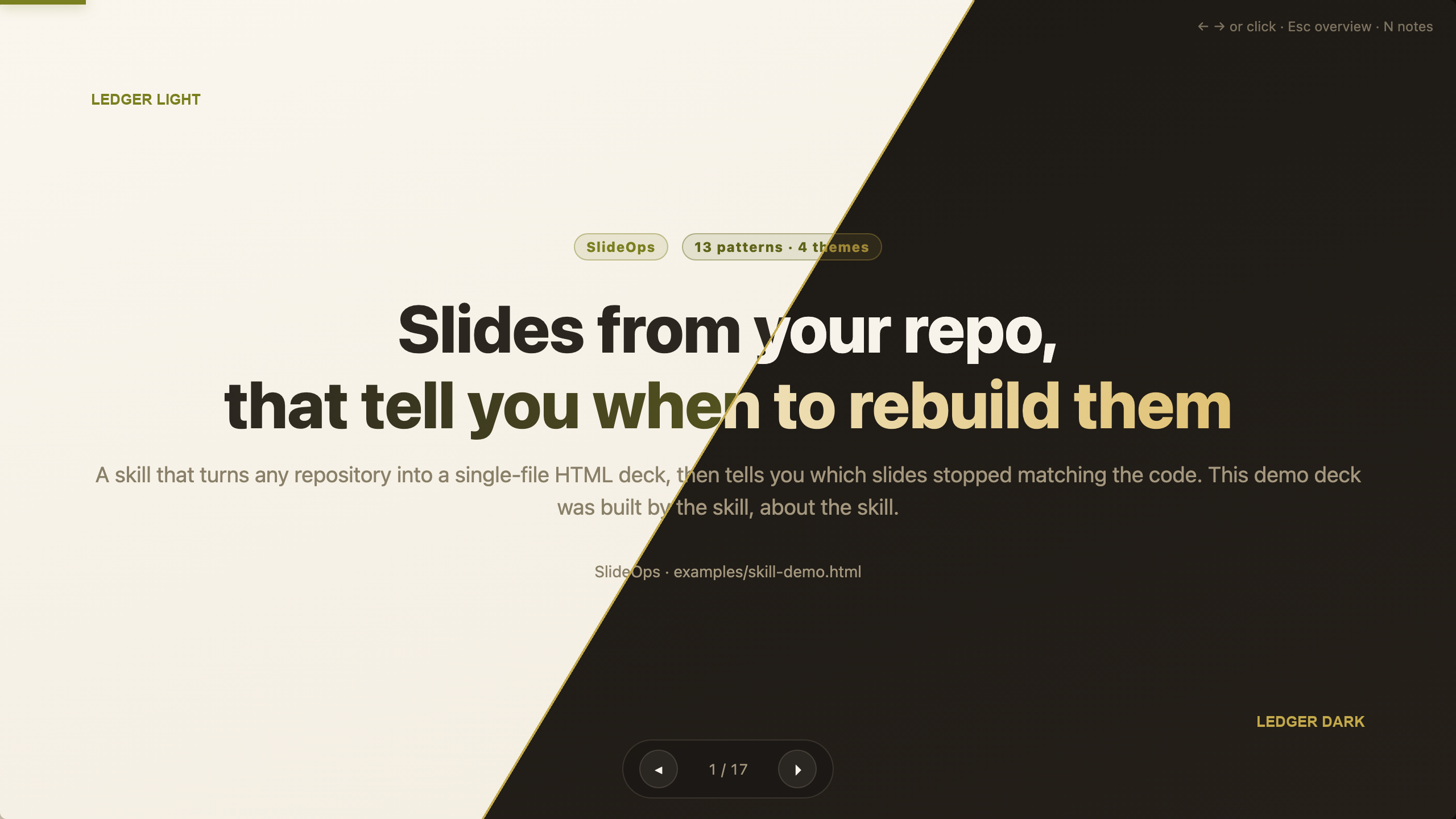
SlideOps is a pair of Agent Skills for Claude Code and compatible coding agents. It treats a generated document the way you'd treat generated code: it's built from a source, and it records which source it came from.
The reasoning behind it is written up in Your documentation is a build artifact. Start treating it like one.
Install
Claude Code
This repo is its own marketplace, so two commands are the whole setup, and it's the only install that keeps itself up to date. Add the marketplace:
/plugin marketplace add glukicov/slideops
Then install the plugin from it:
/plugin install slideops@slideops
Any agent with the skills CLI
One line, and it works everywhere:
npx skills add glukicov/slideops
Codex, Copilot CLI, OpenCode
Or a plain checkout:
git clone https://github.com/glukicov/slideops && cd slideops
./install.sh
All four agents read SKILL.md and nothing needs porting between them. For the symlink and
snapshot installs, the per-agent table and how updates reach you, see
docs/install.md.
[!NOTE] Third-party marketplaces have auto-update off by default. Turn it on once in
/plugin→ Marketplaces, or new versions only arrive when you run/plugin marketplace update slideopsby hand.
Use
Open a repository and say:
[!TIP]
💬 make slides about this repo
SlideOps scans the repo first, then asks one compact set of questions: which topic (it proposes concrete candidates it found, each with a "why now"), audience, length, theme and extras. You get an outline to approve before it writes any HTML.
If you already know what you want, skip the intake:
[!NOTE]
💬 deep dive on the auth subsystem, Ledger Dark theme, 15 slides, with a PDF
Prefer a document to a deck? Since v1.1.0 the same mechanism writes Markdown:
[!TIP]
💬 write markdown docs for the sync subsystem
You get a single .md that renders on GitHub, with every quoted snippet carrying an
invisible citation comment (<!-- slideops data-src="app/main.py:40-58" data-sha256="a1b2c3d4e5f6" -->) above its fence, Mermaid diagrams as native fences, and
the build commit stamped on line 1. The same check.py sweep verifies docs and decks
together, and the same --json repair brief lets an agent regenerate only the sections
that drifted. PDF export mirrors the deck path with a verified, print-paginated export.
Months later, in the same repository:
[!IMPORTANT]
💬 is the architecture deck still accurate?
The agent sweeps the deck folder and triages by status. It re-quotes whatever merely moved, and flags the slides whose claim might no longer hold. It repairs what drifted instead of regenerating the deck, so the pacing and narrative you signed off on the first time survive.
Features
-
Freshness checking.
scripts/check.pysweeps a wholedocs/slides/folder and reports which slides cite code that has changed, moved or vanished since the deck was built, then suggests the fix or hands an agent a JSON repair brief. No model, no network, no tokens: standard library Python, and it runs in milliseconds. -
Markdown docs with the same guarantee. The
.mdcarrier uses HTML comments instead of attributes, headings instead of slide numbers, and shares every status, the sweep, and the repair brief with decks. The worked example isskill-demo.md, checked by this repo's CI. -
One self-contained file per deck. No build step, no CDN, works offline, attaches to an email.
-
Navigation: arrow keys, click-to-advance, URL hash deep links, an Esc-toggled overview grid, and speaker notes on
N(never visible in screenshots or exports). -
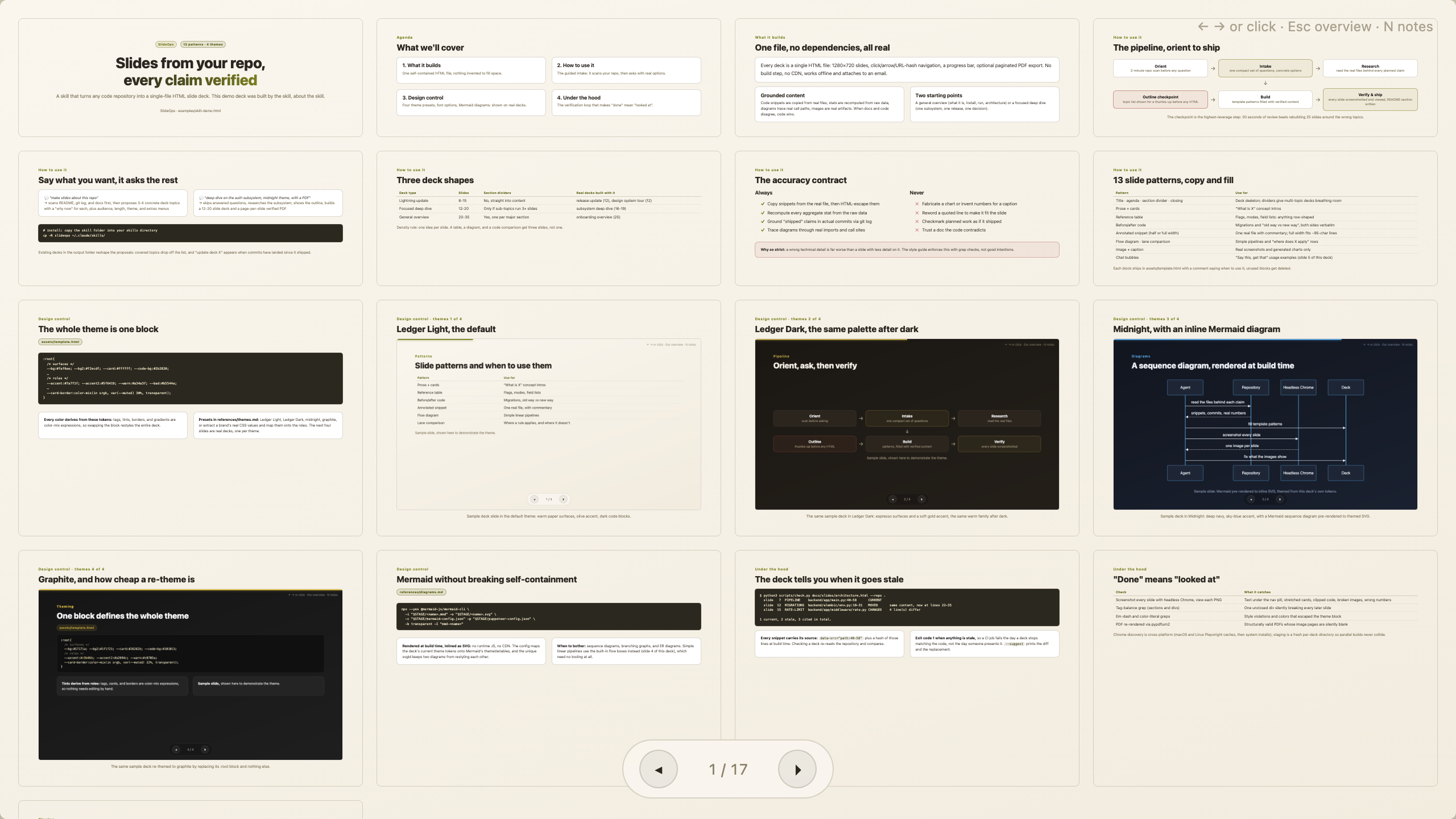
13 slide patterns: title, agenda, section divider, prose + cards, reference table, before/after code, annotated snippet (half and full width), flow diagram, lane comparison, image + caption, chat bubbles, closing.
-
4 themes, one block each. Every color derives from a single
:roottoken block viacolor-mix(), so switching theme is one replacement: Ledger Light (default), Ledger Dark, Midnight, Graphite. Or point it at a brand's real CSS values and map those onto the token roles.Ledger Light (default) Ledger Dark 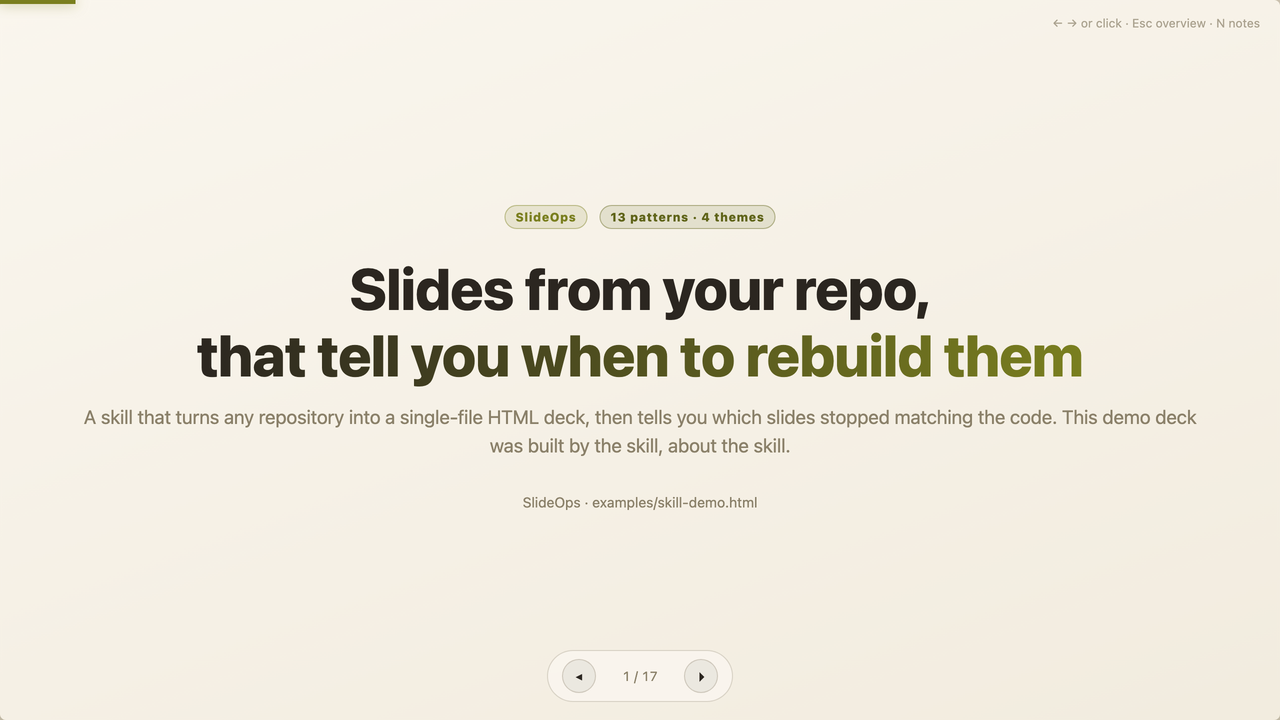
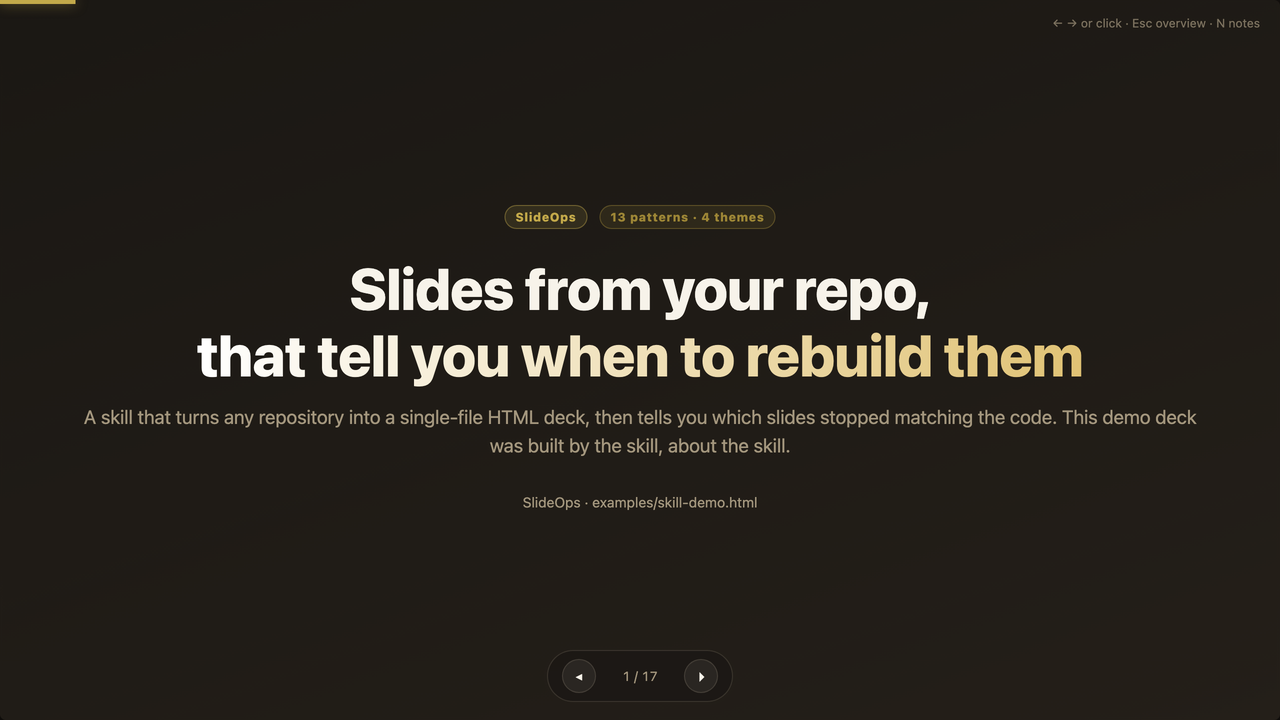
Same deck, same markup, same content. One :rootblock apart. -
Mermaid diagrams pre-rendered to inline SVG at build time and themed from the deck's own tokens, so the deck stays dependency-free.
-
Verified PDF export. The companion skill renders the finished PDF back to images and checks the pages, because a PDF can have the right page count and still hand you blank images.
Documentation
| Page | What's in it |
|---|---|
| 📦 Install | Every install path, all four agents, updating, requirements, what gets installed |
| 🔎 Freshness | Citations, the status table, the cost model, where to automate, the accuracy contract, what never reaches a slide |
| 🛠️ Development | Working on this repository: the gate, CI guards, generated artifacts, releasing |
| 📋 Changelog | What changed in each release |
Inside the skill, skills/slideops/references/ holds the specifications the agent reads:
freshness, automation, style, themes, diagrams and verification.
Credits
Prior art worth knowing: frontend-slides for visual-first theme selection, and presentation-skills for pioneering the render-then-look visual QA loop that SlideOps also relies on. What SlideOps adds is the Ops half: content grounded in a repository, and a cheap way to ask later whether it still holds.
Licence
MIT. See LICENSE. Use it, fork it, ship it commercially; attribution is the only condition. The decks you generate are your own content either way.
Install · Docs · Changelog · Releases
Built with SlideOps, about SlideOps. If a slide in this repo ever stops matching the code, check.py says so.
No comments yet
Be the first to share your take.