
Connor Griffin's agent skills
A portable skill pack for coding agents. Skills live under skills/
and work with clients that support the Agent Skills format. Some skills compose:
the UI workflow uses the bundled browser driver for rendered evidence.
Included skills
| Skill | Purpose | Extra requirement |
|---|---|---|
ui-craft |
Full surface lifecycle: lock a visual spec, build to it, critique with personas, audit against the lock, polish, re-settle | drive-local-webapp for rendered review; parallel-agent support is recommended |
drive-local-webapp |
Drive and screenshot a local web app with headless Chromium | Node.js 20+; installs Playwright locally |
cbm-onboard |
Index a repository with codebase-memory-mcp and keep it current | codebase-memory-mcp on PATH |
spin-worktree |
Create isolated Git worktrees for issue and PR work | Git; GitHub CLI only for --pr discovery |
scope |
Triage front door for work that isn't ready to build: classify the dominant uncertainty and route to one specialist skill, including a bundled interview mode | — |
plan-review |
Adversarially review a plan or work order with cold agents before building | Parallel-agent support recommended; persona-review optional for load-bearing plans; the round-count evidence behind its rules is in docs/review-round-mining.md |
persona-review |
Convene a panel of persistent reviewer personas to review a document and synthesize a verdict | Private data repo for persona memory; GitHub CLI for mining real-colleague profiles; parallel-agent support recommended |
orchestrate |
Flip the session into coordinator mode: delegate all real work to sub-agents routed by an empirically benchmarked model capability table | Codex CLI for GPT-tier sub-agents; table re-benchmarked per its bundled procedure |
wayfinder |
Chart a large, foggy effort as a GitHub map of decision tickets, then hand clear subtrees to implementation | GitHub CLI; composes with research, scope's interview mode, ui-craft |
pr-body |
Write a PR body and score it before the PR opens, or audit an existing one, against a deterministic linter and a voice judge | A PreToolUse hook that hard-denies gh pr create until the body is scored, installed separately from hooks/ |
research |
Investigate a question against primary sources and capture findings as Markdown in the repo | — |
prototype |
Build a throwaway prototype — a terminal app for logic questions or switchable UI variants in the real app | — |
tdd |
Test-driven development through public interfaces, red-green-refactor | — |
review |
Review changed code against the project's standards and the originating issue | — |
implement |
Implement a PRD or issue set via tdd, then review, then commit |
tdd and review from this pack |
say-less |
Answer-first output shaping with a per-repo glossary of approved terms; adapted from i-have-adhd, merged with this pack's reader-preference rules and an ASD-STE100 subset | Optional prompt hook for always-on digest; see docs/overlay.md and the measured comparison |
code-review |
Review changes since a fixed point on two axes, Standards and Spec, each returning a verdict per enumerated item so a round terminates | Parallel-agent support recommended; GitHub CLI to fetch an originating issue; see docs/review-round-mining.md for the mined evidence behind the fix protocol and the round cap |
writing-for-agents |
Write or review a skill against a shared pointer/load/pruning vocabulary; doctor verb audits the loaded skill and CLAUDE.md/AGENTS.md estate for token cost and trigger risk |
Hand-only; invoke by name |
Install
Install the primary UI workflow with its required browser driver using the
standard skills CLI:
npx skills add ConnorGriffin/skills \
  --skill ui-craft \
  --skill drive-local-webapp
Install another skill by itself:
npx skills add ConnorGriffin/skills --skill spin-worktree
Install every skill:
npx skills add ConnorGriffin/skills --all
The CLI prompts for the target agents and whether to install per-project or globally. Review skill instructions and scripts before running them; several skills intentionally start processes, modify repositories, or install Git hooks.
Optional upstream skills
Optional integrations are enhancements, not hidden runtime requirements:
- Codebase Memory: accelerates structural exploration. Without it, use ordinary repository search and file reads.
codebase-design: referenced bytdd; helps shape non-trivial module interfaces. Without it, keep the shipping module shape and preserve locality.domain-modeling: referenced byscope's interview mode andwayfinder; maintains a project's domain vocabulary. Without it, ground terms in the repo's own docs.impeccable: adds a final visual-quality audit. Without it, run the explicit contrast, focus, overflow, and target-size checks.persona-review: referenced byplan-reviewfor load-bearing plans; convenes a panel of persistent reviewer personas. Without it,plan-reviewproceeds on its own fresh-cold-pass termination alone.
Install Matt Pocock's optional skills from their repository:
npx skills add mattpocock/skills --skill codebase-design --skill domain-modeling
Attribution
The implement, tdd, review, and prototype skills are adopted from — and
scope's interview mode and code-review are derived from — Matt Pocock's
skills repository (MIT, copyright (c) 2026
Matt Pocock), lightly edited here to be self-contained. See LICENSE and
NOTICE.
Output style
output-styles/say-less.md is a Claude Code output
style: it replaces the built-in coding instructions so every reply leads with the
outcome and stops there. The say-less skill is the full ruleset for documents;
the style is the always-on subset.
Same task, same model, style the only difference. Neither reply is truncated:
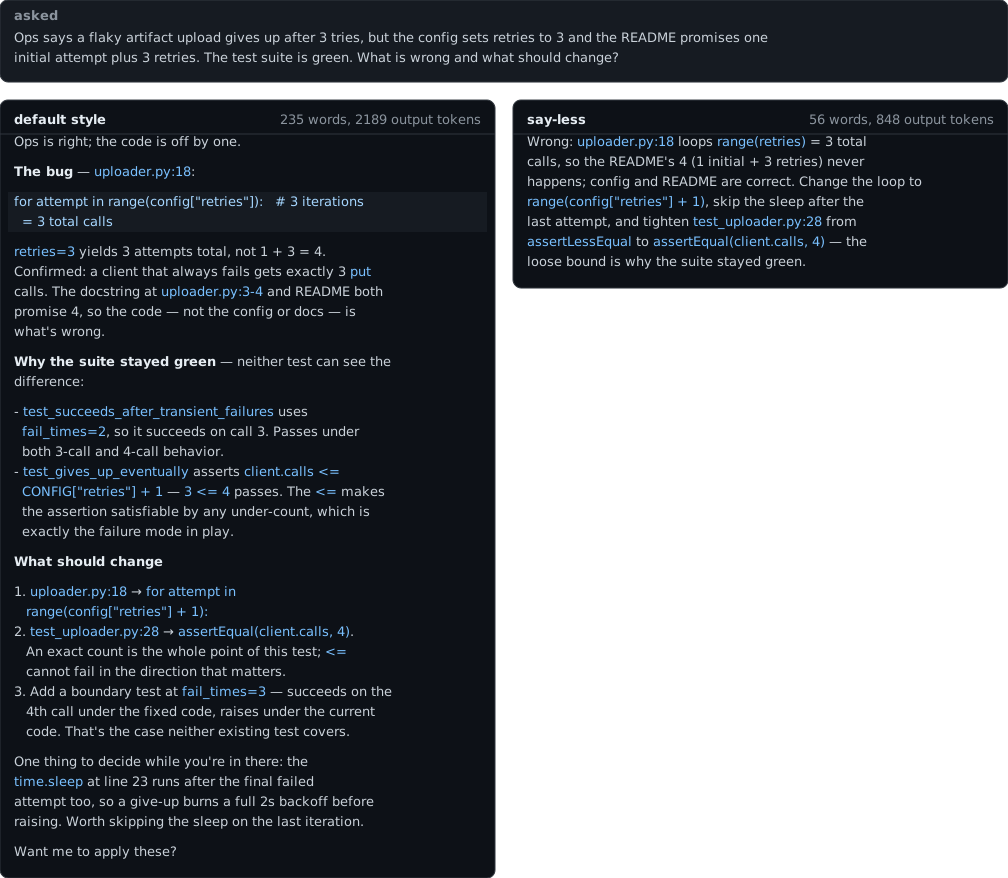
Both arms found the same three defects. Full text of every arm:
examples/transcripts/.
Across 120 headless runs on a 10-question set with an executed answer key:
| model | median output tokens, default | say-less | outcomes correct, default | say-less |
|---|---|---|---|---|
| claude-opus-5 | 348 | 164 | 20/20 | 10/10 |
| claude-sonnet-5 | 436 | 164 | 115/120 | 38/40 |
| claude-fable-5 | 456 | 178 | 20/20 | 10/10 |
Half to two thirds of the reading, no correctness cost on opus or fable. Sonnet keeps one residual failure worth knowing about before you install it, and compression drops caveats a longer reply would have kept: both are measured, with their method and the counterexamples, in docs/before-after.md.
Activate it by setting "outputStyle": "say-less" in ~/.claude/settings.json
after linking the file into ~/.claude/output-styles/, or run
/output-style say-less in an interactive session. New sessions pick it up; the
one you are in does not.
Shared profile
profile/ holds a machine-agnostic global-instructions
layer (communication rules, working preferences, an engineering charter) meant
to be @-imported from a local checkout of this repo into each machine's own
CLAUDE.md/AGENTS.md, with machine-specific overlays staying private. See
profile/README.md for setup.
Development
Run the repository checks with:
python3 scripts/validate.py
Contributions require a Signed-off-by trailer under the Developer Certificate of Origin.
License and support
MIT, from v0.2.0 onward (v0.1.0 was published under Apache-2.0, and that grant stands for copies taken at that tag). See LICENSE and NOTICE. Security reports belong in the private channel described in SECURITY.md; everything else uses GitHub issues.
No comments yet
Be the first to share your take.