
MoAI-ADK is a Go-based development environment that enables Claude Code to autonomously design, test, and implement features across 16 programming languages using 8 AI agents and 27 skills. It enforces quality gates through TDD/DDD methodologies, persists progress across sessions, and runs instantly as a single binary with zero dependencies.
SPEC-First Agentic Development Kit for Claude Code — 24 AI agents + 52 skills with TDD/DDD quality gates, 16-language projects, 4-language docs. Go CLI, zero deps.
1,143Stars
211Forks
7Open issues
12Watching
Go Apache-2.0 v3.0.1 Updated 1 day ago
At a glance
Go Actively maintained Commercial OK
README
"Tokenomics is a harness designed to make token consumption economical."
MoAI-ADK is a Tokenomics Harness
MoAI-ADK (Agentic Development Kit) enables Claude Code to produce code, then makes that code reliable at predictable cost. A harness wraps the model from the outside. The model is a stochastic worker moving token by token — it remembers neither budget, nor quality bar, nor where the last session broke off. Cost ceilings, passing test suites, continuity that survives /clear — properties like these cannot be re-seeded by a prompt every turn; the system must enforce them from the outside.
Every design decision serves one goal: token economics — the same quality for fewer tokens, higher quality for the same tokens. Which model to use, how deeply to reason, how to spend context — none of this is left to chance turn by turn; the system decides.
It does not replace Claude Code. It only wraps, in structure, the parts Claude Code leaves to you — model routing, quality gates, cost control, session continuity. A single binary written in Go, it runs on macOS, Linux, and Windows with no extra dependencies.
Why Tokenomics
Token prices keep falling, but actual agent workflow spend rises. Agents spin through dozens to hundreds of steps to solve a single task, consuming proportionally more tokens. In usage-based pricing, this becomes the invoice; in subscription, it consumes the weekly quota shared by all models.
Cost is determined by assignment, not unit price
The DeepSWE leaderboard (113 tasks) demonstrates this problem. Even within the same Claude family and at the same max effort, per-task costs vary widely.
| Model [max] | Pass@1 | Per-task cost | $/solved | Tokens/solved | Steps |
|---|---|---|---|---|---|
| claude-opus-4.8 | 59% | $13.22 | $22.4 | 229k | 120 |
| claude-fable-5 | 70% | $21.63 | $30.9 | 170k | 88 |
| claude-sonnet-5 | 54% | $26.40 | $48.9 | 396k | 268 |
Sonnet 5 max is more expensive than Opus 5 max per task ($26.40 vs $13.22) while scoring lower (54% vs 59%). The cause is 268 steps — at max effort, retry loops explode. "Use a weaker model harder to save money" does not hold. It burns three times the steps, consuming more quota. Cost is determined by assigning the right model and reasoning depth to each task, not by unit price.
MoAI-ADK systematizes this assignment instead of leaving it to chance.
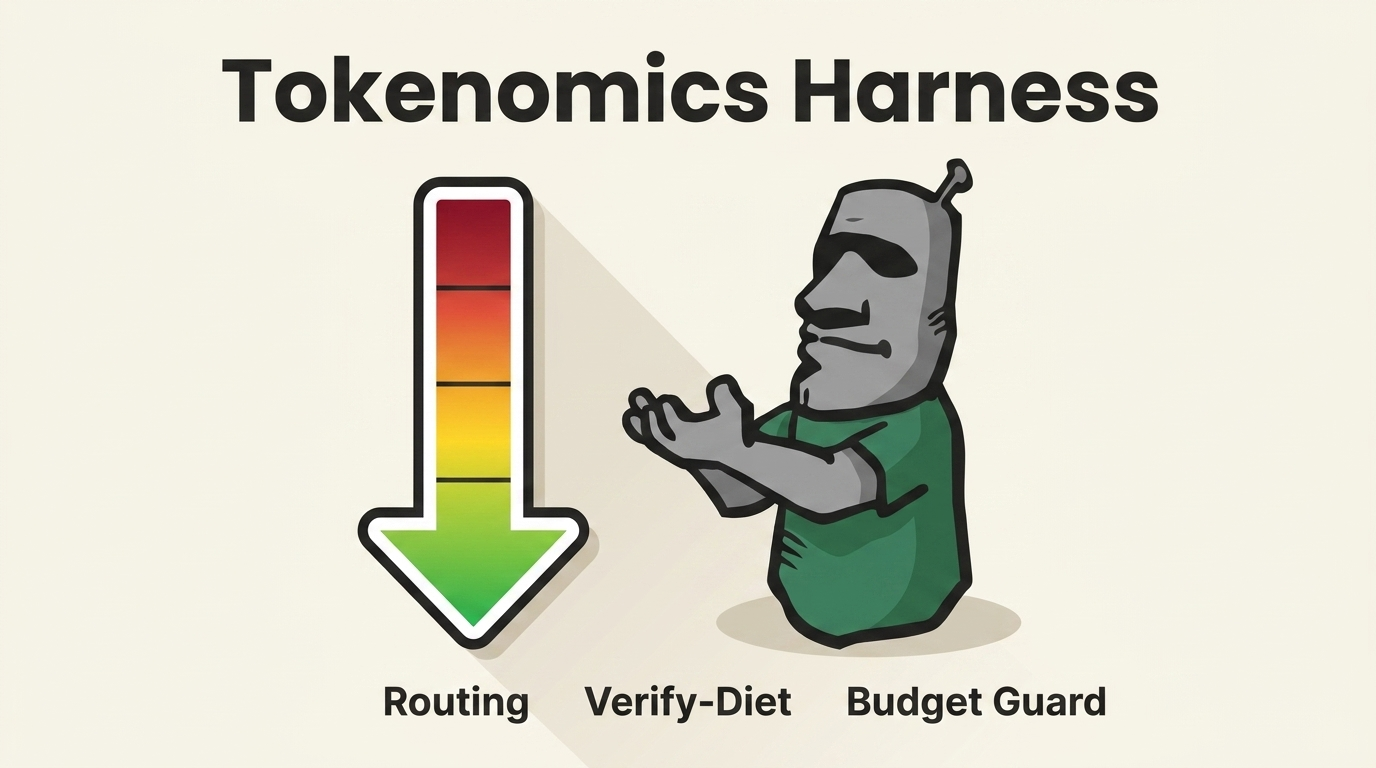
Three Axes of Economization
Routing — Assign the right model and reasoning depth to each task
Tier×Phase Matrix. Declaratively assign models and reasoning effort (effort) by work phase (plan / run / sync) and SPEC size (Tier S / M / L). Deploy high-reasoning models to planning phases that need deep inference, and light models to implementation phases with mechanical repetition. Maximize quality per cost.
No-Haiku 3-Tier Policy. Exclude Haiku from the routing model set, distributing work across a 3-tier structure (Sonnet / Opus / Fable). Assign Sonnet low effort to mechanical tasks to minimize step count, and deploy upper-tier models where reasoning matters.
Profile Matrix. A single per-agent profile matrix maps each retained agent to a {model, effort} pair. One profile axis — max / medium (default) / low, selected via llm.profile (moai init --profile, moai update --profile) — picks the active column; moai model profile resolves each agent's cell. The 10 grouped agents draw model+effort from the matrix (no Haiku anywhere), while Explore and user-defined agents inherit the session model.
CG Mode (Claude + GLM). moai cg is a hybrid mode combining Claude leader and GLM workers. Strategy, planning, and audits run on Claude; bulk implementation runs on GLM. 60-70% cost savings on implementation-heavy workloads.
Verification Economy — Diet context, persist evidence to disk
verify-diet. Redirect verbose verification output to disk files, leaving only exit code and bounded tail (max 50 lines) in context. This file-redirect contract maintains verification evidence integrity while reducing context consumption. Evidence persists under .moai/state/verify/<session>/.
Prompt Cache. When a request's prefix matches the previous request, reuse that section instead of reprocessing. Cached reads cost 0.1× the base input price. Minimize always-loaded instructions and the hit rate rises immediately. The statusline cache hit segment (♻️) shows real-time monitoring.
Context Diet. Apply /clear strategy. When SPEC phase completes, /clear and save progress to progress.md, then issue a paste-ready resume message. At context window thresholds (1M model 50% / 200K model 90%), automatic recommendations appear.
Budget Defense — Stop before overage, resume in next session
Token Circuit Breaker. When agent token usage hits hard-limit (default 90%), execute abort. Save progress to progress.md, issue paste-ready resume message, and never auto-/clear. The system only recommends /clear; the user decides and executes.
Statusline. Keep context usage rate (CW%), prompt cache hit rate, and rate limit depletion visible in terminal at all times. The (⚠️/clear) marker next to CW% appears at model-specific thresholds.
Infrastructure Sustains Tokenomics
Quality Structure — Prevent rework and debug loops (worst token waste)
SPEC 3-Phase Lifecycle. plan → run → sync. Tier S/M/L size classification determines verification depth and PR routing. GEARS format requirements + acceptance criteria judge completion by evidence.
TRUST 5 Quality Gates. Tested (85%+ coverage) · Readable · Unified · Secured · Trackable, applied to every change. Gates judge verification, not agents.
11-Agent Catalog. MoAI custom 10 + built-in Explore. Separate planning and auditing from the start so the authoring side cannot grade its own work.
Learning Loops — Token efficiency improves as loops run
/moai goal·/moai loop. Declare a completion condition and the session works until it is satisfied or the turn limit (default 30) is reached. /moai loop scans LSP diagnostics · AST-grep · linter in parallel, buckets issues by level, and runs until the queue drains.
Routing Ledger. Record routing decisions and gate evidence as privacy-preserving digests. Observations upgrade to rules.
4-Tier Learning Ladder. Observation (≥1) → Heuristic (≥3) → Rule (≥5) → Auto-update (≥10, user approval required); trust threshold 0.70. All applications revertible via moai harness rollback. Harness edits (rule/agent/hook changes) follow a predict–verify discipline: each edit records a falsifiable prediction, must pass held-in/held-out double checks before acceptance, and rejected edits stay on record.
Decision Memory. Questions emerge where uncertainty is highest (p ≈ 0.5); recommendations follow observed statistical majority, not system defaults.
Extension Points — Duplicate proven patterns for project-specific reuse efficiency
Harness v4 Builder. Natural language request → domain·goal·constraint extraction → approval gate → project-specific agents·skills·commands·hooks scaffolding.
@MX Tags. Inline code annotations where AI agents exchange context, invariants, and danger zones.
worktree isolation. Attach isolated worktrees per SPEC for parallel development via /moai plan --worktree.
Quick Start
Install
macOS / Linux / WSL
curl -fsSL https://raw.githubusercontent.com/modu-ai/moai-adk/main/install.sh | bash
Windows (PowerShell 7.x+)
irm https://raw.githubusercontent.com/modu-ai/moai-adk/main/install.ps1 | iex
Build from source (Go 1.26+)
git clone https://github.com/modu-ai/moai-adk.git
cd moai-adk && make build
Project Initialization
moai init my-project
Interactive wizard auto-detects language, framework, and methodology, selects model policy, and generates Claude Code integration files.
First Workflow
claude # launch Claude Code inside the project
/moai plan "Add JWT login"      # author a SPEC
/moai run SPEC-AUTH-001         # TDD/DDD implementation
/moai sync SPEC-AUTH-001        # sync docs + create PR
Natural language works too. /moai "fix the login bug" triggers intent analysis (Analyze-First routing) to read the request and route to the appropriate workflow.
Requirements
| Platform | Supported Environments | Notes |
|---|---|---|
| macOS | Terminal, iTerm2 | Full support |
| Linux | Bash, Zsh | Full support |
| Windows | WSL (recommended), PowerShell 7.x+ | Native cmd.exe unsupported |
Prerequisites
- Git required on all platforms
- Claude Code — MoAI-ADK is a harness for Claude Code
- Recommended:
ghCLI (PR automation) ·tmux(CG mode) · language linter/test toolchain (e.g.,golangci-lint)
Reference
/moai Slash Commands (16)
| Subcommand | Role |
|---|---|
plan / run / sync |
SPEC 3-phase pipeline |
project / harness / design |
Project docs+harness generation · harness lifecycle · Design-phase collaboration |
goal / loop / fix |
Declarative goal loops · iterative fixes · single-pass fixes |
review / gate / clean |
Code review (--deep for multi-agent adversarial vulnerability scan) · pre-commit quality gates · dead code removal |
mx / codemaps / feedback |
@MX annotations · architecture docs · GitHub issue reporting |
e2e |
Multi-platform E2E tests (web/mobile/desktop, CLI-first) |
| (natural language) | Analyze-First routing: autonomous plan → run → sync pipeline |
→ Details: Workflow Commands · Utility Commands
CLI Commands (frequently used 12)
| Command | Description |
|---|---|
moai init |
Interactive project setup (auto-detects language/framework/methodology) |
moai doctor |
System state diagnosis and environment verification |
moai status |
Project status summary (Git branch, quality metrics) |
moai update |
Update to latest version (auto-rollback supported) |
moai cc / moai glm / moai cg |
Claude-only / GLM-only / hybrid Claude leader + GLM worker sessions |
| `moai worktree <new | list |
| `moai session <list | register |
| `moai spec <audit | archive |
| `moai goal <arm | status |
| `moai harness <status | apply |
| `moai handoff <save | list>` |
| `moai preference <list | decay-scan |
moai web |
Web Console — 6-tab settings console |
Full 36 commands: CLI Reference
11-Agent Catalog
| Category | Agent | Cost | Role |
|---|---|---|---|
| Manager | manager-spec | 🔴 | Plan-phase SPEC authoring |
| manager-develop | 🔴 | Run-phase TDD/DDD/autofix implementation | |
| manager-docs | 🔵 | Sync-phase documentation | |
| manager-git | 🩵 | PR creation and routing | |
| manager-design | 🟠 | Design-phase collaboration (Claude Design) | |
| Evaluator | plan-auditor | 🔴 | Independent plan audit (bias prevention) |
| sync-auditor | 🔴 | 4-dimensional quality scoring (Functionality 40 · Security 25 · Craft 20 · Consistency 15) | |
| Builder | builder-harness | 🟠 | Project-specific agents, skills, commands, hooks scaffolding |
| Advisor | super-advisor | 🔵 | On-demand high-reasoning consultation (E1-E4 escalation) |
| Specialist | e2e-tester | 🟠 | Web/mobile/desktop E2E test execution (CLI-first) |
| Built-in | Explore | ⚪ | Read-only codebase exploration |
Cost colors follow the default medium profile's model×effort cells (inspect via moai model profile): 🔴 opus+high · 🟠 opus+medium · 🔵 sonnet+medium / fable+low · 🩵 sonnet+low · ⚪ session-model inherit. Assignments shift when switching profiles (max/low). Progress of long-running delegations is recorded on the Task channel and relayed by the orchestrator as an icon Progress Board.
TRUST 5 Quality Gates
| Criterion | Meaning | Verification |
|---|---|---|
| Tested | Tested | 85%+ coverage, characterization tests, unit tests pass |
| Readable | Readable | Clear naming, consistent style, lint errors 0 |
| Unified | Unified | Consistent formatting, import order, project structure compliance |
| Secured | Secured | OWASP compliance, input validation, security warnings 0 |
| Trackable | Trackable | Conventional commits, issue references, structured logging |
Methodology Selection (TDD vs DDD)
flowchart TD
    A["Project analysis"] --> B{"New project or<br/>10%+ test coverage?"}
    B -->|"Yes"| C["TDD (default)"]
    B -->|"No"| D["DDD"]
    C --> F["RED → GREEN → REFACTOR"]
    D --> G["ANALYZE → PRESERVE → IMPROVE"]
| Methodology | Cycle | Target |
|---|---|---|
| TDD (default) | RED → GREEN → REFACTOR | New projects and feature work |
| DDD | ANALYZE → PRESERVE → IMPROVE | Existing code with <10% coverage |
Reading the Statusline
🤖 Opus │ 🧠 xhigh·t │ ♻️ 87% │ 🔅 v2.1.212 │ 🗿 v3.0.0 │ ⏳ 2h 34m │ 💬 MoAI
🪫 CW: ████████░░ 88% (⚠️/clear) │ 🔋 5H: ████░░░░░░ 45% (4h 30m) │ 🪫 7D: ████████░░ 82% (Jan 21)
📁 moai-adk-go │ 🔀 modu-ai/moai-adk | 🅱️ feat/statusline ↑2 +3 │ 💾 +1 M2 ?0 │ 📋 [run SPEC-AUTH-001-run] │ 💌 PR #1042 (⌥approved)
| Element | Meaning |
|---|---|
| 🤖 Model | Current active model |
| 🧠 effort | Reasoning effort level — ·t suffix when extended reasoning active |
| ♻️ Cache hit rate | Prompt cache hit rate |
| CW: Context | Context window usage rate + 2-stage /clear markers (⚠️ soft, 🛑 hard) |
| 5H / 7D | Pricing plan usage rate + reset time |
| 📁 Directory | Project directory name |
| 🔀 Repo | GitHub repo identity owner/name |
| 🅱️ Branch | Current branch + ↑ahead ↓behind + +dirty count |
| 💾 git status | staged / modified / untracked counts |
| 📋 Task | Active SPEC workflow [command SPEC-ID-phase] |
| 💌 PR | Active GitHub PR number + review state (⌥state) |
Details: Statusline Guide
FAQ
Q: Why doesn't every function have an @MX tag?
Normal. Tags mark high-fan-in, complex, or dangerous code. Most code in any project won't hit any tag threshold, and a file without tags is not a defect.
Q: What does the statusline version display mean?
🗿 v3.0.0 ⬆️ v3.0.1
The first value is the currently installed MoAI-ADK version; the arrow indicates an available update. Disappears after running moai update.
Q: Can I use Claude only without GLM?
Yes. moai cc launches a Claude-only session. CG mode (moai cg, Claude leader + GLM workers) and GLM-only (moai glm) are cost-saving options; the harness·SPEC workflow·quality gates work identically across all three modes.
Q: Does it work on existing projects?
Yes. moai init detects project state and selects methodology — DDD (characterization tests fix behavior, then incremental improvement) for existing code with <10% coverage, TDD for new/well-tested code.
Community and Documentation
Contributing
Contributions are welcome. See CONTRIBUTING.md for detailed procedures.
- Fork the repository
- Create a feature branch:
git checkout -b feature/my-feature - Write tests (TDD for new code, characterization tests for existing code)
- Verify tests, lint, format pass:
make test·make lint·make fmt - Commit with Conventional commit message and open pull request
Code quality requirements: 85%+ coverage · lint errors 0 · type errors 0 · Conventional commits
Community
- Discord — Real-time discussion and tips
- Issues — Bug reports, feature requests (use
/moai feedbackin Claude Code)
License
Apache License 2.0 — see LICENSE file for details.
Documentation Guide
adk.mo.ai.kr online documentation is organized into 12 sections.
| Section | Description |
|---|---|
| Getting Started | Introduction, installation, Windows guide, init wizard, quickstart, CLI overview, FAQ |
| Core Concepts | MoAI-ADK identity, constitution, harness engineering, SPEC-based development, DDD, TRUST 5 |
| Workflow Commands | plan · run · sync — SPEC pipeline backbone |
| Utility Commands | fix · loop · gate · review · clean · codemaps · e2e · feedback · goal |
| CLI Reference | All moai binary commands — status, profile, doctor, update, web, goal, handoff, harness, init, worktree, etc. |
| Claude Code Guide | Claude Code integration — basics, context·memory, agentic, extensibility (skills·hooks·plugins) |
| Multi-LLM | CG mode and model policy |
| Cost Optimization | Prompt caching strategies and token cost reduction |
| Guides | CI automation, multi-LLM CI, and other operational recipes |
| Git Worktree | Worktree guide for parallel SPEC development, examples, FAQ |
| Advanced | Tokenomics overview, token budget, statusline, settings.json, hooks, @MX tags, skill guide, Harness v4 Builder, self-evolution, decision memory, catalog system, security notes, CLAUDE.md/agent guide |
| Contributing | Open-source contribution guide |
Links
Comments (0)
Sign in to join the discussion.
No comments yet
Be the first to share your take.