
ML Architecture Diagram Skill


A framework-neutral Agent Skill + Architecture IR + scientific renderer toolkit for creating accurate, publication-oriented, editable machine-learning architecture diagrams from model code, structured specifications, or prose descriptions.
The project separates architecture fidelity from figure design:
- recover the real computation path from code/configuration;
- normalize it into a framework-neutral Architecture IR;
- semantically review ambiguous parser output without changing exact topology;
- compile architecture-specific visual grammar;
- compose evidence-backed scientific mini-illustrations;
- derive a paper-facing publication view with provenance;
- jointly optimize stage layout and obstacle-aware edge routing;
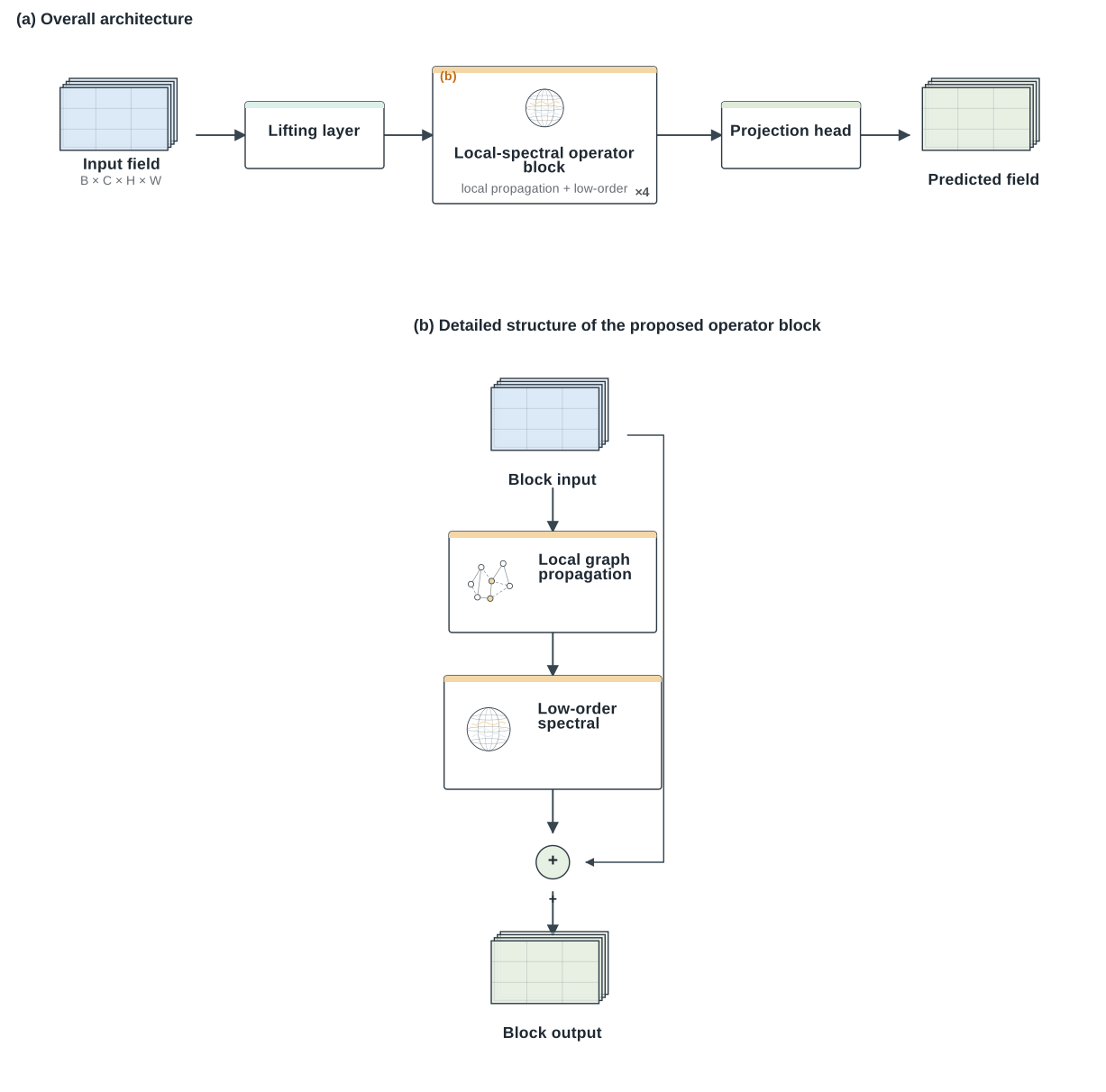
- optionally expand a verified proposed block into a detailed panel;
- export editable SVG, draw.io, and native PowerPoint shapes, plus PNG/PDF.
Highlights
- Static PyTorch and Keras parsers that inspect common execution patterns without running user code.
- Framework-neutral Architecture IR with JSON Schema validation.
- Semantic-review workflow for complex multi-input, attention, fusion, gating, and multi-output models.
- Scientific Visual Grammar for CNNs, Transformers, U-Net/encoder-decoder models, GNNs, MoE, RNNs, diffusion models, operator learning, multimodal networks, and generic DAGs.
- Scientific Illustration Composer with editable primitives for temporal histories, fields, coordinates, graphs, spherical nodes, spectral operators, attention, uncertainty, measurement geometry, and custom vector sketches.
- Content-driven publication layout with stage sizing based on labels, illustrations, graph depth, and branch complexity.
- Obstacle-aware routing, stage gutters, semantic ports, fan-in/fan-out buses, and geometry linting.
- Joint layout optimization using routed crossings, path length, bends, and occupied area.
- Automatic
(a) Overall architecture+(b) Detailed proposed blockwhen verified block internals are available. - Editable SVG, draw.io, and native PowerPoint output; PNG/PDF for manuscript use.
- Optional AI-reference bundle for image-model art direction while keeping deterministic vector output as the structural source of truth.
Installation
python -m venv .venv
source .venv/bin/activate      # Windows: .venv\Scripts\activate
pip install -e '.[dev,export]'
For optional image-model integration:
pip install -e '.[ai]'
Quick start
Parse a PyTorch model
ml-arch parse-pytorch examples/pytorch/residual_cnn.py \
  --class ResidualCNN \
  --output build/residual.yaml
Parse a Keras model
ml-arch parse-keras examples/keras/functional_fusion.py \
  --output build/keras.yaml
Review a complex model
For non-trivial source models, inspect the parsed IR and active execution path before creating the paper figure:
ml-arch parse-pytorch examples/pytorch/complex_multibranch.py \
  --class ComplexFusionNet \
  --output build/complex.yaml

ml-arch apply-review build/complex.yaml \
  examples/pytorch/complex_multibranch.review.yaml \
  --output build/complex.reviewed.yaml
The review patch may improve paper-facing labels, roles, shapes, and overview hints, but it may not add or delete exact graph nodes or edges.
Compile the publication figure
ml-arch compile-publication build/complex.reviewed.yaml \
  --output build/complex.paper.yaml

ml-arch lint-publication build/complex.paper.yaml

ml-arch render build/complex.paper.yaml \
  --format svg pptx drawio png pdf
Inspect layout quality
ml-arch layout-metrics build/complex.paper.yaml
Proposed-block detail
For a custom block, inspect its implementation and record verified internals in node.detail. You can generate a review skeleton with:
ml-arch detail-review build/complex.reviewed.yaml \
  --output build/proposed-block-review.yaml
After the block internals are verified and applied, publication compilation can produce an overall panel plus a detailed proposed-block panel. Unknown custom internals are never invented merely to fill a figure.
Architecture IR
The normalized YAML/JSON representation is the contract between parsers, Agents, layout, and renderers. It captures:
- inputs, internal nodes, outputs, and panels;
- semantic roles and groups;
- edges and edge types;
- repeats and reliable tensor shapes;
- visual and scientific-illustration metadata;
- publication-view provenance;
- unresolved facts that should not be presented as certain.
See templates/architecture_spec.yaml and templates/architecture.schema.json.
Scientific illustration
The renderer does not need to reduce every concept to a plain rectangle. Selected modules may carry an evidence-backed illustration plan. Built-in primitives are supplemented by a safe custom vector DSL using simple shapes, lines, polylines, polygons, and text. Scientific sketches are symbolic; they must not fabricate experimental observations.
See references/scientific-illustration.md.
Agent Skill
SKILL.md defines the recommended Agent/Codex workflow. The Agent should recover the true execution graph first, then decide the appropriate publication abstraction, local scientific illustrations, and detail hierarchy. Visual sophistication must never override topology fidelity.
Validation
pytest -q
python scripts/render_examples.py --formats svg drawio
Repository structure
SKILL.md
src/ml_architecture_diagram/
templates/
references/
docs/
examples/
tests/
evals/
scripts/
.github/
Contributing
Contributions are welcome. Parser changes should preserve execution-path fidelity, and visual changes should remain editable and scientifically defensible. See CONTRIBUTING.md.
License
MIT. See LICENSE.
No comments yet
Be the first to share your take.