
Loom: a cognitive harness built as a knowledge network
Language: English | 简体中文
Loom gives Claude Code and Codex a durable, inspectable way to turn source material into understanding. Books, papers, web pages, video, and audio move through four cognitive layers: preserved evidence, single-material digestion, cross-material synthesis, and reusable thinking patterns.
The defining loop: agents digest material before use, reason through typed and explicitly linked cards, and return new insights only through computation, semantic checks, and review. The result is a local-first AI knowledge network with a memory of how each idea was formed, not just where a chunk was found.
Loom can support research, Zettelkasten-style personal knowledge management, and AI second-brain workflows. But its core artifact is not a wiki page, vector index, chat transcript, or auto-extracted entity graph. It is a reviewable lifecycle for building and reusing understanding.
How Loom works
source material
    ↓
L1 · original text
    ↓  Scout reads the whole work; Deep reads each unit again
L2 · single-material understanding
    ↓  THINK connects evidence across materials
L3 · synthesis, judgments, and new ideas
    ↓  cross-domain patterns pass proposal + human review
L4 · reusable ways of thinking
    ↓
USE brings the network back into an agent's context
    ↺ new, reviewable insights can return to the network
The four layers represent cognitive depth, not storage tiers:
| Layer | What it contains | Why it exists |
|---|---|---|
| L1 | Preserved source text | Keeps every synthesis traceable and reversible |
| L2 | One material, genuinely digested | Turns sources into atomic, self-contained cognitive units |
| L3 | Cross-material synthesis | Produces comparisons, judgments, counterexamples, and new ideas |
| L4 | Cross-domain patterns | Gives agents reusable thinking frames with explicit boundaries |
Why it is different
- Real digestion, not excerpting. A Scout pass builds the whole-work map; Deep passes reread each unit with that map in context.
- Typed cognition. Cards declare their role: concept, structure, mechanism, case, judgment, reflection, pattern, or topic.
- Links are the source of truth. Explicit links carry reviewed associations; embeddings only discover candidates.
- Quality-gated writes. Deterministic checks and semantic checks run before drafts can enter the SQLite store.
- A return path from use. Asking, deciding, and reflecting can produce reviewable proposals instead of silently mutating the network.
- Local-first and inspectable. Cards, links, full-text search, vectors, and task traces stay on disk. Choose a local or OpenAI-compatible embedding model.
Loom is not another name for...
These categories are useful neighbors, but they solve different primary problems and can be combined with Loom.
| Category | Primary artifact | Typical synthesis point | Loom's distinction |
|---|---|---|---|
| AI wiki | Maintained pages | During ingest and page maintenance | Typed atomic cards plus explicit L1 → L4 cognitive depth |
| RAG knowledge base | Source chunks and retrieval index | At query time | Knowledge is digested before use and connected by reviewed links |
| Agent memory | Conversations, facts, preferences, episodes | During or after sessions | Loom builds durable cognition from chosen materials and reviewed thinking |
| Knowledge graph | Entities and relations | During extraction | Loom's graph also records cognitive role, derivation layer, and feedback gates |
Quick start
Requirements: macOS or Linux, Python 3.11+, Claude Code or Codex, and an embedding model.
git clone https://github.com/q8886b/loom-ai-knowledge-network.git
cd loom-ai-knowledge-network
./install.sh
loom on
For a fully local setup, install Ollama, then configure
~/.loom/.env:
ollama pull bge-m3
LOOM_EMBED_PROVIDER=ollama
LOOM_EMBED_MODEL=bge-m3
LOOM_EMBED_DIM=1024
Put a Markdown source under ~/.loom/sources/, then ask your agent:
Use
loom-digestto digest this material into L2:/absolute/path/to/source.md
The agent reads the source, writes drafts, runs the computation and semantic gates, and commits only after both pass. Explore the result:
loom search "your topic"
loom tui
See the quick-start guide for embedding providers, hooks, the web Workbench, and project-local installation.
Agent skills included
./install.sh links the complete skills into Claude Code and Codex while the
repository remains their single source of truth.
| Skill | Purpose |
|---|---|
loom-digest |
Two-pass source digestion from L1 to L2 |
loom-think |
Cross-material research, synthesis, and reflection |
loom-use |
Answer questions and make decisions through the existing network |
loom-pipeline |
Orchestrate multi-resource ingest, digest, and synthesis runs |
resource-to-markdown |
Convert PDF, EPUB, web, Office, audio, and video sources to Markdown |
Storage and retrieval
- SQLite + FTS5 for cards and full-text search
sqlite-vecfor optional semantic retrieval- Explicit bidirectional links for the durable knowledge graph
- Markdown mirrors for source material and readable card artifacts
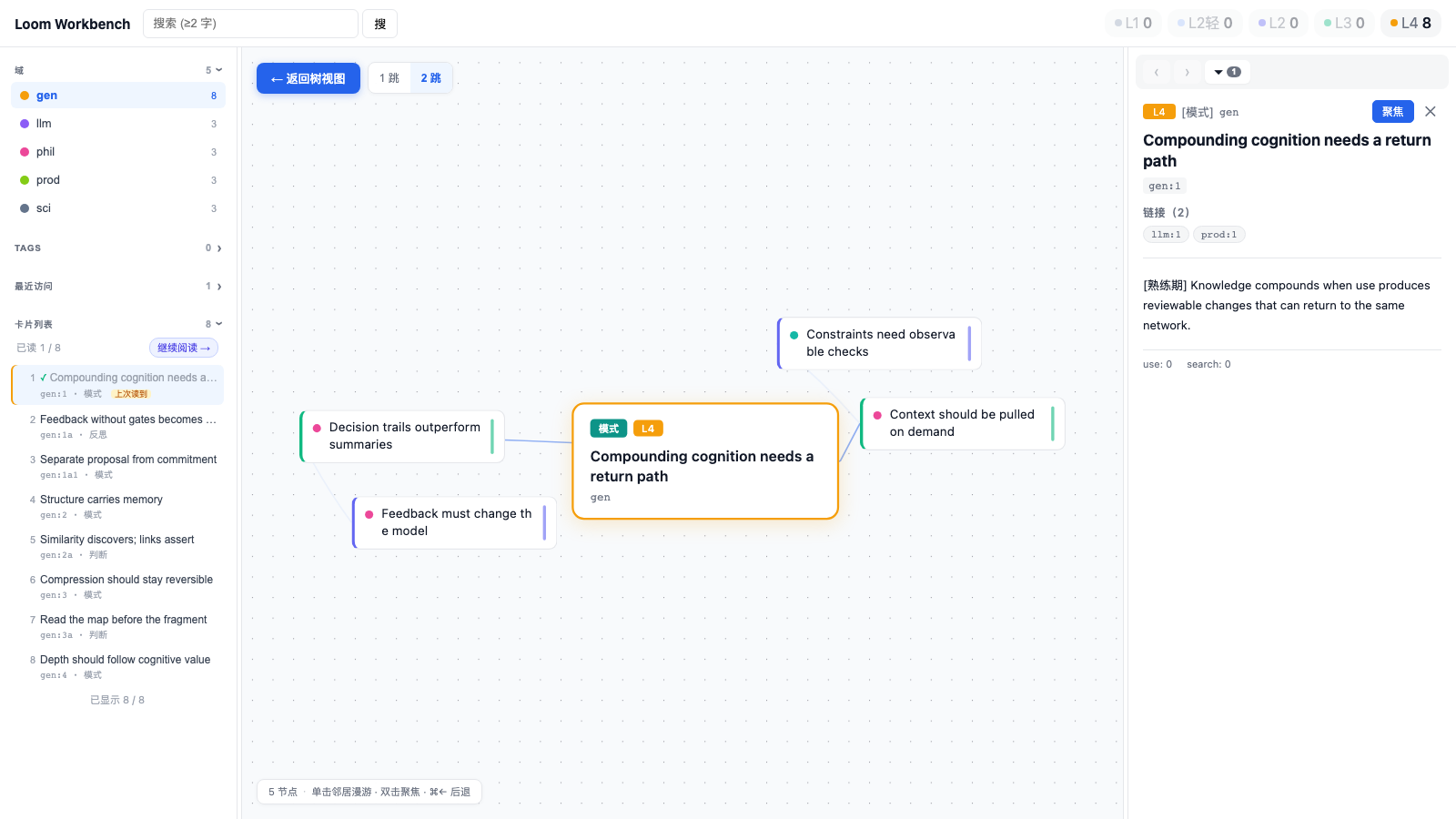
- TUI and local web Workbench for browsing, search, annotation, and graph exploration
Loom's Workbench is local and serves card content without authentication. Do not expose it directly to a public network.
Design
The current design baseline is:
Status
Loom is alpha software. The data model and guarded write path are implemented; interfaces and installation details may still change before 1.0.
Development
python3.11 -m pip install -e ".[dev]"
python3.11 -m pytest
Contributions are welcome. Read CONTRIBUTING.md, the security policy, and the code of conduct.
No comments yet
Be the first to share your take.