
herdr-orchestrate
Run a team of AI coding agents — Claude Code, Codex CLI, pi — as visible terminal panes you can watch, scroll, and interrupt. One orchestrator routes, reviews, merges. You get pinged twice: for a decision only you can make, and when it's done.
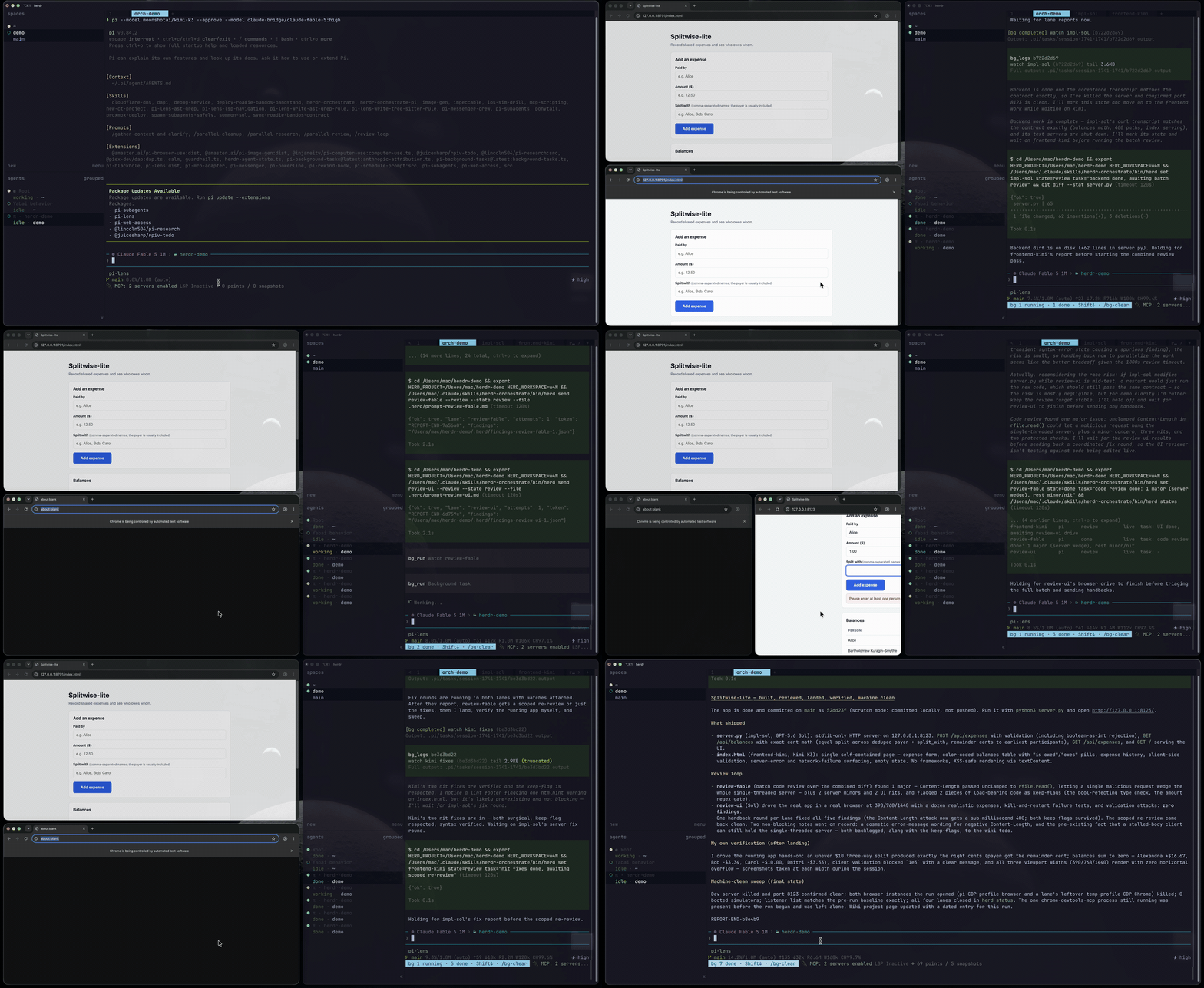
Real unattended 26-minute run, cut to 50 seconds: spec in → Sol backend lane + Kimi UI lane → one cross-model review after both report → a review-ui lane drives the real browser at 390/768/1440 → land both branches → machine-clean sweep → report. No human touched anything between the assignment and the report.
brew install herdr                  # terminal agent multiplexer; put claude / codex / pi on PATH
git clone https://github.com/alexhooi/herdr-orchestrate ~/.claude/skills/herdr-orchestrate
# in a herdr pane running Claude Code: hand it a spec and say "orchestrate this"
Two Claude Code orchestrator skills + herd, a ~700-line stdlib-Python CLI. No framework, no SDK, no daemon. Workers are real interactive CLI sessions in herdr tabs — not headless API calls. The orchestrator routes, triages, and verifies. It never implements.
Why not just subagents?
Subagents are headless. A stuck API call looks identical to a thinking one; a permission dialog is an invisible hang; "done" is whatever the model says. Panes fix all three: the screen is ground truth, you can take the keyboard any time, and herd watch waits on a per-turn sentinel plus settled agent state — not a self-report. Subagents still have a place (recon, parallel reads inside one lane); lanes are for work that earns its own pane: implementers, reviewers, anything you'd want to watch or interrupt.
How it works — 55 seconds
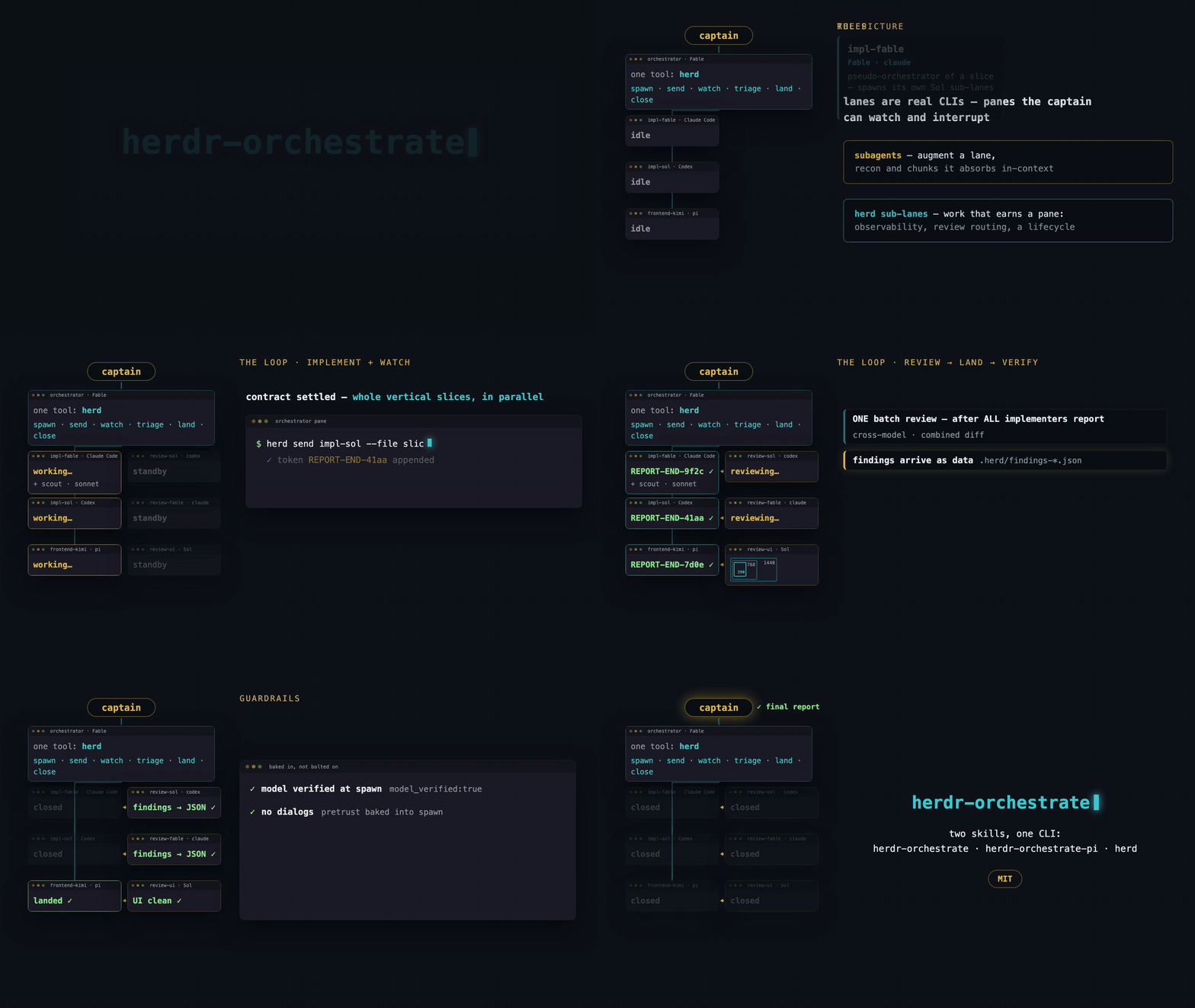
The mechanics as an evolving system picture: the captain hands a spec to one orchestrator pane; workers are real CLIs in visible panes; herd send mints a report token, herd watch runs in the background (a lone-line token, a nudge, or a reviewer's findings file all count as done); review happens once, after every implementer reports, cross-model, with a review-ui lane driving the real UI; herd land gates on review; the orchestrator runs the product itself, sweeps the machine clean, and reports. (mp4)
Why panes
Headless agents fail silently. A stuck API call looks identical to a thinking one. Panes don't have this problem: the agent's screen is ground truth, you can see it, and you can take the keyboard at any moment. Every detection rule in this repo exists because something failed in a way a log file hid. See HISTORY.md.
Under the hood
Built on herdr, a terminal agent multiplexer (brew install herdr). One orchestrator pane drives worker lanes through bin/herd, a ~670-line Python-stdlib CLI: one command per orchestrator intent. State lives in <project>/.herd/ledger.json, flock-guarded, and survives orchestrator death.
The lane loop:
herd spawn          # launch a lane; trust dialogs pre-empted
herd send           # hand the lane its task
herd watch          # the only legal wait; background, one per lane
herd send --review  # reviewers get findings as JSON
herd triage         # blocking findings back verbatim, rest to backlog
herd land           # review-gated --no-ff merge, conflicts handed back
herd close          # retire the lane
status, set, and notify cover the remaining orchestrator intents. Spawn refuses to ledger a lane in $HOME and auto-gitignores .herd/ in the project root; herd close --integrated retires a worktree lane whose files the parent already folded in.
Design points
Each of these was earned by a failure. HISTORY.md has the full record.
-
Dialog doctrine. herd matches no dialog text, ever. Five adversarial review rounds refuted every screen-scrape classifier. Dialogs are prevented at launch (approval flags, sandbox flags, pre-seeded folder trust). Whatever still appears fails closed: exit 3, pane excerpt, notification. The orchestrator answers by hand.
-
Watch the lane, never the artifact. The only legal wait is
herd watch— background, one per lane. It detects a unique per-turn REPORT-END sentinel plus settled agent state, and self-notifies on every escalation: agent gone, dialog, timeout. It also nudges an idle lane once if compaction ate its report footer, and accepts a review lane's findings file as completion in its own right. Polling an output file turns a stuck worker into silence. -
Reviews arrive as data.
herd send --reviewpoints reviewers at a findings JSON file (severity, file, line, symptom, fix_hint).herd triagereturns blocking findings to the owning lane verbatim and backlogs the rest. Cross-review matrix: each model's work is reviewed by a different model. UI work gets its own reviewer,review-ui: it drives the real UI — simulator or browser, every width — before the captain ever sees it. -
Ship modes per project.
scratch: in-tree.merge: worktree lanes onlane/<name>branches, review-gatedherd land --no-ff, conflicts handed back to the owning lane.pr: the lane pushes and opens the PR — noteherd landrefuses to land locally in this mode and does not enforce the review gate; the PR review is the gate. -
Vertical slices, not tickets. One implementer per domain slice, product-level acceptance ("the user can do X"). Kimi owns all UI on any platform — web, SwiftUI, native. The orchestrator personally drives the final product before calling it done — including web UI at 390/768/1440 widths with realistic data.
-
Resume. The ledger survives orchestrator death. A fresh session adopts live lanes idempotently and re-attaches watches. Verified with a literal SIGKILL drill.
-
Pretrust. Spawn pre-seeds codex/claude folder-trust stores so trust dialogs don't appear. Deliberately best-effort: two cases, already trusted or entry absent. It was once 430 adversarially-hardened lines with a byte-safe TOML rewriter and renamex_np race detection. We deleted it after pricing the failure mode: a dialog, once, already handled. HISTORY.md tells that story.
-
Teardown etiquette. Every lane cleans up what it opened — browser tabs, booted simulators, dev servers, log tails — before it reports done, and the orchestrator runs a machine-clean sweep as its own last act. A run isn't done while any of it is still up.
Install
brew install herdr. Put the CLIs you plan to use on PATH:claude,codex,pi.- Clone this repo into
~/.claude/skills/so both skill dirs are siblings (or copy the dirs in individually). - Edit
KIND_ARGSat the top ofherdr-orchestrate/bin/herdto your own model roster and flags. The shipped ones are the authors': Codex → gpt-5.6-sol, pi → Kimi K3 via Moonshot, claude → Fable 5. - In a herdr pane with
HERDR_ENV=1, tell Claude Code to orchestrate a spec. The skill does the rest.
Tests: python3 -m pytest herdr-orchestrate/tests/
The two skills
herdr-orchestrate/— the master-orchestrator skill for mixed native harnesses. SKILL.md carries the doctrine;bin/herdenforces it;LORE.mdholds the failure lore, read on demand.herdr-orchestrate-pi/— a standalone rewrite of the same doctrine with every worker lane on the pi harness, model chosen per role and the thinking level riding the model id (provider/model:level). Architecture-owning implementer runs high; everything else runs medium — the tiering that won our benchmark. pi fronts Anthropic, OpenAI, Moonshot, and others.
Battle-tested via a same-spec double-build showdown: native harnesses versus all-pi seats, independent scorecards. The pi side won on speed, cost, and maintainability — while accidentally running most lanes at medium thinking, which is why the tiering is now deliberate. HISTORY.md holds the war stories.
License
MIT.
No comments yet
Be the first to share your take.