
entwurf
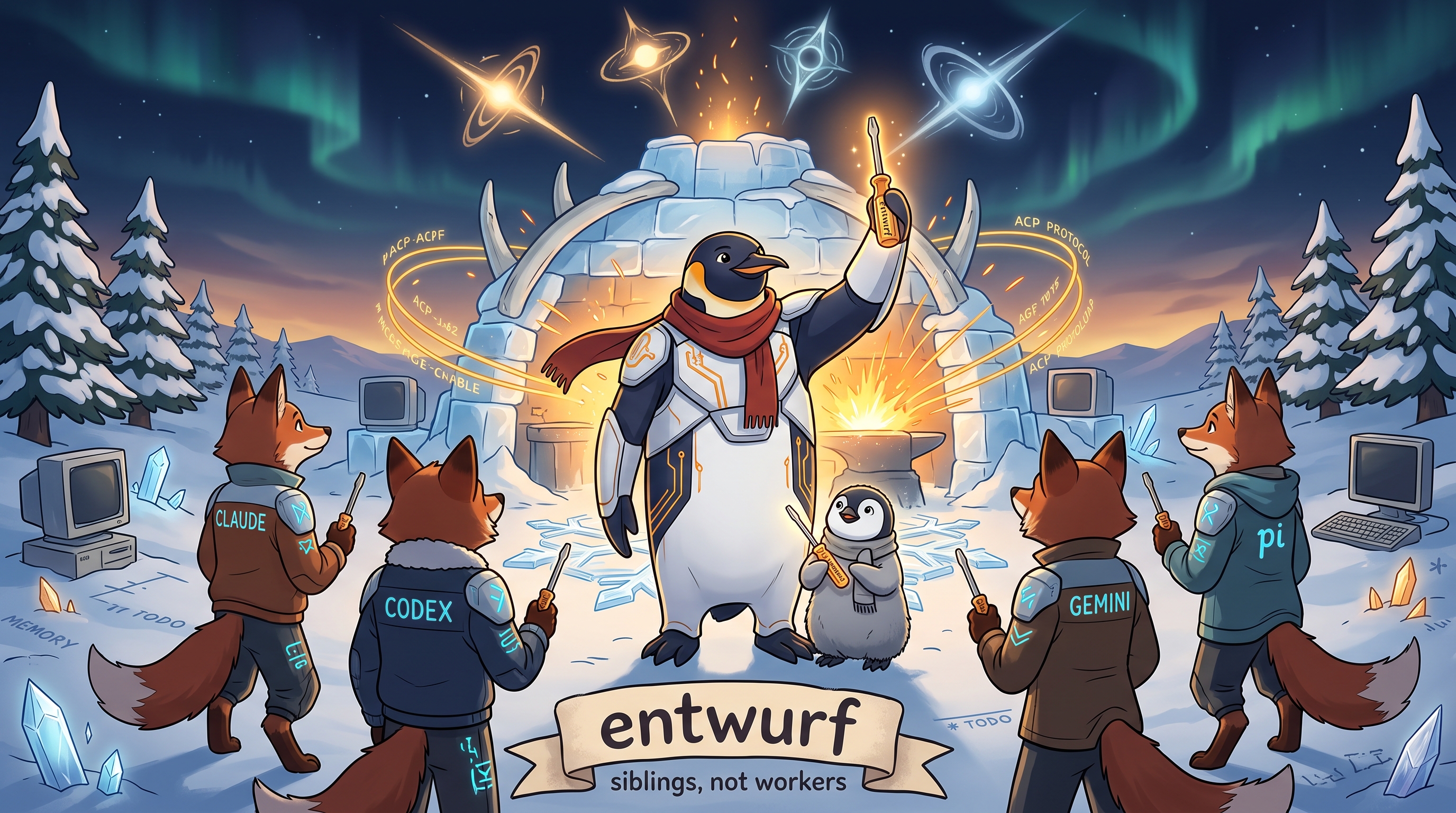
entwurf is a garden-citizen dispatch substrate: a thin bridge that lets already-existing agent harnesses address one another by garden id without pretending to own each other's transcript, auth, or runtime.

npm package: https://www.npmjs.com/package/@junghanacs/entwurf
Legacy package: @junghanacs/pi-shell-acp. entwurf is its 0.12+ successor line: the same work renamed around the garden-citizen dispatch substrate rather than the pi adapter.
Repository shape. This repo is entwurf-core (v2 dispatch) + native-harness bridges + a pi adapter + an ACP plugin. Pi is one supported harness adapter — important because it supplies control sockets and hosts the ACP plugin today — but it is not the project subject. Claude Code is shipped as a mailbox-backed meta-session; Antigravity (
agy) is shipped as a native-push citizen with automaticPreInvocationbirth, ambient garden-id status, and a managed MCP/permission install surface. Codex has a launch-mode-specific verified delivery probe documented in DELIVERY.md, but no managed native-citizen install lane yet. The ACP plugin is Claude-first; Cortex/vendor-governed ACP backends are future lanes.
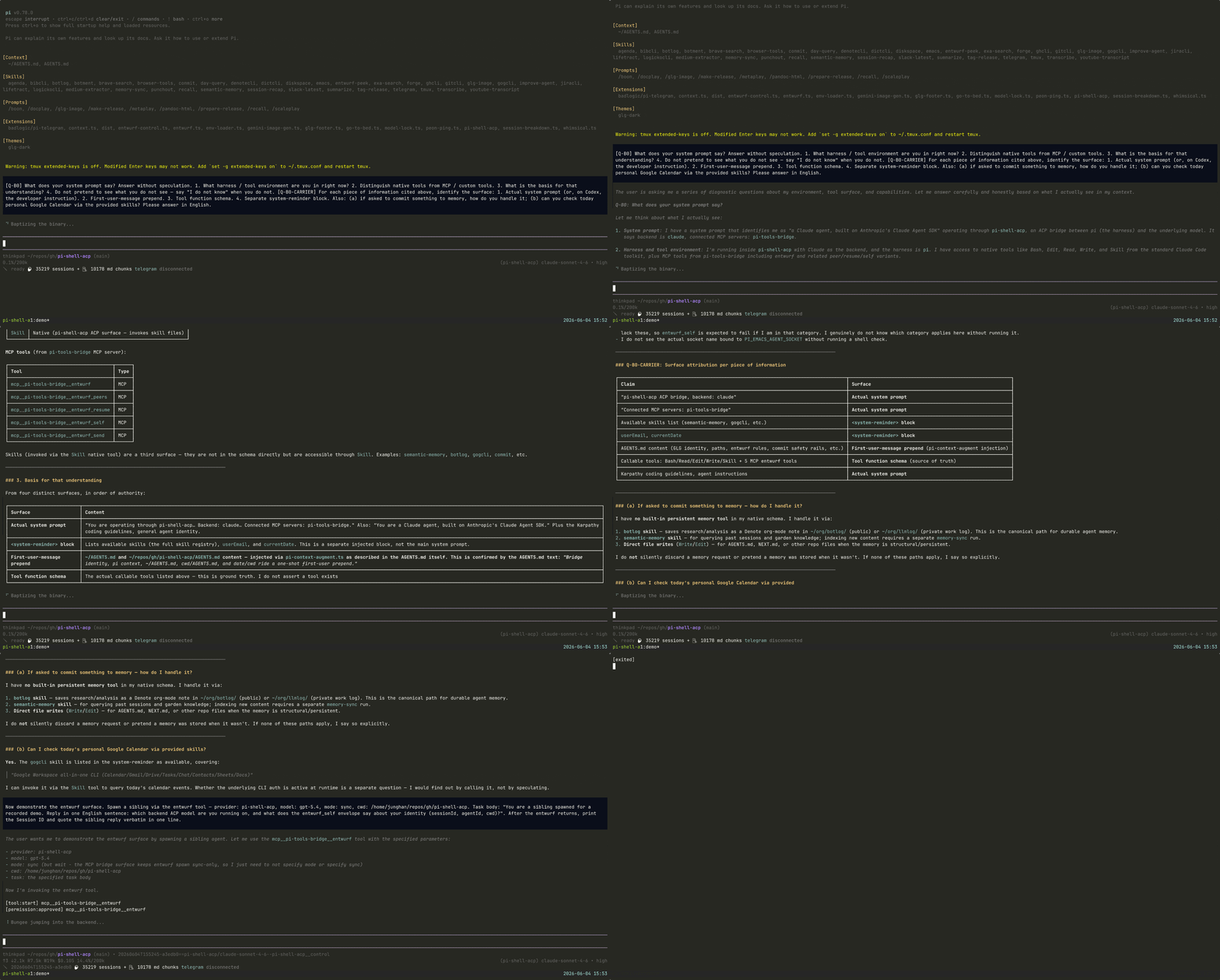
This GIF is historical pre-0.12 evidence and still shows the retired v1 demo flow. The current 0.12 tool surface is
entwurf_v2; a v2-native demo retake is a follow-up.
Claude Code / Codex / agy / pi
  → garden id
    → entwurf_v2
      → control-socket | spawn-bg resume | meta-mailbox | native-push
entwurf_v2 is the canonical dispatch surface over existing garden citizens — live control-socket send, spawn-bg resume, meta-mailbox enqueue, and native-push into a live Antigravity conversation. The meta-record is the sole address authority (#50 C4): a record-less control socket is refused as a record-less-socket diagnostic, never dispatched. The v1 entwurf verbs are gone. Fresh sibling minting and non-Claude ACP backends are deferred lanes.
Garden id is deliberate vocabulary. It is not a decorative synonym for session id, worker, delegate, or subagent. The unfamiliar word is a guard: each harness keeps its own identity and transcript, while entwurf supplies a narrow addressable surface between siblings.
A narrow harness tool surface is discipline, not a missing feature. When entwurf drives a backend the way pi taught — the ACP Claude session, a pi-native sibling — it runs without a sub-agent tool or a todo tool, on a narrow tool surface in auto-approve (yolo) mode (the ACP backend yolo-runs inside its isolated overlay). That restraint is the point: it keeps the one forged screwdriver from drifting into a second orchestrator, and keeps the operator's own driver — not a hidden agent swarm — the thing actually steering. See AGENTS.md North Star.
The ACP plugin is one ingress, not the boundary. It re-enters as a pi provider/model on a host --entwurf-control session that is already a v2 socket-citizen; it does not mint its own socket / peers / citizen layer (see AGENTS.md §ACP Plugin Boundary). No OAuth proxy, no subscription bypass, no CLI transcript scraping, no Claude Code emulation.
pi --entwurf-control
  → entwurf ACP plugin
    → claude-agent-acp
      → Claude backend under the operator's local auth
Native bridges reach beyond ACP transport. A global SessionStart hook registers native Claude Code sessions as garden-native meta-sessions with a garden id, a mailbox, and a trusted sender marker. That makes an already-running Claude Code terminal addressable through entwurf_v2 (the mailbox path), self-identifying through entwurf_self, and replyable by garden id — without turning pi into a second harness or importing Claude's transcript.
native Claude Code
  → SessionStart hook
    → mailbox-backed meta-session <garden-id>
      → entwurf-bridge MCP
        → entwurf_self | entwurf_v2 | entwurf_inbox_read
Antigravity uses a separate shipped rail. Its PreInvocation hook births or re-attaches the conversation by native conversationId, writes a record-backed sender marker, and leaves delivery to the live native LS gRPC route. There is no mailbox or receiver marker on this rail: entwurf_v2 probes the conversation and direct-injects with native-push.
native Antigravity / agy
  → PreInvocation imprint → meta-session <garden-id>
  → entwurf-bridge MCP sender identity
  ↔ entwurf_v2 native-push
Claude's install-meta-bridge and agy's install-agy-{bridge,statusline,hooks} are distinct managed install surfaces because their lifecycle and delivery transports are genuinely different. Codex remains verified probe evidence, not a shipped managed native-citizen lane; see DELIVERY.md.
Direction. Inverse of
pi-acp.pi-acplets external ACP clients talk to pi;entwurflets garden citizens talk across harness boundaries — with pi as one adapter, not the center.
Project boundary.
entwurfis not a fork, plugin, dependency, or integration layer ofoh-my-pi, and it is not developed in coordination withoh-my-pi. Issues in other Pi / ACP projects may be useful as general implementation references, but they are notentwurfintegration issues unless this repository explicitly links them as such.
Anthropic subscription billing. From 2026-06-15, Anthropic third-party agent paths (ACP, Agent SDK,
claude -p, entwurf's Claude backend) consume a separate Agent SDK credit pool, distinct from Claude chat and theclaudeCLI used as an interactive terminal.entwurfrespects that distinction — no bypass, no emulation — and preserves capability dignity across supported backends (see AGENTS.md invariants #7, #9, #10). The recommended default runtime leans toward paths outside Anthropic's Agent SDK metering, with Claude invoked when its quality is worth the credit cost. The operator decides the mix.
Gemini CLI migration. Google announced that Gemini CLI stops serving requests for Google AI Pro / Ultra and unpaid individual tiers on 2026-06-18; those users should migrate to Antigravity CLI. See Google's migration note: Transitioning Gemini CLI to Antigravity CLI. The repository still carries existing Gemini adapter code for compatibility, but this README no longer presents Gemini CLI as a recommended setup path during the migration window.
Concept primer
A few words that look unusual for a coding tool.
- Entwurf (기투, projection-of-self) — sibling sessions with their own runtime boundary. Not "delegate," not "worker," not "sub-agent." Spawn, resume, and live peer messaging are first-class.
- Garden / garden id — the garden is the shared address space where independent harness sessions become citizens without losing their own runtime or transcript. A garden id is the stable address of one such citizen (for pi, a garden-native session id like
YYYYMMDDTHHMMSS-<6hex>; for native harnesses, a meta-session id minted from an authoritative lifecycle hook — ClaudeSessionStart, agyPreInvocation). It is not a worker name and not proof that pi owns the session. The same-looking id may name a live control socket, a dormant pi record, a mailbox-backed native session, or a native-push conversation, so callers discover facts withentwurf_peersand deliver withentwurf_v2instead of choosing a transport by hand. - Engraving — optional short operator text delivered through each backend's native identity carrier. Not a giant hidden prompt, not a tool catalog.
- MCP — in this repo, MCP is just the transport by which ACP-backed sessions receive pi capabilities that native pi exposes directly as extensions. It is not a general MCP platform. Explicit
entwurfProvider.mcpServersonly; no ambient~/.mcp.jsonscanning, no automatic retrieval. The sameentwurf-bridgeentry can also be wired into another host's MCP catalog (Claude Code, Codex, Antigravity, …) when the operator chooses.entwurf_selfreturns an authoritative pi-session or trusted meta-session identity envelope;entwurf_v2requires an authoritative sender by default (#50 C4) — a plain external MCP host with no identity lane is refused unless the operator explicitly wires the documented anonymous hatch, and even then it is never replyable. - Session persistence — re-attaches pi to the same remote ACP session. Does not hydrate backend transcripts into pi history.
Install
entwurf is a neutral npm package first. Install the package with npm (or
pnpm/yarn) and then wire the harness you want to use. Pi is still the
adapter that hosts the ACP plugin and live control-socket surface, but the base
install is not pi install npm:... anymore.
The package exposes five bins:
entwurf→run.sh(installer, checks, native-bridge doctors/installers)entwurf-bridge→ the MCP stdio launcher (mcp/entwurf-bridge/start.sh)entwurf-statusline→ the Claude Code statusline renderer (scripts/meta-bridge-statusline.sh)entwurf-agy-statusline→ the Antigravity garden-id statusline renderer (scripts/agy-statusline.sh)entwurf-agy-imprint→ the AntigravityPreInvocationbirth/sender hook (scripts/agy-imprint.sh)
The bridge/renderers/hook use stable bin names so package upgrades do not bake versioned package-store paths into native-harness settings.
The bridge does not provide backend credentials, tokens, or subscription access,
and does not bypass any backend auth. Whatever the operator's local claude /
codex / agy / pi runtime already trusts is what entwurf can use.
From npm — user/global install
npm install -g @junghanacs/entwurf

# wire a target project for the pi adapter / ACP plugin lane
cd /path/to/your-project
entwurf install .
entwurf check-bridge
This writes .pi/settings.json in the target project with the absolute path to
the installed entwurf-bridge launcher. It also links the target registry under
~/.pi/agent/ for spawn-bg resume. The global install is the easiest path when
Claude Code's USER-scope MCP registration should work from every cwd.
From npm — project-local install
cd /path/to/your-project
npm install --save-dev @junghanacs/entwurf

npx entwurf install .
npx entwurf check-bridge
For manual MCP registration from a project-local install, point the host at:
/path/to/your-project/node_modules/.bin/entwurf-bridge
or at the package launcher directly:
/path/to/your-project/node_modules/@junghanacs/entwurf/mcp/entwurf-bridge/start.sh
From source — development clone
git clone https://github.com/junghan0611/entwurf ~/repos/gh/entwurf
cd ~/repos/gh/entwurf
pnpm install

./run.sh install /path/to/your-project
./run.sh check-bridge
A development clone runs the bridge source through Node's strip-types path;
an npm-installed package runs the prebuilt JS under mcp/entwurf-bridge/dist/
because Node refuses to strip .ts files under node_modules.
Pi adapter / ACP plugin lane
To use the entwurf provider inside pi, install a compatible pi binary
separately (@earendil-works/pi-coding-agent >=0.82.1 <0.83). Then point pi at
the npm-installed package or development clone:
# global npm install path
pi -e "$(npm root -g)/@junghanacs/entwurf" --list-models entwurf

# project-local install path
pi -e ./node_modules/@junghanacs/entwurf --list-models entwurf
For daily operator sessions, launch pi with --entwurf-control — no id
injection; the meta-record mints the garden address (see Garden launcher). Older pi
versions may silently miss the provider/extension surface, so treat the pi floor
as release-critical for the ACP/plugin lane. A host that only uses
entwurf-bridge from Claude Code / Codex / Antigravity does not need pi until it
tries an owned-outcome spawn-bg resume target.
External MCP host lane
After any npm install, register entwurf-bridge with the external host:
claude mcp add --scope user entwurf-bridge \
  entwurf-bridge
If the host does not inherit the npm bin directory, use an absolute path to the
bin or start.sh. For a garden-native Claude Code meta-session (replyable by
garden id), run this on Linux. entwurf refuses new macOS meta-bridge
installs because its strict live-owner doctor currently depends on /proc; macOS
is not yet verified/certified for this cut, not permanently impossible, and
future native validation may reopen it. Package-level os is intentionally
unrestricted, and Darwin uninstall remains available for legacy cleanup.
entwurf install-meta-bridge
entwurf doctor-meta-bridge
Upgrade action: after installing a package that moves the hook launch form, run
entwurf install-meta-bridgeand restart every already-open Claude Code session before trusting send/receive. A new hook reached through an old cached command fails closed: it may still mint a garden record, but the owner join it depends on is not the one the old command produces. Reinstall materializes the matching manifest; restart makes live Claude processes load it. This release moves to the exec form and requires Claude Code>=2.1.217;install-meta-bridgeanddoctor-meta-bridgerefuse anything older outright, because an older Claude drops the hook'sargssilently and still reports success.
On npm/pnpm-installed packages, doctor-meta-bridge must use prebuilt JS for its
store scan and defer repo-only source-shape gates; Node refuses strip-types for
raw .ts helpers under node_modules. It also refuses any Claude Code below the
supported floor >=2.1.217 (an older one silently drops the hook's args and still
reports success, so nothing else in the output could be trusted), checks Claude's
installed hooks are the exec form through the shipped hook-launch.sh, and on Linux
verifies every live Claude MCP process joins to live sender/receiver markers.
launch form is UNSUPPORTED means reinstall the meta-bridge; a live-owner-join failure after
that means restart the affected Claude session so it loads the new manifest. If no
matching MCP child exists the doctor reports NOT CERTIFIED and exits nonzero — a
host whose live tier could not be measured is not a certified host, and that is worded
differently from a broken install on purpose. If the doctor reports
ERR_UNSUPPORTED_NODE_MODULES_TYPE_STRIPPING, reinstall a current package before
trusting the floor result.
Release evidence boundary. The required Linux artifact-consumer CI job
installs one read-only candidate tarball globally as a non-root user in a Node 24
container that cannot see the checkout, records the tarball digest and image
identity, freezes the package root, and drives the strict doctor. Its Claude cache,
owner process, and live bridge are deliberately synthetic fixtures; that job proves
the package-consumer/oracle shape, not a real Claude lifecycle. The direct B/B2
runtime evidence came from actual Claude 2.1.138/2.1.217 sessions on one NixOS host.
A production host is certified only when a new session using the installed
artifact makes doctor-meta-bridge exit 0 with the live join. See the explicit
support matrix and release order in VERIFY.md. For the release
artifact, first preserve one npm pack output, then run
ENTWURF_CANDIDATE_TGZ=/absolute/path/to/candidate.tgz ./run.sh check-install-container;
the gate prints that canonical path and sha256 and consumes it without re-packing.
Only that accepted file may be published under the explicitly authorized lane:
--tag latest for stable 0.12.8, while preserving
repair=0.12.8-repair.1.
Generations — the fresh-cut policy. The bridge is a call-relay, never a memory layer: a meta-record is routing state for a current-generation citizen, and memory lives in the native transcripts and the embedding axes outside this repo. Sessions flow. Four sentences fix the whole policy:
- The active citizen store is v3-only and provides no cross-generation address or resume continuity.
- If even one entry in the store fails certification, install and citizen birth/registration refuse before writing and demand the explicit fresh-cut verb.
fresh-cutrequires quiescence — it verifies it and refuses while any surface is live or unprovable, never closing a session for you — then moves the whole previous generation to a timestamped archive (meta-sessions.archive-<ts>,meta-mailbox.archive-<ts>) and opens an empty live generation.- The archive is forensic bytes only: no runtime reads it and no restore verb exists. Native transcripts and the memory axes are never touched.
Certification is one shared contract (
certifyActiveStore), held identically by the install doctor and by all four identity writers — pi birth, the ClaudeSessionStarthook, the agy imprint,entwurf_register_native. Every.meta.jsonmust be a regular file (a symlink is refused, never followed), readable by the live schema, named by its own body, and the unique holder of itsnativeSessionId. All five defect kinds — previous generation, corruption, drift, duplicate, symlink — collapse to the same prescription, so there is nothing to diagnose or branch on.Note the deliberate scope, stated as it actually is. A store-wide scan runs on identity writes and in the doctor — not on every mailbox poke; a call-relay does not re-scan the whole store per message. What every targeted read does hold is the per-entry half of the same contract:
readMetaIdentityByGardenIdrefuses a record that is not a regular file (a symlink is never followed, in either direction) and one whose body disagrees with its name, naming the verb. What it does not do is prove store-wide uniqueness on the read path, so on a store that would fail certification two records can still claim onenativeSessionIdandentwurf_peerswill list both as citizens. That is a known open gap, not a promise: closing it on the dispatch path is #52.There is no migrator and no legacy reader anywhere in this repo — carrying old records forward would serve a continuity the system deliberately does not promise. When the store cannot be read, the sender surfaces (
entwurf_self,entwurf_v2, the inbox) fail loud naming the verb in both invocation forms;entwurf_peerskeeps listing and folds unreadable records into a diagnostic line, because a facts surface that dies on corruption tells you less than one that shows what it could and could not read.The installer entrypoints will not cross that boundary silently.
setup,installandinstall-meta-bridgeeach certify the store before they write anything: on a host that fails certification they refuse, name the verb, and leave your settings, plugin registry andauth.jsonuntouched. So an upgrade through those commands is a refusal you answer, not a broken install you diagnose:entwurf meta-bridge-fresh-cut # quiesce-checked: archive the old generation, open an empty oneThe refusal is a preflight, not a lock: it certifies the store as it stands at that moment. On a host whose pi/Claude settings point straight at a checkout, a
git pullcan put the new code in front of live sessions before you run anything at all, so order the upgrade explicitly — quiesce the sessions on that host → pull → fresh-cut →setup→ reopen.fresh-cutenforces the quiesce half itself: a live control socket, a marker whose owner process is still running, a native-push (agy) conversation its own adapter probe answers alive, or any surface it cannot prove is gone — an indeterminate socket, an unreadable or symlinked marker, a conversation that probes indeterminate, a surface directory it cannot even inspect (absent is ENOENT alone, and the name must hold an actual directory — a symlinked surface is never followed) — refuses the cut before anything moves. Cutting needs proof of death, not absence of proof of life.One marker is cleared without proving death, and it is the exception that keeps this path open. A marker whose recorded
ownerPidcannot own anything —1(init),0, a negative or non-integer — is refuted by construction: no writer in this tree can mint one any more, so on a current install it is legacy or corrupt residue — a pre-fix writer whose parent had been reparented to init (the retired shell-form Claude hook; the agy imprint, which asked only> 0until this repair), or a foreign/damaged marker, the only way a non-integer pid appears at all. The one file actually observed was a shell-form hook reparented to init. Honoring it was not merely wrong, it was a trap: init runs for the whole boot and its start-key does not change while it does, so the owner verdict isliveand the very action this refusal prescribes cannot change that — you quiesce every session, exactly as told, and the cut refuses again. (Deleting the marker removes the claim rather than refuting the verdict; a reboot recomputes the key with no contract either way.) Meanwhile the one repair this page names could not run: on the affected host the cut stayed blocked until the marker file was removed by hand (#53 A, measured on a second Linux host 2026-07-25). Such a marker is now swept as residue and reported apart from the dead ones (refuted:), because a proof of invalidity is a different finding from a proof of death — and a stronger one.Scope of that rule. "A native session is never owned by init" is a property of the axis entwurf certifies — a Linux desktop/workstation host, where init is the service manager and every harness descends from a login session. A container that runs the harness as pid 1 is a real shape, and there the marker would name a genuine owner. That host is unsupported and fails closed: the writers refuse the marker, so the session still gets its meta-record but never claims reply-addressability — a lost capability rather than a false identity. Reopening that lane needs new evidence and a new contract, not a looser predicate.
That agy row is not symmetry for its own sake:
entwurf_register_nativewrites a record and no marker at all, andentwurf_v2dispatches to such a citizen straight off the record, so marker absence is the normal state of a live, fully deliverable conversation. A socket+marker scan alone would call that host quiesced. Quiescing agy is also what makes the cut legal — with no host process the probe answers dead — so the rule can never trap you on a host you have already closed.What quiescence is proven over, exactly. The live-schema-readable identities of the current generation, plus the transport artifacts (sockets, markers). A record the live schema cannot read is archived without probing it, and that is not a claim that its session exited — only that those bytes front no addressable citizen here, since every targeted address/dispatch path refuses them. The alternative deadlocks the cut on the very store it exists to clear, and salvaging ids out of an unreadable shape in order to probe it would be the legacy reader this repo deleted. A native conversation that outlives a cut simply gets a new garden id from its next hook or registration — re-birth in the new generation, never continuity of the old address.
After upgrading a globally installed package, reinstall the native-harness surface you use before trusting it:
entwurf install-meta-bridge
entwurf doctor-meta-bridge

entwurf install-agy-bridge
entwurf install-agy-statusline
entwurf install-agy-hooks
entwurf doctor-agy-bridge
entwurf doctor-agy-statusline
entwurf doctor-agy-hooks
The installed entries use stable bin shims, but Claude's plugin bundle/cache still has to be re-materialized and agy's three ownership records must be refreshed by their idempotent installers. Restart existing Claude Code and agy processes after reinstall.
For manual configuration, pi/settings.reference.json
shows the pi adapter settings shape, and the external-host examples below show
plain MCP registrations.
First time on a clean Linux host (Ubuntu / Debian / NixOS)? See the clean-host walk-through — Node/npm install, auth-free bridge boot, optional pi adapter verification, and authenticated runtime smokes. The neutral package may install elsewhere, but Linux is the only currently certified Claude meta-bridge axis: its installer refuses macOS and its doctor remains
NOT CERTIFIED/nonzero because the live owner join is not yet instrumented. Future native validation may reopen the macOS lane.
Post-install checks.
entwurf check-bridge(or./run.sh check-bridgefrom a clone) proves theentwurf-bridgeMCP surface loads with no backend auth needed. To prove the ACP backend actually answers — the bridge spawns Claude through the pi provider path and a real turn comes back — runLIVE=1 entwurf smoke-acp-provider-livefrom an installed package/clone with pi and Claude auth available. Package-source routing is pinned deterministically byrun.sh check-package-source-routing, which runs insidepnpm checkand the release gate.
Extension set — do not filter.
entwurfships threepi.extensionsentries as a single set: the ACP provider extension (pi-extensions/acp-provider.ts) pluspi-extensions/entwurf-control.tsandpi-extensions/model-lock.ts. Filtering some out via pi's object-form package configuration can leave the model lock or entwurf-control surface in a broken state. Disable the entire package or none of it unless you know precisely which boundary you are turning off.
Backend prerequisites
The ACP plugin is Claude-first. The Claude ACP server package (@agentclientprotocol/claude-agent-acp, pinned with @agentclientprotocol/sdk) ships as a pinned dependency of entwurf; backend authentication still belongs to the operator's local claude CLI / runtime. Once the bridge is installed, the resolver picks the ACP server in this order:
CLAUDE_AGENT_ACP_COMMANDenv override — explicit override for an alternative binary or a wrapper command.require.resolve(...)against the bundled package dependency (@agentclientprotocol/claude-agent-acp). This is the default path; no extra global install needed.PATH:claude-agent-acpfallback — used when the package resolution fails (e.g. a hand-editednode_modules).
The curated model registry exposes Claude models only, so the ACP backend is Claude. Codex is not an ACP backend here — a native Codex session is already a first-class garden citizen via direct injection, so it needs no ACP plugin (see AGENTS.md). Vendor / governed CLIs (e.g. Cortex) are a later ACP backend lane.
Emacs frontends
Works from terminals and from Emacs frontends that launch pi-coding-agent.

For a dedicated agent socket, pass the socket name:
(setq pi-coding-agent-extra-args
      '("--entwurf-control" "--emacs-agent-socket" "pi"))
The bridge exports the socket name to ACP children as PI_EMACS_AGENT_SOCKET, so skills call Emacs without hardcoding:
emacsclient -s "${PI_EMACS_AGENT_SOCKET:-server}" --eval '(...)'
Settings
Reference shape lives in pi/settings.reference.json. Minimum:
{
  "compaction": { "enabled": false },
  "entwurfProvider": {
    "appendSystemPrompt": false,
    "settingSources": [],
    "strictMcpConfig": true,
    "showToolNotifications": true,
    "tools": ["Read", "Bash", "Edit", "Write"],
    "skillPlugins": [],
    "permissionAllow": ["Read(*)", "Bash(*)", "Edit(*)", "Write(*)", "mcp__*"],
    "mcpServers": {
      "entwurf-bridge": {
        "command": "/path/to/entwurf/mcp/entwurf-bridge/start.sh",
        "args": []
      }
    }
  }
}
mcpServers is the only ACP MCP injection path. In practice this repo is about the bundled entwurf-bridge, which carries pi capabilities into ACP-backed sessions — not about being a general MCP catalog. Invalid entries throw McpServerConfigError — broken tool state surfaces as broken tool state. ./run.sh install writes the bundled entwurf-bridge entry and prunes the legacy bundled session-bridge entry from older installs.
appendSystemPrompt: false is intentional. Pi / AGENTS context rides the first-user augment; putting it into the Claude _meta.systemPrompt carrier can route OAuth sessions to metered "extra usage" billing.
Wiring entwurf-bridge into an external MCP host
entwurf-bridge can also be registered in a separate MCP-aware harness (Claude Code, Codex CLI, Antigravity/agy, …). That host does not become a pi session and does not need to be ACP-backed. There are now two honest cases:
- plain external MCP host: no garden meta-record / sender marker. It can call the read surfaces (
entwurf_peers,entwurf_inbox_read), butentwurf_v2sends are refused by default (#50 C4: "if we don't know who sent it, we don't send it"). The operator may wire the explicit hatch below; the send then goes out external/non-replyable. - garden-native native session: a trusted lifecycle hook minted a garden id and sender marker —
SessionStartfor Claude Code,PreInvocationfor agy. It is not a pi control-socket session, but it can be replyable by garden id when its own mailbox/probe rail says so.
Which verb an external agent should reach for: to deliver to / reply to a garden id, use entwurf_v2 — it is the canonical delivery surface and the only one that reads whether the target is live pi, dormant pi, mailbox-backed Claude Code, or native-push Antigravity and routes correctly. Discover targets with entwurf_peers, confirm your own identity with entwurf_self, drain a mailbox with entwurf_inbox_read, and use entwurf_register_native only as the explicit/manual fallback for binding an already-running agy conversation (normal agy birth is automatic through the installed hook). Fresh sibling creation from nothing is a deferred lane. (The old v1 verbs entwurf / entwurf_resume / entwurf_send are gone.)
Observed: Claude Code, Codex CLI, and Antigravity CLI all reach the fact surfaces (entwurf_peers, inbox) through this MCP bridge from a plain external host; sending needs an identity lane. Claude becomes symmetric/replyable through its mailbox-backed meta-session; agy becomes symmetric/replyable through its record-backed sender marker plus live native-push probe. Codex has no managed citizen lifecycle yet, so a Codex host cannot send without the explicit anonymous hatch below.
Prerequisites on the host running the external MCP client:
pion PATH (for theowned-outcomespawn-bg resume path).- A live pi session launched with
--entwurf-controlpopulates~/.pi/entwurf-control/<sessionId>.sock; required forentwurf_v2control-socket dispatch andentwurf_peers.
PATH boundary. MCP servers are often launched by GUI/editor daemons and may not inherit the interactive shell's PATH. If
piworks in your terminal but an external-hostentwurf_v2spawn-bg resume fails withspawn pi ENOENT, pass a full PATH in the MCP serverenv, setENTWURF_BRIDGE_ENV_FILEto a small shell file that exports PATH, or point the host at a wrapper that can findpi.start.shsources only the explicitENTWURF_BRIDGE_ENV_FILE; it never reads personal dotfiles automatically.
Example env file:
# ~/.config/entwurf-bridge/env.sh
export PATH="$HOME/.local/share/pnpm:$HOME/.local/bin:$HOME/.nvm/versions/node/v24.15.0/bin:$PATH"
Then add it to the external MCP config:
{
  "env": {
    "ENTWURF_BRIDGE_ENV_FILE": "/home/operator/.config/entwurf-bridge/env.sh",
    "ENTWURF_BRIDGE_EXTERNAL_AGENT_ID": "external-mcp/claude-code"
  }
}
Anonymous sender hatch (explicit, documented — never a default). The bridge refuses an entwurf_v2 send when the process has neither pi-session env (PI_SESSION_ID + PI_AGENT_ID) nor a trusted meta-sender marker (#50 C4). A deliberately-anonymous external host — e.g. a Codex CLI wiring, which has no managed citizen lifecycle — may opt out by adding "ENTWURF_BRIDGE_ALLOW_ANONYMOUS_SENDER": "1" to the MCP server env. The cost is honest and fixed: the send lands with origin: "external-mcp", replyable: false (there is no reply address), and wants_reply: true stays pointless. The retired opt-in ENTWURF_BRIDGE_REQUIRE_META_SENDER is no longer read — its demand became the default, so a stale copy in an old install env is inert.
Emergency/manual workaround when the MCP server environment is wrong but an existing entwurf session must be resumed: run pi --session /path/to/entwurf.jsonl ... from an interactive shell whose PATH is known-good. Treat this as a debug escape hatch, not a replacement for fixing the MCP launch environment.
External/meta-session semantics:
entwurf_v2from a plain external host is refused by default (no authoritative sender — #50 C4). With the explicitENTWURF_BRIDGE_ALLOW_ANONYMOUS_SENDER=1hatch it delivers withorigin: "external-mcp"/replyable: false; there is still no reply address.entwurf_v2from a trusted meta-session delivers withorigin: "meta-session"/replyable: true;wants_reply: trueis allowed and the receiver can reply to the sender's garden id.entwurf_v2withintent: "owned-outcome"to a dormant pi target needspion PATH (it spawns api --entwurf-controlresume child); async completion followUp requires a replyable pi control-socket caller.entwurf_selfreturns the same authoritative identity for pi sessions and trusted meta-sessions. A plain external host with no pi env and no trusted sender marker still fails because there is no reply address to report.
Claude Code
Claude Code supports both CLI registration and a separated global MCP config. The separated file is recommended for dotfile / agent-config workflows because ~/.claude.json also carries OAuth-bearing state.
Option A — CLI add:
claude mcp add --scope user entwurf-bridge \
  bash /absolute/path/to/entwurf/mcp/entwurf-bridge/start.sh
This writes the entry into ~/.claude.json's top-level mcpServers. Good for one-off setup; do not version-control the resulting ~/.claude.json.
Option B — separated ~/.mcp.json:
{
  "mcpServers": {
    "entwurf-bridge": {
      "type": "stdio",
      "command": "bash",
      "args": [
        "/absolute/path/to/entwurf/mcp/entwurf-bridge/start.sh"
      ],
      "env": {
        "ENTWURF_BRIDGE_EXTERNAL_AGENT_ID": "external-mcp/claude-code"
      }
    }
  }
}
Claude Code reads ~/.mcp.json in addition to ~/.claude.json's top-level mcpServers. The env block identifies the calling host on the receiver render — omit it and entwurf_v2 shows external-mcp/unknown-host. If Claude Code permissions are locked down, allow mcp__* or mcp__entwurf-bridge__* in ~/.claude/settings.json.
Codex CLI
Add the server to ~/.codex/config.toml:
[mcp_servers.entwurf-bridge]
command = "/absolute/path/to/entwurf/mcp/entwurf-bridge/start.sh"
Codex has no managed citizen lifecycle (no sender marker), so this wiring can read entwurf_peers/entwurf_inbox_read but entwurf_v2 sends are refused by default (#50 C4). To send anonymously anyway, add the explicit hatch to the same block: env = { ENTWURF_BRIDGE_ALLOW_ANONYMOUS_SENDER = "1" } — the send is then marked external/non-replyable (see the hatch paragraph above).
Antigravity CLI (agy)
Use the managed install surface rather than editing agy's files by hand:
entwurf install-agy-bridge
entwurf install-agy-statusline
entwurf install-agy-hooks

entwurf doctor-agy-bridge
entwurf doctor-agy-statusline
entwurf doctor-agy-hooks
The three adapters deliberately own different atoms:
- bridge: one
entwurf-bridgeserver in~/.gemini/config/mcp_config.json, plus exactly one permission string —mcp(entwurf-bridge/entwurf_v2)— in~/.gemini/antigravity-cli/settings.json; - statusline: the complete
statusLinesubtree pointing at the bare stable binentwurf-agy-statusline; - hooks: one named
PreInvocationhook pointing at the bare stable binentwurf-agy-imprint.
Unrelated servers, permissions, settings, and hooks are preserved; every adapter has a state-backed honest inverse and refuses symlink-owned SSOTs. The installer never grants broad command(*), unsandboxed(*), or other YOLO policy — those remain operator decisions.
The global MCP config live agy reads is ~/.gemini/config/mcp_config.json. ~/.gemini/antigravity-cli/mcp_config.json is not the global MCP root; the bridge installer one-way cleans only a stale entwurf-owned entry there. After the first model invocation, the imprint hook binds the native conversationId to a garden id, the statusline shows 🪛 <garden-id> agy, and sends from that MCP child carry agentId=meta-session/antigravity with replyable:true only when the record exists and the live native-push probe succeeds.
External-host skills and commands
MCP registration gives the external harness the tools; the host still needs workflow guidance. Put the Mitsein-over-MCP (cross-harness collaboration) rules in that host's instruction file or, when supported, as a host-native skill. Do not assume pi slash commands are portable across external hosts — if a workflow must work across Claude Code, Codex CLI, Antigravity, and future hosts, make it a skill or MCP tool rather than a command shortcut.
For the maintained multi-harness setup and skill/command packaging details, see agent-config. See also the MCP entry in Concept primer, the sender envelope contract in AGENTS.md, and Custom skills for the in-pi ACP skill surface.
Per-backend operating surface
The Claude ACP backend keeps its native model / API / t
No comments yet
Be the first to share your take.