
Elpis


You run an agent inside Elpis, and it becomes Elpis.
Elpis is a terminal shell for coding agents. It keeps one local control environment around the agent: context, memory, continuity.
Elpis actively prunes its context which allows more headroom and higher qulity.
Current release: v0.1.1 for Linux x86_64. Technical details: TASKS.md.
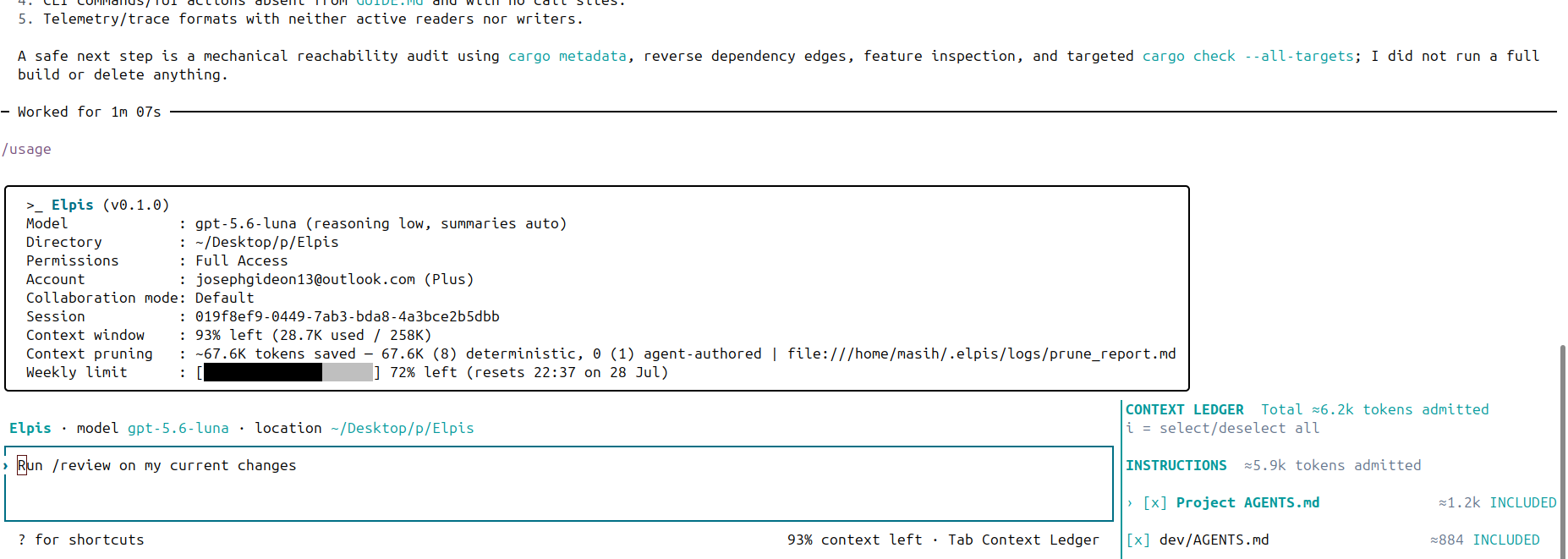
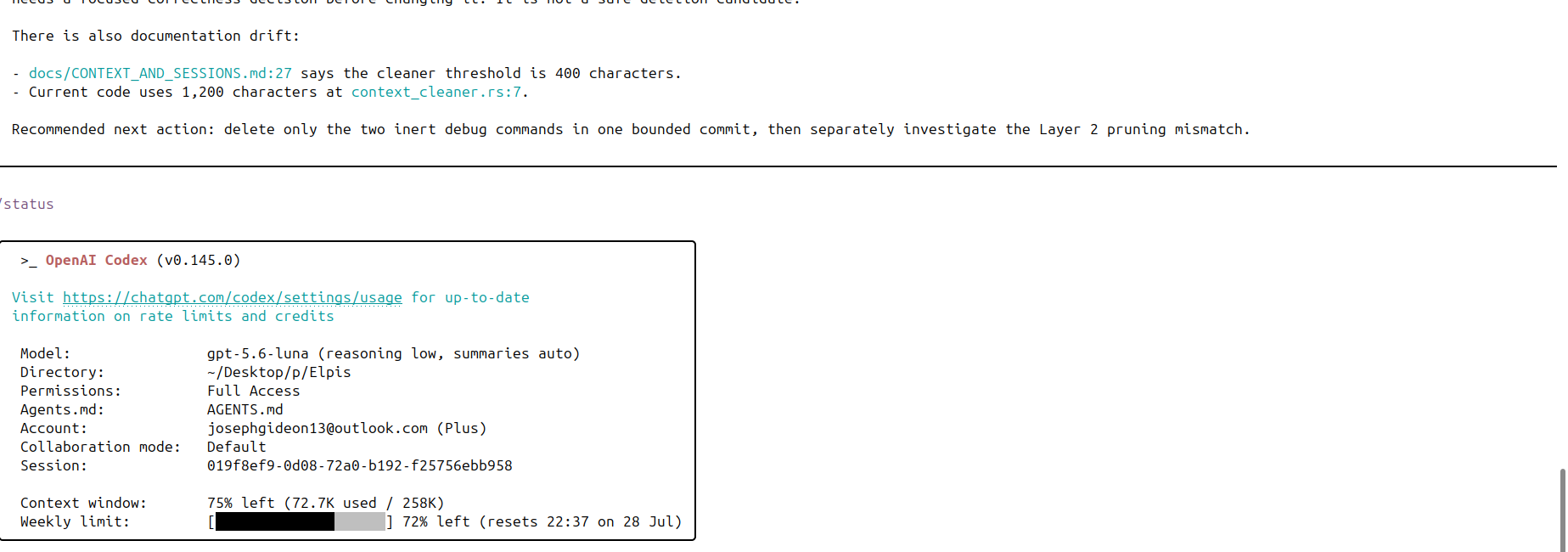
One controlled comparison: same task, same prompt — Elpis finished with 93% free context, Codex with 73%. Screenshots: proof below.
Quick Start
Install
mkdir -p "$HOME/.local/bin"
curl -fL --progress-bar -o "$HOME/.local/bin/elpis" https://github.com/MasihMoafi/Elpis/releases/latest/download/elpis-linux-x86_64
chmod 755 "$HOME/.local/bin/elpis"
elpis
This assumes ~/.local/bin is on your PATH.
Clone the repository
git clone https://github.com/MasihMoafi/Elpis.git
cd Elpis
./scripts/install-elpis.sh
elpis
The installer downloads the latest checksummed Linux x86_64 release and installs it atomically into ~/.local/bin.
Debian / Ubuntu
deb_url=$(curl -s https://api.github.com/repos/MasihMoafi/Elpis/releases/latest | grep -oE '"browser_download_url": *"[^"]*\.deb"' | grep -v sha256 | cut -d '"' -f4)
curl -fL --progress-bar -o elpis.deb "$deb_url"
sudo dpkg -i elpis.deb
On first launch, Elpis asks you to choose a provider and complete sign-in or API-key setup.
Demo

What's Elpis?
Long coding-agent sessions accumulate transcripts, file reads, searches, command output, and failed paths. The useful state of the work can become difficult to distinguish from the history of how the agent got there.
Elpis separates those things.
- Working context is the small set admitted into the next model request.
- Evidence stays exact and durable even when it is no longer in working context.
- Continuity preserves goals and checkpoints without replaying the whole transcript.
- Memory is bounded, selective, and backed by provenance.
- Runtime choice stays explicit instead of silently collapsing every provider into one route.
The selected agent still performs the model loop. Elpis owns the environment around it.
Elpises
Elpis is the home, not any one agent. Put an agent inside Elpis and it becomes an Elpis: it inherits the environment around the work — context, memory, permissions, evidence, and control.
Elpises can take different paths while sharing the same roots. The image below is one representation of how that model can expand: multiple Elpises working continuously to improve one shared Elpis environment.

Elpis can grow beyond a terminal shell into a broader agent environment — potentially an agent OS. This is a direction, not a claim that multi-agent control ships in v0.1.1.
Context pruning: one controlled comparison
The screenshots below show Elpis and Codex running the same task. In this recorded comparison, Elpis ended with 93% free context and Codex with 73% free context.
This demonstrates one controlled workflow, not a claim that every task will produce the same reduction.
Start


End
Elpis: 93% free context remaining
Codex: 73% free context remaining
How it works
Elpis uses three context-reduction layers:
| Layer | What happens | Inspection |
|---|---|---|
| Tool cleanup | Oversized stdout/stderr becomes compact head/tail receipts | /status, evidence pointers |
| Model pruning | Transient conversation material is removed while useful decisions are retained | /prune, pruning report |
| Session compaction | Older history becomes portable goal/checkpoint state | Context Ledger, /usage, rollout logs |
Full conversations, terminal events, and artifacts remain on disk. Elpis can retrieve exact evidence later instead of attaching the full history to every request.
The execution foundation — terminal UI, patches, permissions, sandboxing, and sessions — is derived from OpenAI's Apache-2.0 Codex CLI. Elpis adds its context, continuity, memory, retrieval, and provider-control layer around that execution loop.
Current state
v0.1.1 ships a Linux x86_64 release with a checksummed installer, the Ratatui
terminal UI, dual-layer pruning (deterministic tool receipts plus Ace message
pruning), the Context Ledger with ctrl+clickable context files, portable session
continuity, bounded local memory, local read-only RAG, and
OpenAI/Anthropic/Gemini/OpenRouter provider support. macOS, Windows, /auto
routing, multi-agent control, voice input, and LSP integration are not in
v0.1.1.
Full status, in-progress work, and the backlog: TASKS.md.
Documentation
- Context and sessions
- Memory
- Providers
GUIDE.md— product vision and architectureTASKS.md— release state and backlogdocs/BUILD_AND_REDUCTION_AUDIT.md— measured build and reduction work
License
Elpis is MIT licensed. Codex-derived source retains its upstream Apache-2.0 notices and attribution.
No comments yet
Be the first to share your take.