
dcc-mcp-core





中文 | English
Skill-first, Rust-powered control plane for a growing creative-tool ecosystem.
dcc-mcp-core connects agents to desktop DCCs, game engines, 2D tools, production systems, asset providers, profilers, and custom studio hosts through discoverable MCP and REST capabilities. It provides the gateway, Skills, structured results, main-thread dispatch, diagnostics, IPC, workflows, and packaged CLI/server binaries needed to operate real sessions.
Choose your entry point
| You want to… | Start with |
|---|---|
| Control a running DCC from an agent or CI job | dcc-mcp-cli |
| Expose a DCC adapter over MCP/REST | create_skill_server |
| Add tools without Python registration code | SKILL.md + tools.yaml |
| Discover and install reusable Skills | DCC-MCP Marketplace |
| Build a new DCC adapter | new-adapter-onboarding.md |
| Understand routing and multi-instance behavior | gateway.md |
| Integrate from any HTTP client | rest-api-surface.md |
The current contract
The default agent path is CLI + REST:
dcc-mcp-cli dcc-types (when adapter support is unclear)
  -> list
  -> search
  -> describe
  -> load-skill (only when needed)
  -> call
The gateway keeps tools/list bounded. It advertises the canonical discovery/dispatch wrappers (search, describe, load_skill, and call) instead of fanning every backend tool into one large list. Backend capabilities are discovered by search, inspected by describe, and invoked through the wrapper or the REST twin (POST /v1/search, /v1/describe, /v1/call).
When a concrete DCC session is needed, read gateway://instances; each entry already includes its mcp_url. Do not use the removed legacy instance tools (list_dcc_instances, get_dcc_instance, or connect_to_dcc). Wrapper inputs belong inside arguments; do not put backend fields beside tool_slug.
For direct per-DCC MCP connections, the compatibility discovery names (search_tools, describe_tool, and call_tool) remain available where the server exposes them. New gateway integrations should use the canonical names above.
Why dcc-mcp-core exists
The shortest DCC agent demo asks a model to write and run a mayapy, hython,
or Blender Python script. A production pipeline cannot depend on getting the
right script from the model on every turn. Repeated code generation costs
tokens, varies with the model and context, and leaves every adapter to rebuild
transport, main-thread dispatch, validation, process lifecycle, routing, and
diagnostics.
dcc-mcp-core moves that common engineering into one reusable control plane:
| Layer | Reused capability |
|---|---|
| Integration | MCP and REST endpoints, Host RPC/IPC, typed schemas, resources, prompts, and structured results |
| DCC runtime | Main-thread affinity, readiness, multi-instance routing, async jobs, cancellation, checkpoints, workflows, artefacts, and UI Control |
| Skill delivery | SKILL.md packages, progressive discovery, lint/schema validation, hot reload, persistence, marketplace distribution, and project/team scopes |
| Operations | CLI, gateway, Admin UI, policies, audit records, traces, logs, metrics, health checks, and VRS replay |
This project provides the infrastructure for agents to control DCC applications; it does not build or prescribe the agent itself. Agents and models will change, while studio interfaces, permission boundaries, and pipeline knowledge still need to be maintained. The framework turns those investments into reusable engineering assets.
Existing tools need AI access too
Adding an AI-facing interface to a new tool is usually straightforward. The harder problem is making years of existing tools usable by agents when they have no API, cannot be modified, or expose part of a workflow only through a window or modal dialog.
For that gap, dcc-mcp-core provides the bounded Computer Use-style DCC UI Control capability. It combines exact-window screenshots, semantic controls when available, scoped actions, waits, recording, policy checks, audit, and result verification. Native Skills/APIs remain the preferred path; UI Control lets legacy and interface-only workflows join the same agent control plane without pretending that every application has a clean programmable API.
MCP is an entry point, not the ceiling
MCP is the industry-standard agent interface we reuse, not the limit of the framework. A stable Python, C++, HTTP, command-port, or native plugin interface can be integrated under the same discovery, execution, safety, and operations contracts.
We also include useful vendor capabilities instead of replacing them. Unreal Engine 5.8 introduced an experimental built-in MCP server and Toolset Registry. The Unreal Official MCP Bridge enables and calls those official toolsets through DCC MCP without redistributing them. Vendor tools, DCC-MCP tools, and studio tools can share one agent-facing workflow.
Skills are the production unit
A Skill turns proven pipeline knowledge into a versioned, typed, testable, and distributable operation. A lower-cost model may struggle to invent scene-editing logic from scratch but remain effective when selecting a well-described tool and supplying validated arguments. Studios can distribute different Skill sets by project and production stage, reducing repeated code generation, token use, and model-dependent variance.
This is also the practical customization boundary for studio TDs and TAs. Core
and adapters keep ownership of host connectivity, main-thread execution,
routing, safety, and observability. A TD or TA can encode the actual project
flow—naming and scene checks, asset preparation, publish gates, cache/export
rules, and review hand-offs—as a Skill made from SKILL.md, tools.yaml, and
the studio's existing scripts. Those Skills can be tested, scoped to a project
or team, and distributed through a public or private marketplace without
forking the control plane or rebuilding an adapter.
One contract, a growing ecosystem
The same Skill and runtime contract now spans much more than the original DCC adapters:
| Area | Examples |
|---|---|
| Desktop DCCs | Maya, Blender, Houdini, 3ds Max, Nuke, Katana, MotionBuilder, ZBrush |
| Design and content tools | Photoshop, Substance 3D Designer/Painter, After Effects, Premiere, GIMP, Krita |
| Game and 2D engines | Unreal Engine, Unity, Godot, Tiled, Material Maker |
| Pipeline and quality | OpenUSD, Flow Production Tracking, MaterialX, texture/publish workflows, RenderDoc, Tracy |
| Reusable Skills | Asset providers, generative 2D/3D services, UI automation, rigging, procedural authoring, game release and acceptance |
Browse every integration in the DCC-MCP organization, or use the official Marketplace to discover optional Skills without changing an adapter.
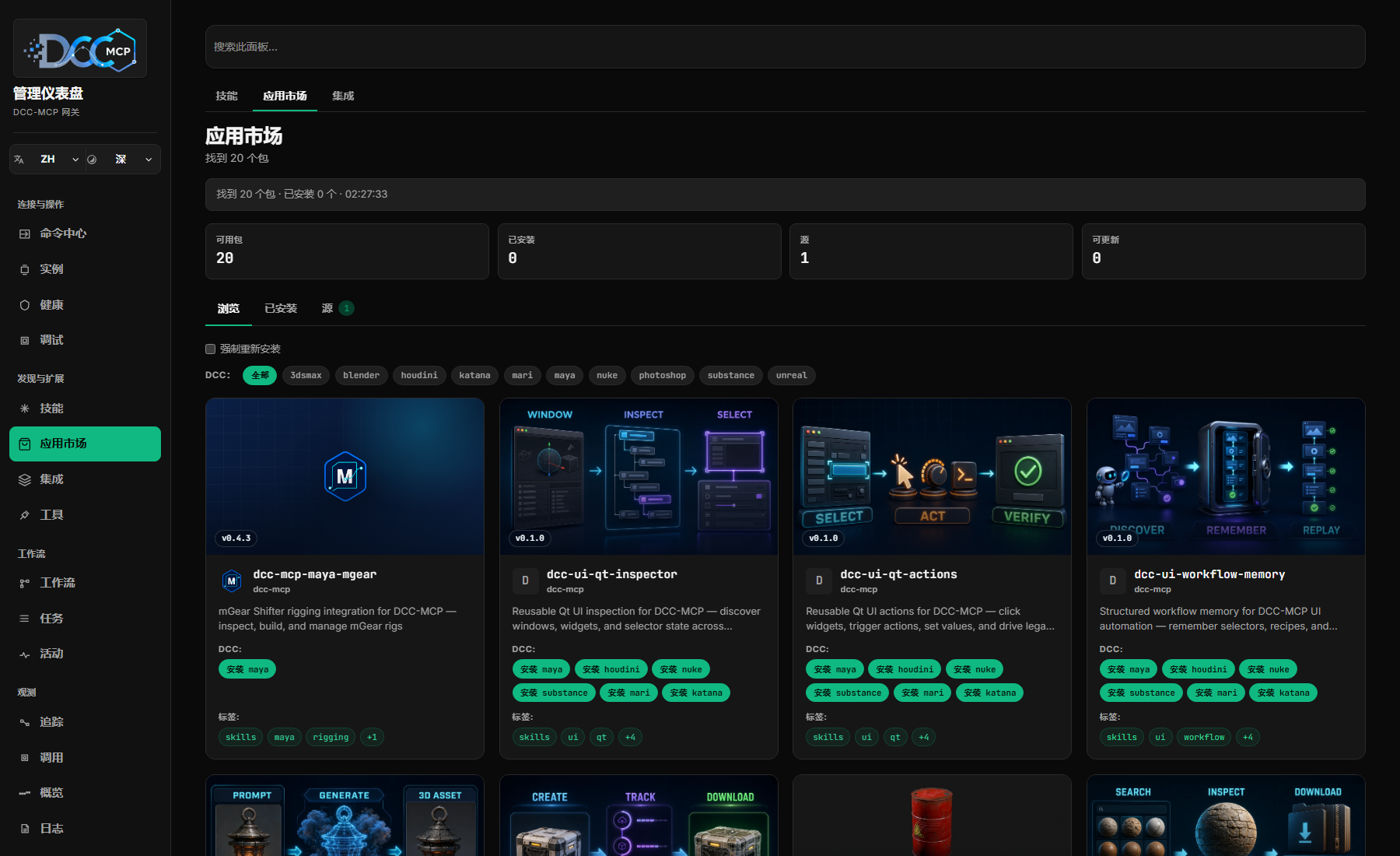
The Admin UI closes the feedback loop. Calls, traces, logs, health, statistics, and usage data show which tools agents selected and where they failed. Teams can improve a description, schema, or implementation, then verify the result against real calls instead of treating tool use as a black box.
The boundaries remain explicit. Core cannot safely preempt arbitrary code already running on a DCC main thread, guarantee rollback for host APIs without transactions, or define one lossless mesh/rig/material model for every application. Host semantics still belong in adapters and pipeline Skills.
Quick start: operate a DCC
dcc-mcp-cli is the preferred control path for every shell-capable agent.
If it is missing, obtain the user's consent, install the public dcc-mcp
Skill below, and run its bundled verified helper from the Skill directory:
python scripts/check_cli.py --ensure-cli --pretty
Without the Skill, download the official installer to a local file, inspect it, and only then execute that file:
# Linux/macOS
curl -fL https://raw.githubusercontent.com/dcc-mcp/dcc-mcp-core/main/scripts/install-cli.sh -o install-cli.sh
cat install-cli.sh
# After reviewing the file:
sh ./install-cli.sh
# Windows PowerShell
Invoke-WebRequest https://raw.githubusercontent.com/dcc-mcp/dcc-mcp-core/main/scripts/install-cli.ps1 -OutFile .\install-cli.ps1
Get-Content -Raw .\install-cli.ps1
# After reviewing the file and subject to the current execution policy:
& .\install-cli.ps1
Both paths accept only the official dcc-mcp/dcc-mcp-core release, validate
the platform update manifest and CLI SHA-256, and leave any existing binary
untouched if validation or download fails. This is an integrity check, not a
digital signature. Never pipe a remote installer directly into a shell or
bypass the machine's script execution policy.
Install the agent Skill suite
Install the three public Skills directly from ClawHub; cloning this repository is not required:
openclaw skills install @loonghao/dcc-mcp
openclaw skills install @loonghao/dcc-mcp-skills-creator
openclaw skills install @loonghao/dcc-mcp-creator
Add --global to each command when every local OpenClaw agent should see the
suite. Other ClawHub-compatible workspaces can use the registry CLI directly:
npx --yes [email protected] install @loonghao/dcc-mcp
npx --yes [email protected] install @loonghao/dcc-mcp-skills-creator
npx --yes [email protected] install @loonghao/dcc-mcp-creator
| Skill | Agent role |
|---|---|
dcc-mcp |
Default live DCC control and marketplace discovery; Skill-store requests begin with dcc-mcp-cli marketplace search |
dcc-mcp-skills-creator |
Create, validate, package, and review DCC-MCP Skill packages |
dcc-mcp-creator |
Create or modernize a complete DCC adapter and its runtime wiring |
All three packages carry Codex agents/openai.yaml metadata while preserving
their DCC-MCP and ClawHub contracts. Their immutable ClawHub releases are
versioned independently in
.github/clawhub-skills.json, so Skill updates
do not collide with an already-published core version. The sync workflow
publishes the manifest versions and verifies their packaged files. Bump both
the manifest entry and the matching SKILL.md metadata version for every new
immutable Skill release.
Keep an official build current through the release manifest:
dcc-mcp-cli update check
dcc-mcp-cli update apply
update apply downloads and stages the latest CLI for the next launch. It does
not update a running dcc-mcp-server; update that server in its own environment.
Then discover a live capability before calling it:
dcc-mcp-cli dcc-types
dcc-mcp-cli list
dcc-mcp-cli search --query "create sphere" --dcc-type maya --limit 20
dcc-mcp-cli describe <tool-slug>
dcc-mcp-cli call <tool-slug> --json '{"radius": 2.0}' \
  --meta-json '{"agent_context":{"session_id":"task-42"}}'
--query "create sphere" is compatible with released CLI builds. Builds that
contain the unified search parser also accept unquoted positional words.
dcc-types is an offline, catalog-backed capability query. It reports
canonical adapter identifiers and install-plan availability; list remains
the source of truth for live instances.
Replace the placeholder with the slug returned by search. For remote workstations, register a gateway profile and select it:
dcc-mcp-cli gateway register https://workstation.example:19293 --name pcA
dcc-mcp-cli gateway set pcA
dcc-mcp-cli list
Use dcc-mcp-cli doctor when startup or readiness is unclear. Open the local Admin UI at http://127.0.0.1:9765/admin after the gateway is available.
After a task is accepted, agents can inspect bounded gateway evidence with
dcc-mcp-cli stats --range 24h --session-id task-42. A zero call count means
no telemetry evidence, and direct local calls may not be represented. Feed the
result plus short task and validation summaries to the
review_skill_improvement prompt.
The prompt defaults to no change, prefers improving an existing skill, and
never grants authority to edit or publish outside the task scope.
Quick start: expose skills from Python
pip install dcc-mcp-core
Point the server at a skill directory and start the MCP endpoint:
import os

from dcc_mcp_core import McpHttpConfig, create_skill_server

os.environ["DCC_MCP_MAYA_SKILL_PATHS"] = "/path/to/skills"

server = create_skill_server("maya", McpHttpConfig())
handle = server.start()
print(handle.mcp_url())
Local DCC instances bind an OS-assigned port by default. The resolved URL is
registered automatically, so the gateway and CLI discover it without a
hardcoded per-instance port. Pass port=<number> only for an explicit fixed
listener requirement.
For manual handler registration, use McpHttpServer and ToolRegistry. For adapter lifecycle, readiness, gateway registration, and hot reload, use DccServerBase as described in the adapter guides.
Add a skill without framework glue
The project follows the agentskills.io frontmatter contract. Put dcc-mcp-core extensions under metadata.dcc-mcp and keep tool declarations in a sibling file:
my-skill/
├── SKILL.md
├── tools.yaml
└── scripts/
    └── do_thing.py
# SKILL.md
---
name: my-skill
description: "Does a useful Maya task. Use when the user asks for it."
metadata:
  dcc-mcp:
    dcc: maya
    tools: tools.yaml
    search-hint: "geometry, scene task"
---
# tools.yaml
tools:
  - name: do_thing
    description: Do the task in the active Maya scene.
    source_file: scripts/do_thing.py
    execution: sync
    affinity: main
    annotations:
      read_only_hint: false
      destructive_hint: true
Run the same production validator used by CI with dcc-mcp-cli lint path/to/skills. See Skills for schemas, groups, dependencies, testing, and migration rules.
DCC UI Control
Desktop application automation for cases where native DCC APIs cannot observe
or drive the interface state directly. Agents use ui_control__snapshot,
ui_control__find, ui_control__act, ui_control__wait_for,
ui_control__record_clip, and ui_control__stop_computer_use to observe,
find, act on, and record exact target windows.
Use UI Control as a bounded fallback, not as the default DCC integration:
- Prefer structured adapter tools for scene, asset, render, and project work.
- Use UI Control for controls that have no API, incomplete adapter coverage, and end-to-end GUI acceptance tests.
- Do not treat every image in an agent task as UI Control evidence. DCC-native captures, RenderDoc exports, ImageGen output, and video frames have different provenance.
How screenshots and clicks work
ui_control__snapshot captures only the bound window. It preserves native
resolution until either the longest edge exceeds 1600 pixels or the image
exceeds 1.5 million pixels, then downsizes while preserving aspect ratio. A
1280×720 window stays 1280×720; a 1920×1080 window becomes 1600×900. Smaller
text and custom-drawn icons are therefore easier to recognize when the target
window is large and unobstructed.
The agent receives three complementary signals:
- PNG pixels for visual recognition and spatial understanding.
- A Windows UI Automation (UIA) tree with labels, roles, and stable control identifiers when the application exposes them.
- Observation metadata for the exact PID, HWND, DPI, source rectangle, desktop generation, session, and snapshot.
Clicks prefer a semantic control_id. For custom-drawn UI, screenshot-relative
coordinates are mapped back through the source rectangle and DPI. Every action
must cite the latest snapshot_id; the host revalidates the window, desktop,
geometry, and generation before sending input, and rejects stale observations.
Successful snapshots and recordings include capture_provenance, including
the backend, session, target PID/HWND, output and source dimensions, scaling,
and native capture backend. Preserve that block with screenshots used as
evidence. Older images without provenance cannot be reliably attributed to UI
Control after the fact.
Capabilities
- Scoped window targeting — snapshots and actions are bound to a single process or window handle, never the whole desktop.
- Multi-instance sessions — the gateway selects the DCC
instance_id, while the native host namespaces each adapter connection. Separate DCC instances may therefore reuse a logicalsession_idsuch asdefaultwithout sharing capabilities or cleanup state. - Semantic UIA + raw input fallback — prefer stable semantic controls
(button, text field, checkbox) resolved by
ui_control__find, then fall back to screenshot-relative coordinates when custom-drawn controls have no semantic node. - Bounded security model — every action is scoped by the
adapter/operator-bound PID/HWND. Raw input requires an explicit opt-in
(
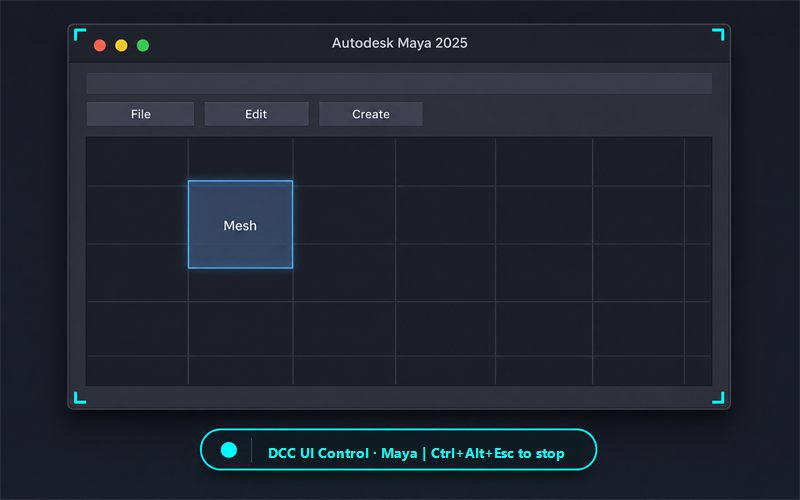
DCC_MCP_COMPUTER_USE_ALLOW_RAW_INPUT=true). Hard-denied: passwords, authentication controls, LockApp, Windows Security, terminals, and credential manager windows. - Visible capsule overlay — while a native DCC UI Control session is active,
click-through corner brackets mark the target window and a bottom-center
capsule reads
DCC UI Control · <app> | Esc to stop. The user stops control at any time withEsc. - One shared input safety owner — multiple exact-window sessions may remain
active in one Windows logon session. Native input is still serialized through
one process coordinator and one cross-process owner;
Esclatches every session, while an ordinary stop only releases the selected session. - Exact-window recording — records a bounded, constant-frame-rate JPEG sequence from the operator-bound PID/HWND. The host owns the directory, hashes every frame, commits the manifest last, and deletes partial captures.
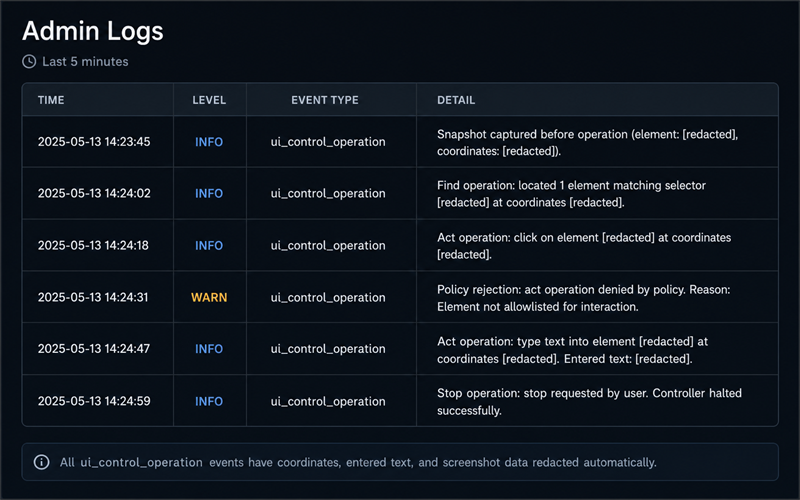
- Audit trail — every snapshot, recording, action, wait, stop, and rejected operation
appends a redacted
ui_control_operationevent to the shared log directory, visible in the Admin Logs panel without exposing entered text or screenshot coordinates.
Tool reference
| Tool | Description |
|---|---|
ui_control__snapshot |
Capture a bounded PNG plus UIA tree from the scoped window |
ui_control__find |
Locate semantic controls by query, role, label, or object name |
ui_control__act |
Perform one scoped semantic or coordinate-based action |
ui_control__record_clip |
Record a host-owned, hash-verified JPEG sequence from the exact window |
ui_control__wait_for |
Poll until a UI condition becomes true or times out |
ui_control__stop_computer_use |
Release the capsule, hotkey, and global input owner |
ui_control__system_operation |
Ensure a named Windows configuration item (operator-granted) |
For detailed skill reference and agent workflows, see the ui-control skill.
Architecture
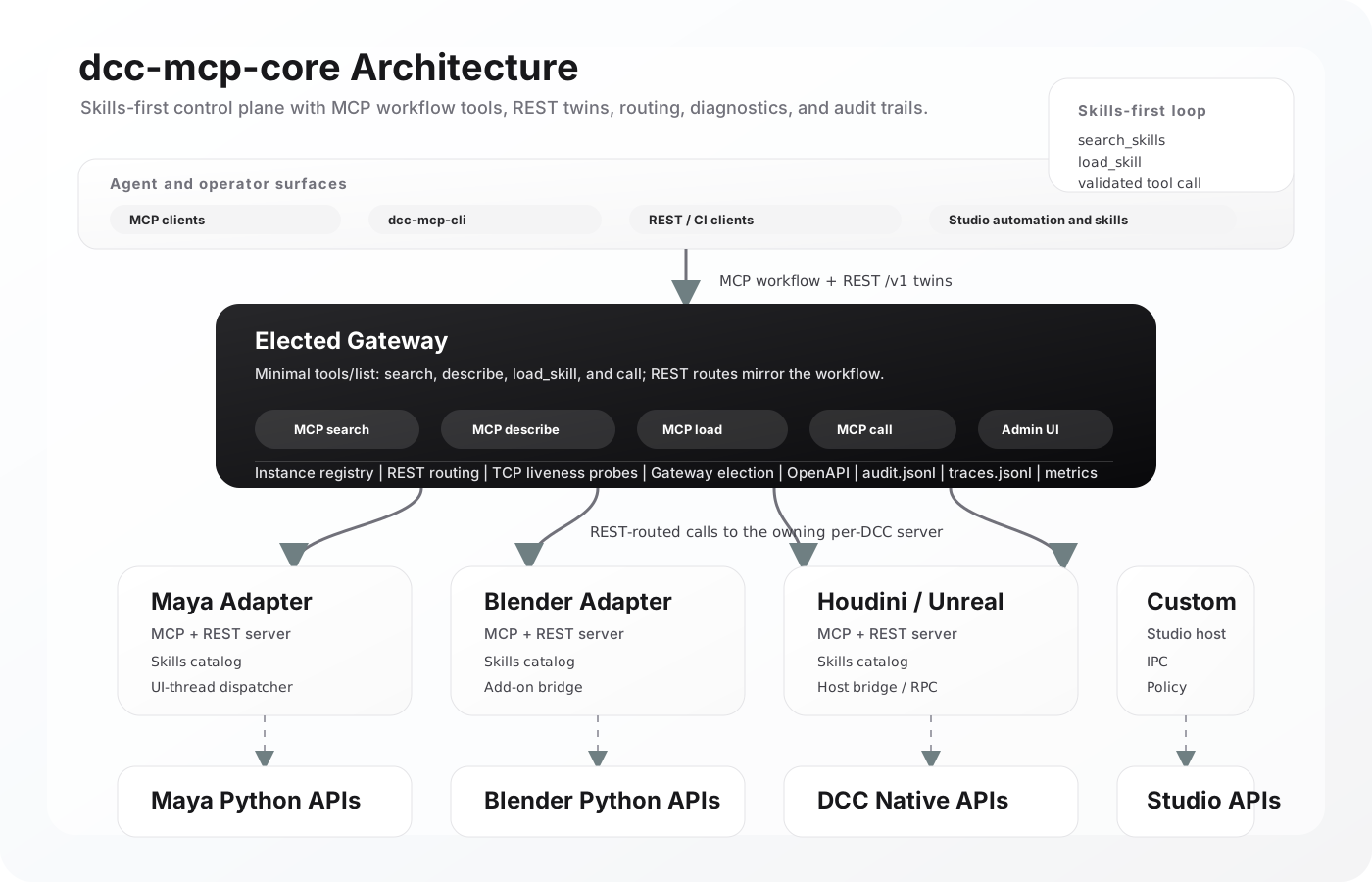
The runtime has four useful layers:
- DCC service — owns skills and executes tools inside one DCC process.
- Sidecar/supervisor — bridges host RPC, readiness, process lifetime, and gateway registration when an adapter uses the packaged runtime.
- Gateway daemon — aggregates live instances and owns discovery, routing, REST, Admin UI, audit, and diagnostics.
- Client surfaces — CLI, MCP clients, REST clients, and marketplace tools.
The Rust workspace and package membership are defined by the root Cargo.toml. The Python package is a PyO3 extension with pure Python helpers and supports Python 3.7–3.14. Build-from-source requirements come from rust-toolchain.toml and package metadata; the repository does not duplicate version or package counts in this README.
Documentation map
- Getting started — install the package and start a first server.
- CLI reference — complete operator commands and flags.
- Gateway guide — daemon, registry, routing, relay, and multi-instance behavior.
- REST API surface — request envelopes, tool_slug, readiness, and error contracts.
- Skills guide — authoring, loading, validation, and persistence.
- Adapter onboarding — the supported adapter implementation and release path.
- Documentation index — the complete guide/API map.
- AI agent guide and AGENTS.md — agent workflow and repository rules.
Development
Use the repository-pinned toolchain where possible:
vx just install
vx just dev
vx just test
vx just test-rust
vx just lint
vx just docs-check
docs-check builds the VitePress site and catches documentation links and syntax errors. Markdown lint runs in the docs CI workflow. See CONTRIBUTING.md for coding, testing, and release rules.
License
MIT — see LICENSE.
No comments yet
Be the first to share your take.