
Claude skills for business intelligence, certified
Every figure reconciles to a total the file itself asserts. A free skill and the full doctrine from Kymira that teach Claude Code and Cursor to build charts, dashboards and reports on your own exports, name what the file cannot prove instead of shipping it as a number, and refuse to guess.
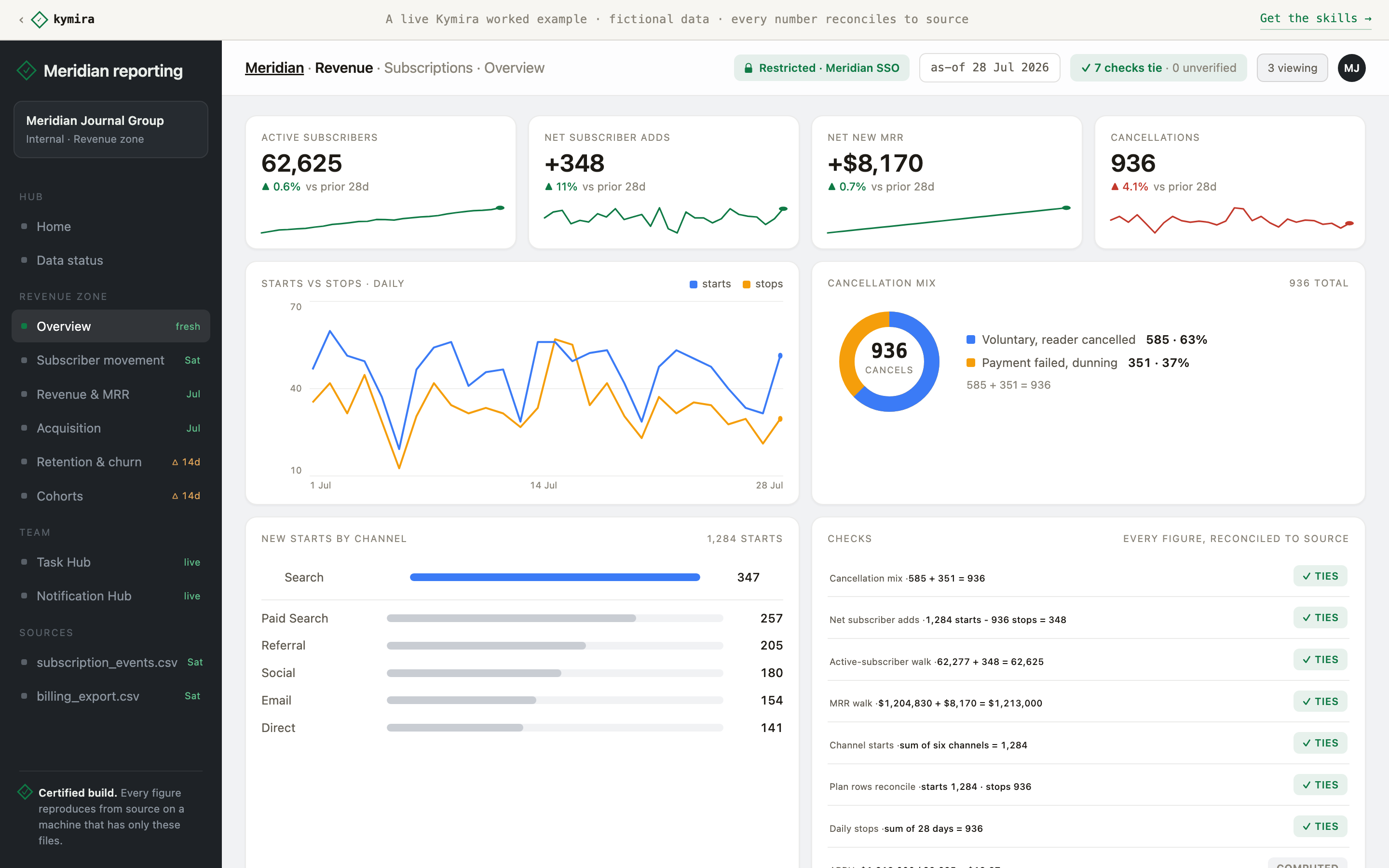
A live demo report built with the full skill set: every check ties to the file it came from, on fictional data.
Install
One command, for Claude Code, Cursor, Codex and the other agents the skills CLI supports:
npx skills add dylnbaker15/Claude-Skills-For-Business-Intelligence
Or copy the folder yourself. A skill is a folder with a SKILL.md in it, so
installing is a copy. No build step, no dependencies.
Claude Code
git clone https://github.com/dylnbaker15/claude-skills-for-business-intelligence.git
mkdir -p ~/.claude/skills
cp -R claude-skills-for-business-intelligence/honest-dataviz ~/.claude/skills/
Start a new session (skills load at startup) and ask "which skills do you have
available?". honest-dataviz should be in the list.
Cursor
Cursor reads project rules rather than a skills folder, so the skill also ships as a
.mdc rule. From the clone above, inside the project you want it in:
mkdir -p .cursor/rules
cp honest-dataviz/honest-dataviz.mdc .cursor/rules/
honest-dataviz/AGENTS.md at your repo root works too, and
honest-dataviz/plain-prompt.md is the same content with no tool-specific framing,
for Windsurf, Cline, Zed, or a raw API loop. INSTALL.md covers each
route, Windows included.
As a Claude Code plugin
/plugin marketplace add dylnbaker15/Claude-Skills-For-Business-Intelligence
/plugin install kymira-certified-bi@kymira
Install by exactly one route. Two copies of the same skill both try to trigger.
What's in this repo
honest-dataviz/, the free skill: charts and dashboards that read at a glance, survive a colour-blind reviewer, and never imply more certainty than the data has. Every rule in it was bought with a measured failure in a production reporting engine. None is taste.DOCTRINE.md, the eleven principles of certified BI, published in full. The one-sentence version: reconcile every figure to what the source asserts about itself, and refuse to guess, out loud.doctrine_gate.py, the gate: a plain script that reads a finished artifact and fails the build when a principle is broken.INSTALL.md, every install route in about a minute, plus troubleshooting.
Try it with one prompt
Start on a real export from your own business, not a sample. Drop the file into a
project that contains DOCTRINE.md, then:
Here is a raw export from my business: [the file]. Read DOCTRINE.md and use the honest-dataviz skill, then build me a single-file HTML dashboard from this export. Rules: every figure must reconcile to totals the file itself asserts, show the reconciliation, and if the file cannot prove a number, name that on the page instead of shipping it. Refuse to guess.
The difference shows up immediately: the agent hunts for what the file asserts about itself before it types a single figure, and tells you what it cannot prove.
Six ways a number goes wrong
These are observed failures, not hypotheticals, each one caught in our own audits of agent-built reports and each one now the reason a rule exists.
| Failure mode | What we saw |
|---|---|
| The 100x slip that ties perfectly | A price entered as 5900.00 instead of 59.00 multiplies through every subtotal consistently, so every reconciliation passes while the headline triples. |
| The filename that lies about the period | A file called Q2 carrying July rows. Headline the file and the quarter is wrong. |
| The join that quietly covers 62% | A reference join drops a third of the rows and the report says nothing, because nothing asked. |
| Two churn definitions, 3.4 points apart | Two teams, one word, different denominators, both defensible, and a leadership deck that mixes them. |
| The verify script that silently did nothing | The agent wrote itself a verification script, it no-op'd, and everything passed. |
| The certified page that opens as garbage | No charset declaration, so every heading renders as mojibake in the recipient's browser. |
Fifty-one of them, grouped by family and each tied to the principle that addresses it, are catalogued at kymira.ai/failure-modes. The eleven principles are at kymira.ai/doctrine, and this skill has its own page at kymira.ai/skills/honest-dataviz.
Why "certified"
A model on its own writes a clever first draft, confident everywhere: it guesses a total when the file states none, and presents every figure with equal confidence. These skills came from building a real reporting system that was broken on purpose across thirteen audit rounds and rebuilt until it stopped shipping a single number it could not prove. The doctrine in this repo is that system's constitution.
Free versus paid
This repo is the free tier and it is not a teaser: the skill here is the complete file, the same content the paid packs install under a namespaced name, MIT licensed, nothing gated. The packs add the rest of the system.
| Free, this repo | Core, $199 | Everything, $349 | |
|---|---|---|---|
| Skills | honest-dataviz |
The 13 craft skills, versioned | All 22 skills |
| The doctrine, 11 principles | Yes | Yes | Yes |
| Report templates | 12 | ||
| Metric Library | 351 definitions, every fork worked | ||
| Format Library | 47 export shapes, every trap named | ||
Installer and the kymira CLI |
Yes | Yes | |
| License | MIT | Personal | Personal |
Both packs are a one-time purchase with lifetime updates. All sales are final; the free skill and the full doctrine cost nothing, so judge the quality here first. Details at kymira.ai/get?tier=free, the road from raw export to a report your team runs on at your first week, and what is being built next on the roadmap.
FAQ
Is the free skill cut down? No. It is the complete file, the same content the paid packs install, under MIT. The doctrine is published in full for the same reason: the method is checkable or it is worth nothing.
Does it work outside Claude Code?
Yes. The skill ships in four shapes in this repo: SKILL.md for Claude Code, a
.mdc rule for Cursor, AGENTS.md for agents that read that file, and
plain-prompt.md for anything with a system prompt.
Where does my data go? Nowhere. These are plain text files that run inside your own agent on your own machine. There is no server, no telemetry, and no network call in the skill.
Will a better model make this unnecessary? The guarantees here are process, not model behaviour. Reconciliation runs as code that re-runs, and a gate that fails closed cannot be talked out of by a smarter model.
How do I get updates?
Updates to the free skill land in this repo: git pull and re-copy the folder, or
re-run the npx skills add command. Watch the repo to see them land. The zip at
kymira.ai/get?tier=free always carries the current
version, and needs no email.
I installed a Kymira pack. Do I remove this?
Yes, remove this copy first. The packs ship their own namespaced version
(kymira-honest-dataviz) and two copies will both try to trigger.
License
Everything in this repo is MIT licensed. Cite it with the metadata in CITATION.cff; llms.txt is the index for agents.
No comments yet
Be the first to share your take.