
cinematic-scroll-landing
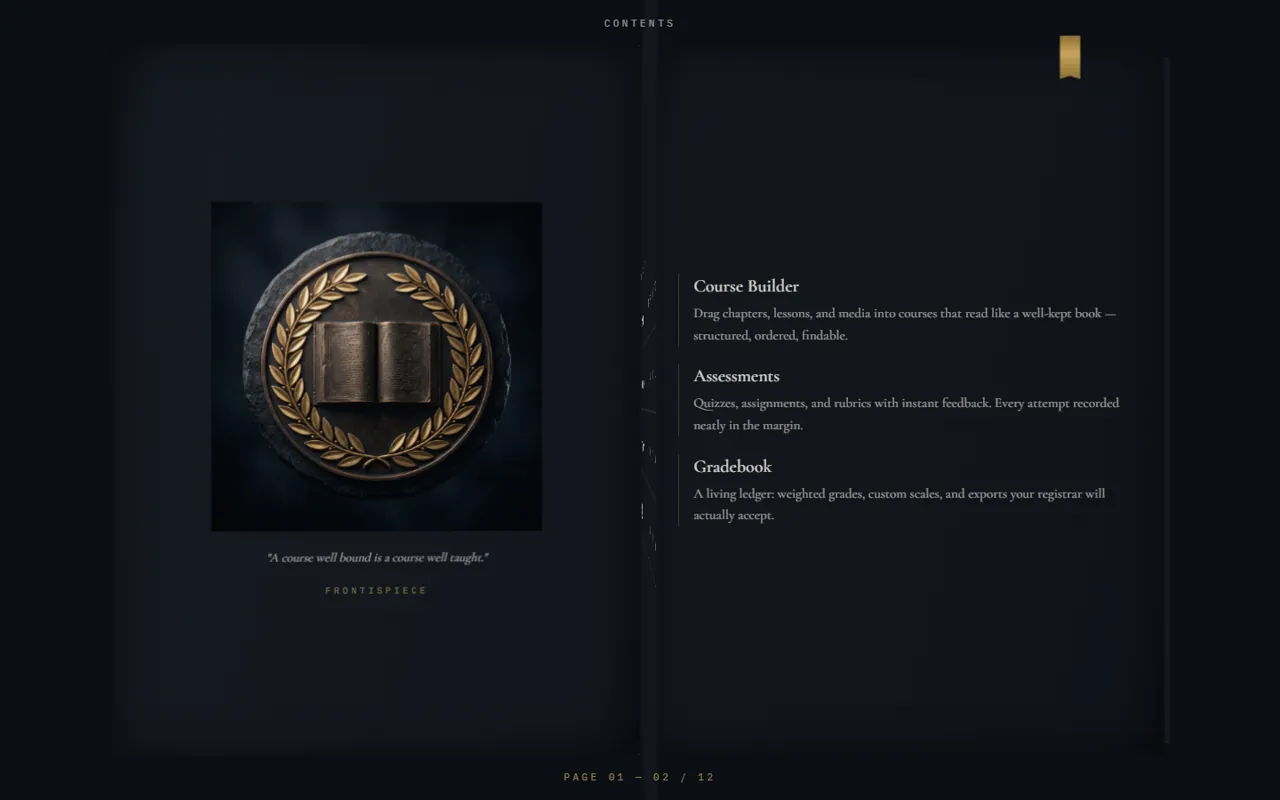
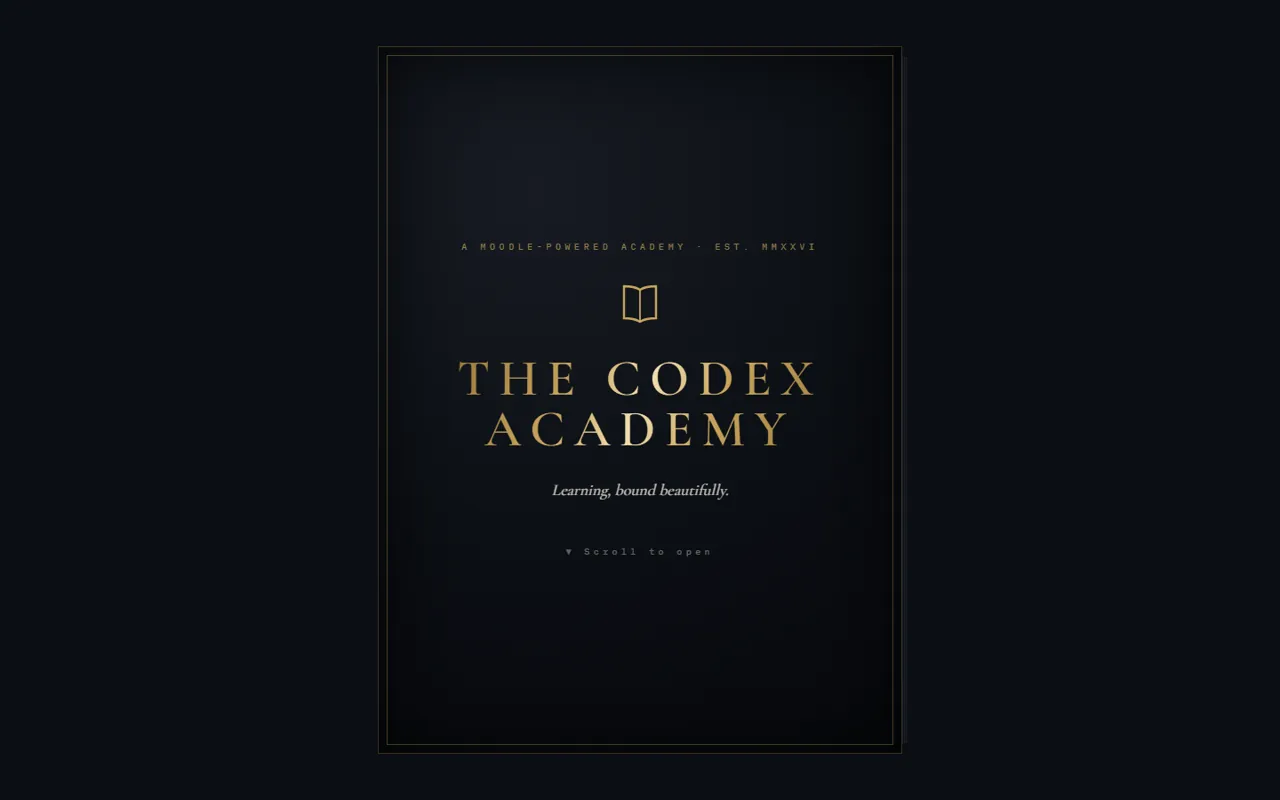
A Claude Code skill for building dark, cinematic, awwwards-style landing pages with seamless scroll choreography — plus its living proof: The Codex Academy, a landing page where the entire site is a book whose pages turn as you scroll.
Live demo: https://codex-academy-five.vercel.app
What's in here
| Path | What it is |
|---|---|
SKILL.md |
The skill: core system, set-piece menu with honest costs, workflow, hard-won gotchas |
references/book-mode.md |
Full-page book sites: the sheet model, z-index choreography, timeline math, flat fallback |
references/motion-recipes.md |
GSAP/Lenis recipes: infinite loop, morph gallery, flip-book, dissolves, marquee, preloader |
references/imagery-universe.md |
One-visual-universe AI imagery: locked style template, generation ops, contact-sheet QA, ship-size discipline |
references/verification-harness.md |
Visual verification when browser tooling misbehaves: puppeteer-core harness, Lighthouse guidance |
scripts/audit_images.py |
Audits image refs vs public/ (missing, unused, shared-generic wiring smells) |
demo/ |
The Codex Academy — React 19 + Vite + Tailwind + GSAP ScrollTrigger + Lenis, built with the skill |
docs/superpowers/ |
The full paper trail: design spec, 14-task implementation plan, retrospective |
The demo in one paragraph
One 100vh sticky stage and a single scrubbed GSAP timeline turn CSS-3D
sheets around a spine — cover opens, five spreads flip, the book ends open
on the CTA (~8 viewports of scroll). Each sheet's front is right-page k and
its back is left-page k+1, with choreographed z-indexes so a turning page
passes above already-turned ones. Mobile and prefers-reduced-motion get
the identical DOM reflowed into stacked sections (display: contents +
flex order). All imagery was generated from one locked style template and
shipped as 676KB of WebP. Lighthouse: accessibility 100, CLS 0.
Requirements
Installing the skill needs nothing but the copy commands below — skills are passive documents, so there is no setup step and nothing to configure up front. Each requirement matters only when its workflow step arrives:
- Node 20+ — building the demo or any site made with the skill
- Python 3 (stdlib only) —
scripts/audit_images.pyand the setup checker; Pillow optional (contact sheets, watermark crops) - An image-generation tool + key — only when generating imagery; any image-gen MCP/skill works, and Google AI keys are free at aistudio.google.com/apikey
- Installed Chrome — the visual-verification harness drives it via puppeteer-core
- Deploy auth of your choice (
npx vercel login,gh auth login) — only at deploy time
On first use, run python scripts/check_setup.py for a gap report; the
skill instructs the agent to walk you through closing any gaps, with your
approval, at the moment each one is actually needed.
Using the skill (Claude Code)
Copy the skill files into your skills directory:
mkdir -p ~/.claude/skills/cinematic-scroll-landing/references ~/.claude/skills/cinematic-scroll-landing/scripts
cp SKILL.md ~/.claude/skills/cinematic-scroll-landing/
cp references/*.md ~/.claude/skills/cinematic-scroll-landing/references/
cp scripts/*.py ~/.claude/skills/cinematic-scroll-landing/scripts/
It triggers on requests like "book landing page", "flipbook site", "endless scroll", "cinematic landing page", or complaints that a scroll experience "feels disjointed".
Running the demo
cd demo
npm install
npm run dev        # develop
npx vitest run     # 11 tests: timeline math + content wiring
npm run build && npm run preview
Dev harnesses (drive the installed Chrome via puppeteer-core):
node shoot.mjs <url> <outdir> screenshots exact scroll depths;
node console-check.mjs <url> sweeps the full scroll for errors.
Provenance & disclaimers
- Original skill drafted by a kimi-3-swarm run; reviewed, restructured, and battle-tested against this build (the original is preserved as the repo's baseline commit).
- The Codex Academy is a fictional demonstration: every institution, person, and statistic is invented; the CTA is intentionally inert and no data is collected. "Powered by Moodle™" is a nominative reference to the open-source LMS; this project is not affiliated with or endorsed by Moodle.
- Demo imagery was AI-generated (Gemini) from a locked style template.
License
MIT — see LICENSE.
No comments yet
Be the first to share your take.