
Bookshelf
Book quotes that appear inside your coding-agent sessions.

Bookshelf puts a quiet, perspective-widening book quote inside your Codex or Claude Code session every few completed turns. Instead of staring at terminal churn while an agent works, you get one small literary reset—selected locally, without sending your prompts, code, or transcript anywhere.
It also includes a full terminal library, reading lists, search, and on-demand relevant quotes. Those are the library behind the ambient moment, not the main event. Shipped totals come from the catalog: see catalog counts.
Visit the Bookshelf landing page.
The ambient experience
Ambient mode is optional and off by default:
bookshelf ambient enable --cadence 5 --intent refactor
bookshelf ambient status
bookshelf ambient disable
Hosts and scripts can also override ambient behavior per process through the
environment, no config edit needed: BOOKSHELF_AMBIENT_ENABLED (1/0/
true/false), BOOKSHELF_AMBIENT_CADENCE (positive integer), and
BOOKSHELF_DATA_HOME (redirects config and ambient state to another
directory). Environment values win over saved config; blank or invalid values
are ignored.
Installing an agent integration does not enable ambient mode. Adapters contain their own errors, but Bookshelf does not make an absolute claim about any host turn.
For deliberate use, invoke the Bookshelf skill or run bookshelf quote,
bookshelf quote --intent refactor, or bookshelf feedback up|down.
Relevance and privacy
bookshelf quote --intent refactor is the explicit on-demand path. Ambient
Stop hooks use the equally explicit theme saved by ambient enable --intent;
they do not pretend a completed-turn event contains task context. Both paths
map an allow-listed intent to local tags. Neither reads commands, paths,
prompts, transcripts, code, tool arguments, model output, or makes a network
call. Ambient delivery is optional, off by default, and fails closed when a
safe bounded quote is unavailable.
Relevant alternatives rotate before repeats inside a 50-quote recent window. Ambient lines are capped at 220 UTF-8 bytes and 32 whitespace-delimited words; the explicit on-demand command retains its wider compact-display budget.
The versioned 176-case evaluation is an authored regression contract for that intent-to-tag mapping and the deterministic ranker. Its precision metrics catch ranking drift; they are not a human-rated claim of literary or semantic relevance.
Install
Bookshelf requires Python 3.10 or newer and has no runtime dependencies.
pipx install git+https://github.com/Amal-David/bookshelf.git
# After the first PyPI release:
# pipx install ambient-bookshelf
Then run bookshelf to open the interactive library.
Codex Desktop and CLI
codex plugin marketplace add Amal-David/bookshelf
codex plugin add bookshelf@bookshelf
Bookshelf is packaged as a Codex plugin with a skill and a fail-soft Stop
hook. Codex shares plugin configuration across its app and CLI surfaces; the
hook returns a compact systemMessage when the local cadence is due.
Claude Code
Run these inside Claude Code:
/plugin marketplace add Amal-David/bookshelf
/plugin install bookshelf@bookshelf
The marketplace validates strictly with Claude Code 2.1.212 and declares the
same optional Stop cadence used by the Codex integration.
Pi
pi install git:github.com/Amal-David/bookshelf
Pi 0.57 installs and lists the canonical skill plus its agent_end extension
from an isolated home. A live native notification is not claimed.
Hermes
hermes plugins install Amal-David/bookshelf --enable
Hermes 0.16 installs and loads Bookshelf from a clean working directory,
registering the canonical skill plus its transform_llm_output hook. A live
authenticated turn and appended output are not claimed.
Bookshelf validates install, manifest, loader, and adapter behavior at the strongest locally available boundary for Codex, Claude Code, Pi, and Hermes.
The Codex and Claude hooks resolve their own installed plugin roots, and the
skill's scripts/quote.py wrapper resolves the bundled Python package relative
to itself; neither requires a globally installed bookshelf command. The old
manual bookshelf/skill/hook.py and codex_notify.py paths are compatibility
adapters only and are deprecated for new installs.
protocol/ambient-companion-v1.schema.json and its example are shipped as
inert protocol data for integrators. Bookshelf does not import them at runtime
and ambient delivery never makes network requests.
Library
The generated catalog counts distinguish catalogued
books from works referenced by quotes. Legacy records are explicitly marked
legacy-unverified; 585 primary-source-linked v2 records remain pending human
review and retain their repository link, source locator, extraction-snapshot
digest, excerpt digest, rights, and review-pending metadata. Those source links
were not pinned to immutable commits, so the v2 records must not be described
as source-verified.
Quotes carry context tags used to prefer relevant entries for work such as
debugging, building, reviewing, or shipping. This is not a claim that all
quotes are verified or curated.
See DATA.md for provenance and the correction policy.
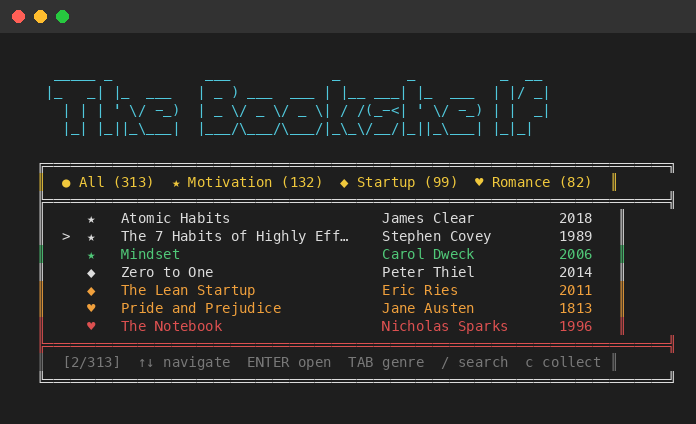
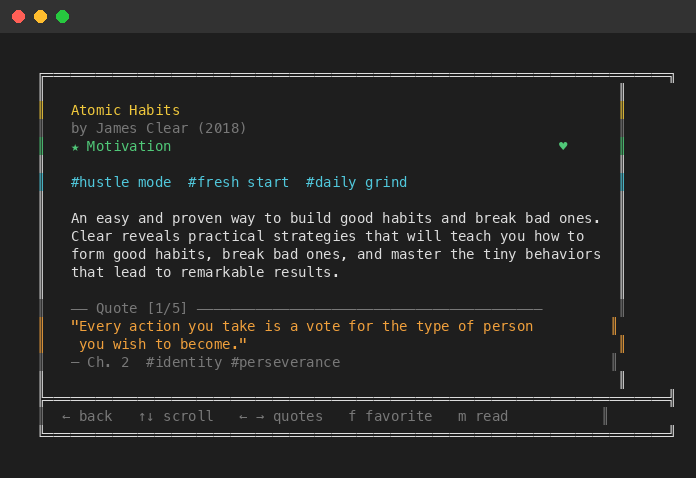
Terminal library
bookshelf
| Key | Action |
|---|---|
Up / Down / j / k |
Navigate |
Enter / Right |
Open a book |
Tab / Shift+Tab |
Cycle genres |
/ |
Search |
c |
Open reading lists |
r |
Pick a random book |
f |
Toggle favorite |
m |
Mark as read |
w |
Add to want-to-read |
? |
Show help |
q |
Go back or quit |
Favorites, reading lists, statistics, hook counters, and ambient settings remain
local under the platform application-data directory named bookshelf.
Development
python3 -m unittest discover -s tests -v
python3 -m compileall -q bookshelf hooks scripts tests
python3 -m pip wheel . --no-deps --no-build-isolation --wheel-dir dist
See CONTRIBUTING.md for catalog corrections and code contributions.
License
The application code is MIT licensed. Book titles, author names, summaries, and quoted text have separate provenance and rights considerations described in DATA.md.
No comments yet
Be the first to share your take.