
awaithumans — HITL infrastructure for AI agents
Your agents already await promises. Now they can await humans.






Docs · Quickstart · Examples · Discord
HITL infrastructure for AI agents — open source. A single primitive (await_human() / awaitHuman()) your agent calls when it needs a human. A real person reviews via Slack / email / a built-in dashboard, submits a typed response, and your agent resumes — like awaiting any other promise.
from awaithumans import await_human
from pydantic import BaseModel

class Decision(BaseModel):
    approved: bool
    note: str | None = None

decision = await await_human(
    task="Approve refund request",
    payload_schema=RefundRequest,
    payload=RefundRequest(order_id="A-4721", amount_usd=180),
    response_schema=Decision,
    timeout_seconds=900,
)

if decision.approved:
    process_refund(...)
The agent waits on decision like it waits on any other Promise or Future.
A human gets notified (Slack, email, dashboard), reviews the request, and
submits a typed response. The agent resumes with the typed answer.

The problem
Every production agent hits a wall where the model can't or shouldn't proceed alone. Three distinct walls, each permanent:
- Judgment. The agent has the information but can't be trusted to decide. High liability, regulation, or consequence — KYC approvals, refund sign-offs, content moderation escalations. A human carries the accountability.
- System-uncertainty. The agent doesn't know the state of the world. The source of truth is in a bank dashboard, a partner system, a manual file. No model can close this gap. A human investigates and tells the agent what's true.
- Embodiment. The task requires a real person — signing, calling, picking something up, passing a CAPTCHA. Not a model problem.
Better models don't solve walls 2 and 3. awaithumans makes the call
to a human a first-class primitive instead of a pile of bespoke glue
per project.
Why awaithumans
| awaithumans | humanlayer | DIY glue code | |
|---|---|---|---|
| Maintained | ✅ Active development | ❌ Abandoned | — |
| Setup time | One command (awaithumans dev) |
Per-customer rebuild | Weeks |
| Channels | Slack + email + built-in dashboard | Slack only | Build each yourself |
| Typed responses | ✅ Pydantic (Python) / Zod (TS) — schema-validated end to end | Partial | Build each yourself |
| Restart-safe | ✅ Stripe-style idempotency — agent resumes across restarts | ❌ | Build each yourself |
| AI pre-verification | ✅ Claude / OpenAI / Gemini / Azure — pre-check the human's answer before the agent trusts it | ❌ | Build each yourself |
| Workflow engines | ✅ Temporal + LangGraph adapters — hand the wait to the engine | ❌ | Build each yourself |
| Self-hostable | ✅ Docker + Postgres in one command | SaaS-only | — |
| License | Apache 2.0 (patent grant) | — | — |
Built by engineers who hit the HITL wall three times in production fintech and ScaleBrick agent systems — and watched the only OSS alternative get abandoned by its founder over per-customer-fork creep. The architecture has exactly four extension points (channels, verifiers, routers, task-type handlers) so no single customer can push the core into the same trap.
Quick start
60 seconds. Two terminals. First-time setup needs a browser click; everything else is paste-and-run.
Terminal 1 — server + dashboard:
pip install "awaithumans[server]" && awaithumans dev
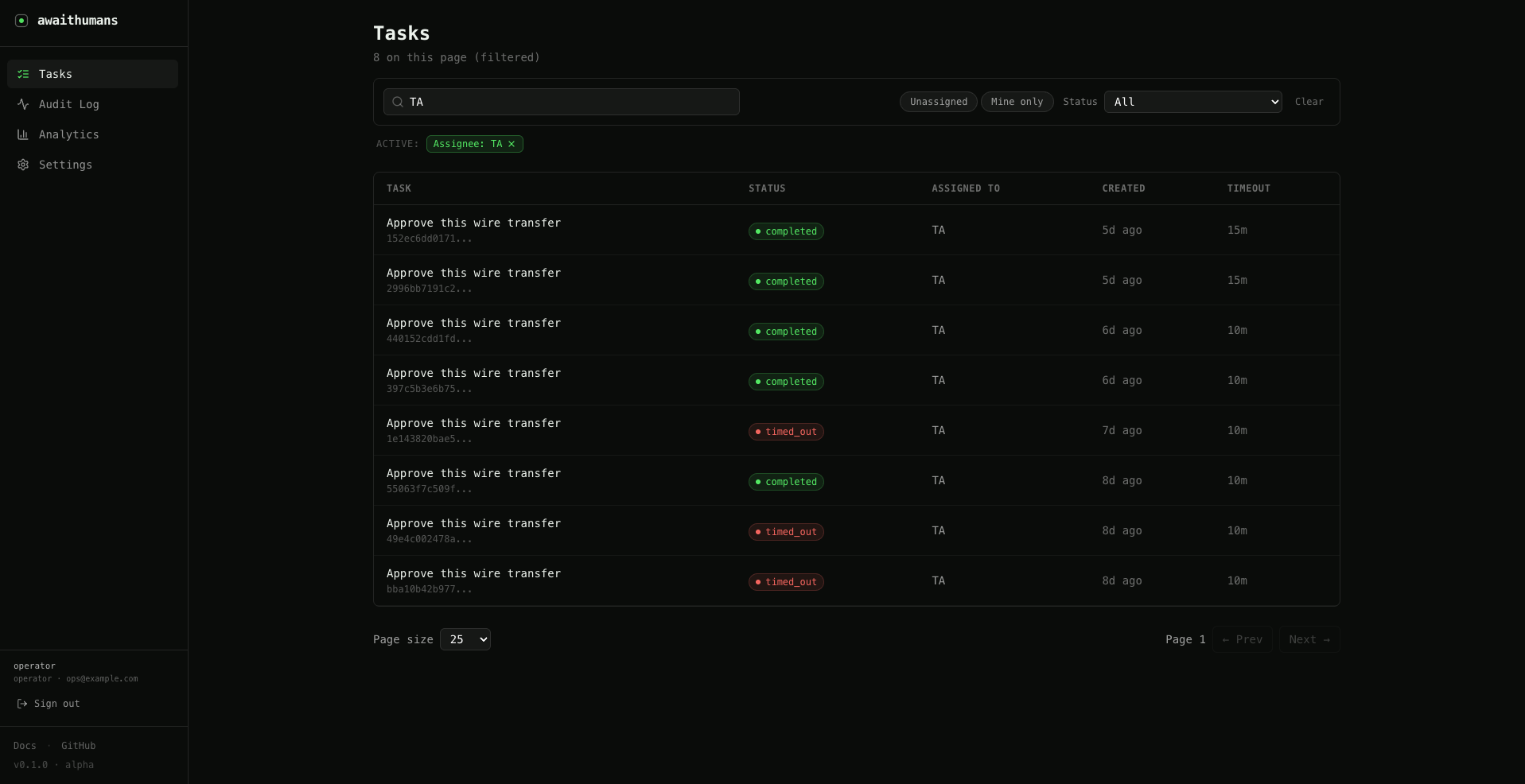
Click the setup URL it prints, create your operator account. The dashboard is now at http://localhost:3001.
Terminal 2 — paste this whole block:
pip install awaithumans pydantic && cat > /tmp/refund.py <<'PY'
from awaithumans import await_human_sync
from pydantic import BaseModel

class RefundRequest(BaseModel):
    order_id: str
    amount_usd: float

class Decision(BaseModel):
    approved: bool

d = await_human_sync(
    task="Approve refund of $180?",
    payload_schema=RefundRequest,
    payload=RefundRequest(order_id="A-4721", amount_usd=180),
    response_schema=Decision,
    timeout_seconds=300,
)
print("approved" if d.approved else "rejected")
PY
python /tmp/refund.py
The script blocks. Open the dashboard, click the pending task, hit Approve. The script unblocks with the typed Decision.
That's the full loop. From here, swap the schema for your own, add notify=["slack:#ops", "email:[email protected]"] to route the task elsewhere, or wrap the call in a Temporal / LangGraph workflow.
More examples — refund, KYC, content moderation, Slack-native, Temporal, LangGraph — in examples/.
What you can build with it
Real production patterns this primitive collapses into a single function call:
- High-value approvals — refunds above a threshold, wire transfers, plan upgrades, contract renewals. Agent prepares the case (Pydantic payload), human signs off with a typed decision (approved + reason).
- KYC / identity review — agent flags borderline documents, human inspects, sends back
verified: boolwith notes. Pair withverifier=verify_with_claude(...)to pre-check the reviewer's reasoning. - Content moderation escalation — AI tags a borderline post; instead of hard-deciding, it calls
await_human()with the content + AI's reasoning + a Switch for keep/remove. Reviewer's decision flows back into the moderation pipeline. - Agent-generated code review — your LLM drafts a pull request; before merge, the agent waits for a human to approve via Slack. The "Claim this task" button assigns it to whoever's on rotation.
- Customer-success escalation — support agent answers FAQs; on a complex thread, it escalates to a human with the full transcript as the payload. Human writes the reply, agent posts it.
- Scrape-and-CAPTCHA fallback — automation hits a CAPTCHA wall, calls
await_human()with the screenshot, a human solves it, agent resumes the scrape.
Anything where an LLM's confidence is too low, the liability too high, or the source of truth lives outside the model's reach — it's HITL-shaped, and this primitive fits.
Complete tasks in Slack
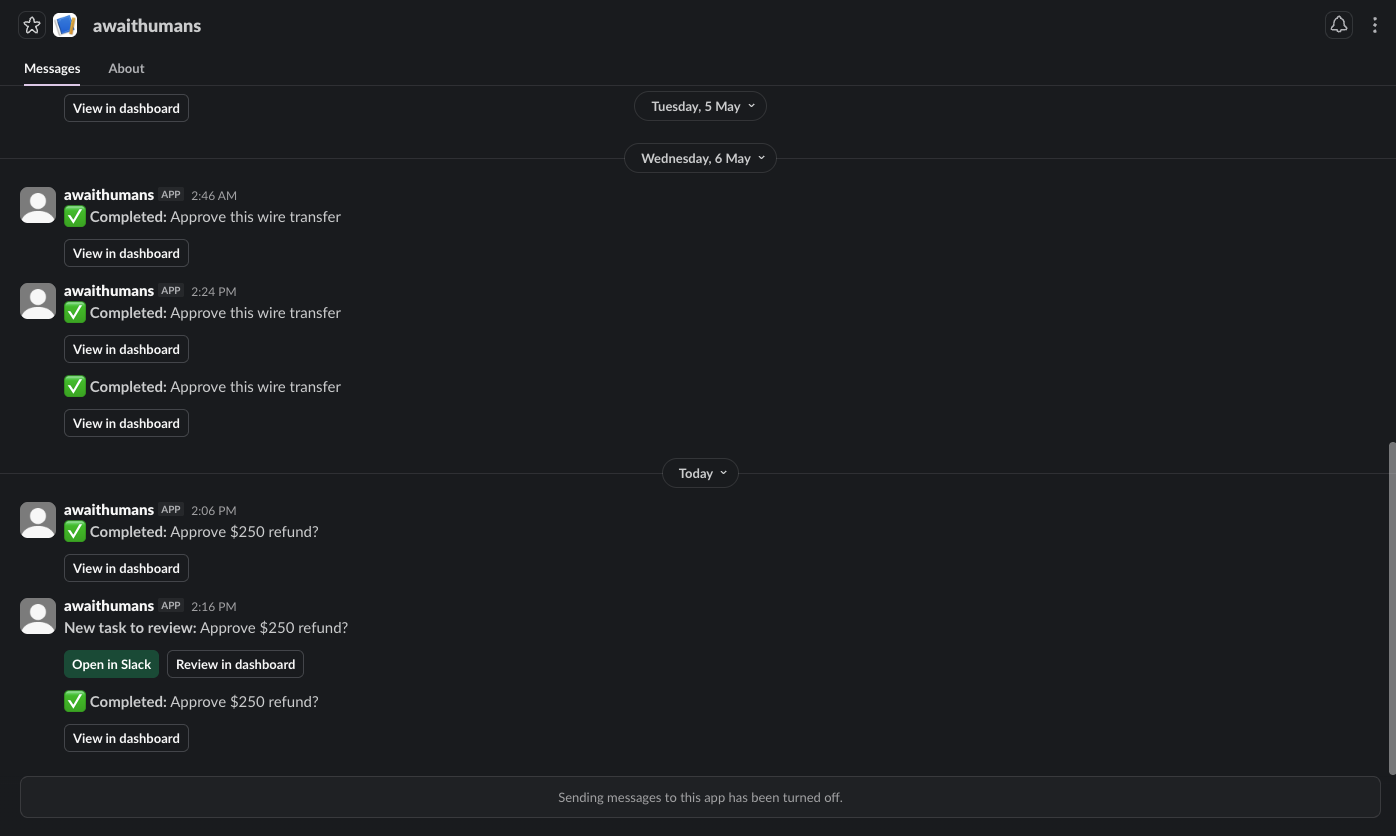
Add notify=["slack:#ops"] and the task lands in the channel with a
"Claim this task" button. First clicker atomically wins; their
response form opens as a modal. Completing it unblocks the agent
just like the dashboard path.
decision = await await_human(
    task="Approve refund",
    payload_schema=RefundRequest,
    payload=RefundRequest(order_id="A-4721", amount_usd=250),
    response_schema=Decision,
    timeout_seconds=900,
    notify=["slack:#ops"],
)
Works for direct messages too (slack:@U01ABC234) and email
(email:[email protected]).
Durable mode
When your agent runs inside a workflow engine, you don't want a long-poll hanging on the orchestrator's thread for 15 minutes. The Temporal and LangGraph adapters hand the wait to the engine itself:
Temporal — signal-based suspend + callback:
from awaithumans.adapters.temporal import await_human_temporal

decision = await await_human_temporal(
    task="Approve refund",
    payload_schema=RefundRequest,
    payload=...,
    response_schema=Decision,
    timeout_seconds=900,
)
LangGraph — interrupt/resume:
from awaithumans.adapters.langgraph import await_human_langgraph
Same await_human shape, same typed response. The adapter just
changes how the wait is orchestrated.
AI verification
Ask an AI to pre-check the human's work before the agent trusts it. Catches the "human clicked approve without reading" case:
from awaithumans.verifiers.claude import verify_with_claude

decision = await await_human(
    task="Approve refund",
    payload_schema=RefundRequest,
    payload=...,
    response_schema=Decision,
    verifier=verify_with_claude(
        instructions="Reject if the note contradicts the approval.",
        max_attempts=2,
    ),
)
The verifier runs after each human submission. If it fails, the task is re-sent to the human with the verifier's reason attached.
TypeScript
npm install awaithumans
import { awaitHuman } from "awaithumans";
import { z } from "zod";

const RefundRequest = z.object({
  orderId: z.string(),
  amountUsd: z.number(),
});

const Decision = z.object({
  approved: z.boolean(),
});

const decision = await awaitHuman({
  task: "Approve refund",
  payloadSchema: RefundRequest,
  payload: { orderId: "A-4721", amountUsd: 180 },
  responseSchema: Decision,
  timeoutMs: 900_000,
});
Full walkthrough: examples/quickstart-ts/.
The server + dashboard are Python — TypeScript runs npx awaithumans dev (via uv) so you never touch a Python env.
Self-hosted
docker run -p 3001:3001 ghcr.io/awaithumans/awaithumans-human-in-the-loop-ai-agents:latest
Note on the image name. The canonical image is
ghcr.io/awaithumans/awaithumans-human-in-the-loop-ai-agents. The shorterghcr.io/awaithumans/awaithumansfrom earlier release notes is deprecated and frozen at a pre-rename build — older docs and blog posts pointing there pull a stale image. Update any pipelines or compose files referencing the short name.
Or docker compose up with the included docker-compose.yml
(optional Postgres block inside). Backs everything — API, dashboard,
channels — from one image.
Managed: AwaitVerify
If your use case is document verification and you would rather not run the infrastructure or recruit reviewers yourself, AwaitVerify is the managed service we sell on top of this primitive. We provide the humans, the ops, and the SLA. You keep the same one-function-call integration.
from awaithumans import verify_document  # also aliased as awaitVerify
from pydantic import BaseModel

class LineItem(BaseModel):
    sku: str
    qty: int
    unit_price_cents: int

class Invoice(BaseModel):
    invoice_number: str
    total_cents: int
    line_items: list[LineItem]

result = await verify_document(
    document_path="./invoice.pdf",
    prior_extraction={
        "invoice_number": "INV-4471",
        "total_cents": 12000,
        "line_items": [...],
    },
    response_schema=Invoice,
    priority="standard",                          # or "high" for the Express queue
    api_key=os.environ["AWAITHUMANS_API_KEY"],
)
$0.80 per page standard. $0.60 at 1,000+ pages/month. Custom at 10,000+. The Express SLA (30-minute target during Mon-Fri 8am-8pm ET, best-effort outside) runs at 2x the rate and is triggered by priority="high".
The SDK fragments the document client-side into five masked views before any upload. The full unfragmented document never leaves your environment. Fragments are encrypted in transit (TLS 1.2+) and at rest (AES-256-GCM with per-task data keys destroyed on reviewer submit).
Sign up at app.awaithumans.dev · Pricing · Security
Architecture
- Core primitive: one function,
await_human()/awaitHuman(), typed-in-typed-out. - Task store: SQLite in dev, Postgres in prod. Idempotency keys, atomic state transitions, audit trail.
- Channels: Slack + email today. Plug in your own by implementing
a small interface (
server/channels/). - Verifiers: Claude today, OpenAI, Gemini, and Azure OpenAI shipped; any provider is a one-file adapter.
- Router: least-recently-assigned over a user directory with
free-form
role/access_level/poollabels. - Task-type handlers: forms auto-generated from your Pydantic / Zod schema, rendered per channel (Slack Block Kit, email, web form).
Every customization flows through one of these four buckets. That's the entire extension surface.
Documentation
- Quickstart:
examples/quickstart/ - Full docs: docs.awaithumans.dev
- Contributing:
CONTRIBUTING.md - Security policy:
SECURITY.md
Built with awaithumans?
Drop this badge in your project's README so folks know where the HITL primitive came from:

[](https://github.com/awaithumans/awaithumans-human-in-the-loop-ai-agents)
Or generate a generic variant via shields.io:
[](https://github.com/awaithumans/awaithumans-human-in-the-loop-ai-agents)
Troubleshooting
If something isn't working, run the pre-flight check first:
awaithumans doctor
It scans your environment for the most common misconfigurations —
missing or malformed PAYLOAD_KEY, Slack token issues, unreachable
database, Docker bind-mount gotchas — and prints a clear report with
actionable fixes. Catches ~80% of first-run issues in under 2 seconds.
Packages
| Package | Registry | License |
|---|---|---|
awaithumans (Python SDK + server + CLI + dashboard) |
PyPI | Apache 2.0 |
awaithumans (TypeScript SDK) |
npm | Apache 2.0 |
ghcr.io/awaithumans/awaithumans-human-in-the-loop-ai-agents (container) |
GHCR | Apache 2.0 |
License: Apache License 2.0. Permissive, OSI-approved, with an explicit patent grant. Use it in proprietary stacks, fork it, ship it inside paid products — no fee, no contact required. The only thing the license asks is that you preserve the notice and don't use the project's trademarks without permission.
Status
v0.1.0 — public preview. Released 2026-05-11.
The full primitive, all three channels (dashboard / Slack / email), both durable adapters (Temporal / LangGraph), AI verification across four providers, and one-command self-hosting are all live in this release.
This is a young project — APIs are stable for v0.x, but expect rough edges in the long tail. File issues, open PRs, drop questions in Discussions or Discord. Every reproducible bug report shipped with a fix in v0.2.
For the post-launch roadmap — local task book for runtimes without an orchestrator, custom router strategies, post-launch hardening — see Roadmap & help wanted.
Contributors
awaithumans is built by the maintainers and these brilliant community contributors.
Want to be on this list? Pick a good first issue, drop a comment on it to claim, and we'll review your PR within ~24h. As we grow, this gallery shrinks each avatar back down to a tight grid — same shape, more faces.
No comments yet
Be the first to share your take.