
AMA: Adaptive Memory via Multi-Agent Collaboration
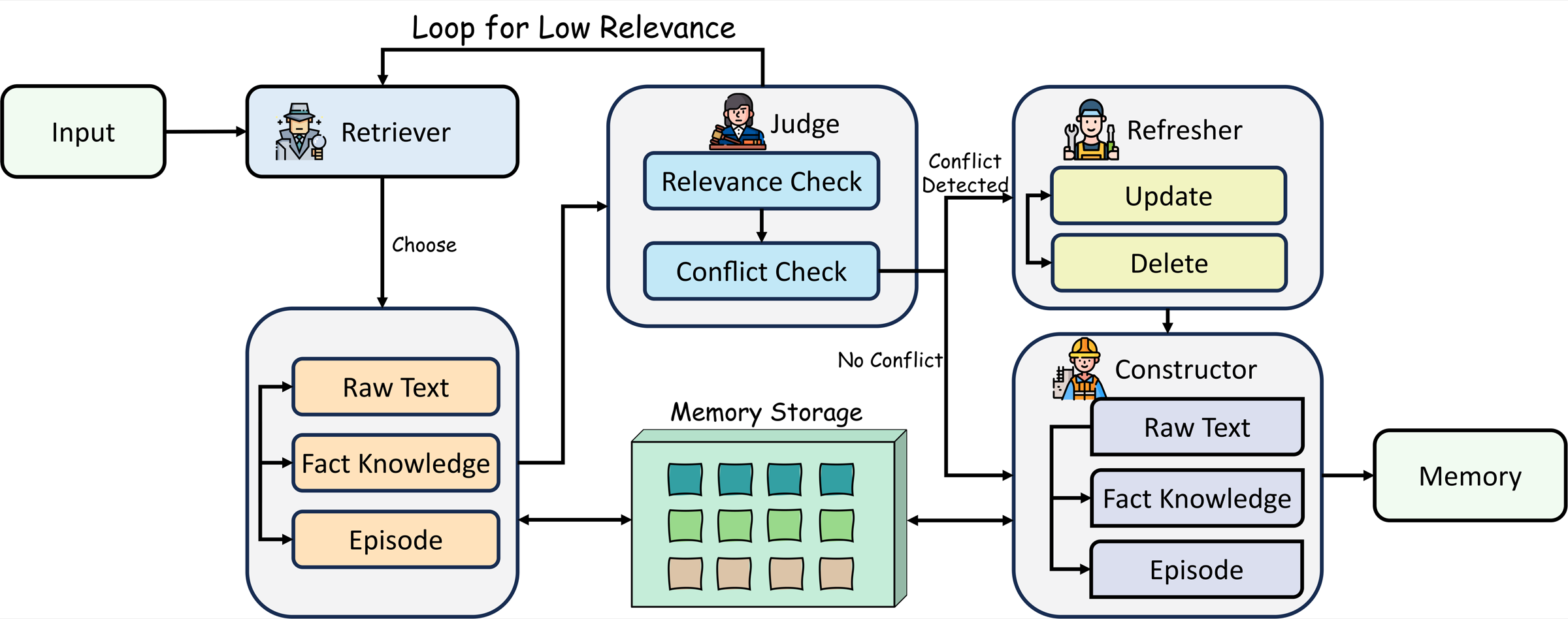
AMA is a long-term memory framework for LLM agents. It coordinates four specialized agents—Constructor, Retriever, Judge, and Refresher—to build multi-granular memories, route each query to the appropriate granularity, verify retrieved evidence, and keep evolving knowledge consistent.
This repository contains:
- the research implementation used to study AMA;
- an OpenAI-compatible Python sidecar backed by SQLite and FAISS;
- an OpenClaw memory plugin with automatic recall and capture;
- reproducibility, architecture, and deployment documentation.
Overview
| Agent | Responsibility |
|---|---|
| Constructor | Builds raw-text, fact-knowledge, and episodic memories. |
| Retriever | Rewrites queries and adaptively routes them to the best memory granularity. |
| Judge | Checks relevance and logical consistency, requesting another retrieval round when needed. |
| Refresher | Updates or removes conflicting memories to preserve temporal consistency. |
With GPT-4o-mini on LoCoMo, AMA reaches an overall LLM score of 0.774. At the default retrieval depth (K_r=2), it processes 3,613 tokens—about 19% of the 18,625-token FullContext input—and records 3.91 s latency versus 7.21 s for FullContext. On LongMemEval(_s), AMA reaches 0.698 average accuracy and 0.897 on knowledge-update questions.
Installation
Requirements
- Python 3.10+
- Node.js 22.22.3+ (Node.js 24.15+ is also supported)
- pnpm 11+
- an OpenAI-compatible chat-completions endpoint and embedding endpoint
Set up the repository
git clone https://github.com/Sherlockwz/AMA.git
cd AMA
corepack enable pnpm
./scripts/setup.sh
Configure credentials in your shell. Do not commit API keys.
export AMA_LLM_API_KEY="your-api-key"
export AMA_LLM_BASE_URL="https://api.openai.com/v1/chat/completions"
export AMA_EMBEDDING_URL="https://api.openai.com/v1/embeddings"
The implementation accepts any provider exposing compatible chat-completions and embeddings APIs. Copy .env.example when you need a local template.
OpenClaw plugin
Install the local checkout during development:
openclaw plugins install --link .
openclaw plugins enable openclaw-ama
Then add the following to ~/.openclaw/openclaw.json:
{
  plugins: {
    slots: { memory: "openclaw-ama" },
    allow: ["openclaw-ama"],
    entries: {
      "openclaw-ama": {
        enabled: true,
        hooks: {
          allowConversationAccess: true
        },
        config: {
          llmApiKey: "${AMA_LLM_API_KEY}",
          llmBaseUrl: "${AMA_LLM_BASE_URL}",
          embeddingApiUrl: "${AMA_EMBEDDING_URL}",
          dataDir: "./ama-data",
          sidecarAutoStart: true,
          autoRecall: true,
          autoCapture: true
        }
      }
    }
  }
}
allowConversationAccess is OpenClaw's explicit permission for the agent_end hook to read the completed turn. It is required for autoCapture; omit it and set autoCapture: false if you only want explicit tool-based writes.
Restart the OpenClaw gateway and verify the integration:
openclaw ama doctor
openclaw ama stats
openclaw ama search "What do you remember about me?"
See the complete OpenClaw setup guide for Git installation, manual sidecar startup, configuration options, tools, and troubleshooting.
Research code
The original Python implementation lives in python/AdaptiveMemory. For a direct sidecar smoke test:
.venv/bin/python -m uvicorn python.server:app --host 127.0.0.1 --port 8321
curl http://127.0.0.1:8321/health
Evaluation entry points are in python/AdaptiveMemory/Core. Benchmark datasets are not redistributed in this repository; follow the reproduction guide to obtain and place them.
Repository structure
AMA/
├── python/AdaptiveMemory/   # research implementation
├── python/server.py         # local HTTP sidecar
├── backend/                 # OpenClaw ↔ sidecar adapter
├── tools/                   # six agent-callable AMA tools
├── docs/                    # guides, project page, and paper figures
├── tests/                   # TypeScript and Python unit tests
├── index.ts                 # OpenClaw plugin entry
├── openclaw.plugin.json     # plugin manifest
└── SKILL.md                 # agent-facing operating instructions
Validation
./scripts/check.sh
This runs strict TypeScript checks, Vitest, Python unit tests, Python bytecode compilation, and the production bundle.
Citation
If AMA helps your work, please cite:
@inproceedings{huang-etal-2026-ama,
  title     = {{AMA}: Adaptive Memory via Multi-Agent Collaboration},
  author    = {Huang, Weiquan and Wang, Zixuan and Lin, Hehai and Wang, Sudong and Xu, Bo and Li, Qian and Zhu, Beier and Yang, Linyi and Qin, Chengwei},
  booktitle = {Findings of the Association for Computational Linguistics: ACL 2026},
  year      = {2026},
  pages     = {3099--3120},
  doi       = {10.18653/v1/2026.findings-acl.152},
  url       = {https://aclanthology.org/2026.findings-acl.152/}
}
Machine-readable citation files are available as CITATION.cff and CITATION.bib.
Contributing
Bug reports, reproducibility notes, documentation improvements, and integrations are welcome. Please read CONTRIBUTING.md and use the issue templates.
License
Released under the Apache License 2.0.
No comments yet
Be the first to share your take.