
AI Team OS
Your AI coding tool stops when you stop prompting. Ours doesn't.
⚡ v1.10.2 — Cross-session orchestration: wake system v2 (dynamic /loop, event watcher, turn-end guard) + targeted sibling-session driving + agent reuse recommendation + context watermark observability. Patch: server event-write exactly-once + model-tier charter (Fable orchestrates, Opus executes).





168 MCP tools · 217 REST endpoints · 22 dashboard pages · 1,758 tests · 25 agent templates · 47 ecosystem research tools · 5 machine-checked invariants
AI Team OS turns Claude Code into a self-driving AI company. You're the Chairman. AI is the CEO. Set the vision — the system executes, learns, and evolves autonomously.
The Problem With Every Other AI Tool
Every AI coding assistant works the same way: you prompt, it responds, it stops. The moment you step away, work stops. You come back to a blank prompt.
AI Team OS works differently.
You walk away at night. The next morning you open your laptop and find:
- The CEO checked the task wall, picked up the next highest-priority item, and shipped it
- When it hit a blocker that needed your approval, it parked that thread and switched to a parallel workstream
- R&D agents scanned three competitor frameworks and found a technique worth adopting
- A brainstorming meeting was organized, 5 agents debated 4 proposals, and the best one was put on the task wall
You didn't prompt any of that. The system just ran.
How It Works
You're the Chairman. The AI Leader is the CEO.
The CEO doesn't wait for instructions. It checks the task wall, picks the highest-priority item, assigns the right specialist Agent, and drives execution. When blocked, it switches workstreams. When all planned work is done, R&D agents activate — scanning for new technologies, organizing brainstorming meetings, and feeding improvements back into the system.
Every interaction makes the system understand you better. Memory System v2 distills your preferences and corrections into a team direction layer that every dispatched Agent inherits at birth — you never say the same thing twice, and no next Agent repeats a pit an earlier one already fell into.
Core Capabilities
1. Cross-Session Orchestration (new in v1.10.0)
A single CC session can now observe and drive its sibling sessions for one operational turn, instead of only being able to spawn brand-new ones:
- Wake system v2: the
/api/wake/actionablesingle-source predicate feeds both the event watcher and the turn-end guard; SessionStart moves from a fixed 30-minute cron to dynamic/loopintervals; a Stop-hook turn-end guard always letsdecision:blockand user-stop keywords pass through; a session-scoped event watcher carries a 1-hour hard timeout. No resident daemons. - Fleet downlink primitive: headless
claude -p --resume <session_id>drives a target sibling session for one turn, reusing the existing wake machinery (semaphore, fuse, allowlist, per-session dedupe, full audit trail). agent_reuse_recommendMCP tool: a three-way reuse decision (reuse / slim-then-reuse / spawn-new) scored by domain match, reachability (live / resumable / cross-session / expired), and context watermark.- Context watermark ledger: exact token usage read from the transcript tail (cheap-checks-first), surfaced as a three-color watermark bar on agent views and on the new fleet / worktree observability cards.
Usage guidance:
- A new session's SessionStart briefing already points you at running
/looponce - follow it instead of guessing at intervals. - Check the project detail page for the fleet card (per-session CEO / model / in-flight tasks / watermark) and the worktree card (branch ownership + unlanded-work status) before you act.
- Call
agent_reuse_recommendbefore dispatching a follow-up agent - reusing a live or resumable sibling session beats spawning a fresh one. - The S4 worktree teardown guard and per-template
isolation: worktreedefaults apply automatically; no configuration is needed.
2. Memory System v2 — two-layer memory, every Agent inherits at birth (new in v1.9.0)
The OS's signature differentiator: your team's preferences, corrections, and hard-won lessons flow automatically to every Agent it dispatches.
- Direction layer (user preferences / corrections / design intent, 4 kinds): resident injection via both the SessionStart and SubagentStart hooks — every sub-Agent inherits the team's values and red lines the moment it's born, so you don't repeat yourself. Size guardrails (<=40 entries x 400 chars),
supersedesswap to prevent bloat, invalidate-never-delete for auditability. - Episodic layer (
task_memosledger): task-level execution memos promoted to a dedicated table (row IDs / invalidation axis / quality score / scope_path), recalled on demand via pure-Python BM25 Chinese retrieval; 123 legacy memos backfilled with zero loss. - On-demand reconcile (
memory_reconcile): zero-LLM BM25 candidate clustering, then merge / invalidate / score / distill on agent confirmation — "the agent computes, the tool persists", with no background resident process introduced.
Surfaces: MCP memory_add / memory_list / memory_invalidate / memory_search / memory_reconcile_candidates / memory_reconcile_apply.
3. Progressive Tool-Loading Governance (new in v1.9.0)
Treats the resident context budget as the scarce resource it is — however many tools exist, they never drown your Agent.
- alwaysLoad dynamic rotation: at session start a single SQL recomputes the hot-tool whitelist by 7-day real call frequency (>=2-day span gate against bursty spikes + 20% hysteresis, hard cap <=5), and CC skips ToolSearch for them. Not additive, not hand-tuned; any stats failure silently degrades to all-defer, and every whitelist is logged for audit.
AITEAM_TOOLSETSgroup switch: 24 capability-domain toolsets; a startup env var decides which modules register.defaultcore profile = task/team/memory/infra/reports (44 tools, hard cap <=50), with incrementaldefault,ecosystem— fits non-CC clients that cap tool counts.AITEAM_READONLYread-only profile: an orthogonal overlay that strips every write tool by explicit allowlist and keeps only read tools — ideal for audit / observer sessions.- 5 templates on least privilege: meeting-facilitator / debate advocate & critic / technical-writer / project-manager carry
disallowedToolsstructural denials; engineering / testing templates untouched.
4. Workflow / ultracode Persistent Observability (v1.7.0)
The OS does not intercept CC's built-in ultracode/Workflow — it becomes its persistent governance layer. Every Workflow run is automatically tracked into the OS, with no manual team_create:
- Auto-tracking: a hook turns each Workflow run into an OS "team" (
workflow-<wf_id>) the moment it starts - Dashboard
/workflows: a live feed of run cards, a phase swimlane timeline, and per-agent telemetry — tokens / duration / status / tool-call counts, advancing live via incremental journal tailing while a run executes - Calibrated stall detection: the stall threshold was calibrated on 3,378 real agent intervals (p99 = 77.6s, longest healthy silence 173.8s) and set at 5.2× the worst healthy case — it flags late rather than crying wolf
- Project-detail integration: workflow team rows carry an inline run summary (status / agent count / duration / finish time) plus a "view swimlane" deep link; members display semantic phase labels (e.g.
audit:sourceA) instead of ids - Leader auto-detection: a project's Leader session / model / liveness is probed directly from the
~/.claude/projects/file truth by the backend — zero registration dependency,/modelswitches surface in real time - MCP tools:
workflow_list(browse runs),workflow_get(full archive + per-agent rows),workflow_reconcile(repair from on-disk snapshots after the OS was offline) - Self-healing ingestion: hook receipt anchors + on-disk snapshot reconciliation + a reaper backstop close offline gaps automatically — finished runs on disk are ingested idempotently; cross-project attribution matches the on-disk path slug against registered projects
5. Ecosystem Research Platform — 47 tools
A project-isolated knowledge base that accumulates research findings over time. Each repo progresses through 4 stages (a progressive funnel, since v1.5.0), with token-efficient triggers and append-only history:
- Stage 0 — Auto shallow-summary on archive: newly-archived repos automatically get a 200-400 char
ai-engineersummary (core function / positioning / advantages). 8-class failure handling with self-learning (3+ same-class fails →pattern_record, future agents read lessons viapattern_search) - Stage 1 — On-demand architecture analysis: user picks research direction ("memory_system") → batch-dispatch
backend-architectagents to read architecture key files - Stage 2 — Multi-perspective debate: triggers existing
debate_start(NOT a built-in debate engine — reuses meeting system) - Stage 3 — Reference / Integrate marking:
mark_as_referenceadds tag for future quick recall;start_integrationtriggers existingtask_createfor actual implementation - Active vs Full dual-view: data is append-only forever. Stars-falling repos kept (just
is_active=False); stars climbing back auto-promotes + re-queues Stage 0 - Dashboard
/ecosystem: list with stage badges + research timeline + project filter dropdown + candidate-filter page (/ecosystem/research) + per-project settings tab — the single largest tool family in the OS
6. Knowledge Layer — Reference Graph + Unified Search (v1.8.0)
Everything the OS records — task memos, reports, tasks — becomes recallable knowledge:
- Reference graph (P1a): a zero-LLM regex extractor mines OS-native ID references (wf_id / commit hash / task uuid /
[[memory]]) out of memos and reports into an append-onlyknowledge_linkstable — the graph is a derived view, rebuildable from source text at any time - Unified search (P1b):
/api/searchfuses three arms via RRF — BM25 full-text (Chinese bigram native), knowledge-graph fanout (an ID query pulls in everything linked to it), and exact ID-prefix / title match - Global search box in the Dashboard header, plus MCP tools
unified_search/link_query/link_trace— recall past work by natural language ("how was the attribution fix done"), awf_id, or a commit hash
Why zero-LLM? The graph is a derived view: plain regexes extract the IDs, the whole graph can be rebuilt from source text at any time, and both extraction and retrieval cost zero tokens. Your recall pipeline never touches your model budget.
7. Task Wall · Meetings · 22-Page Dashboard
Governance ledger and panoramic visualization — everything leaves a trace:
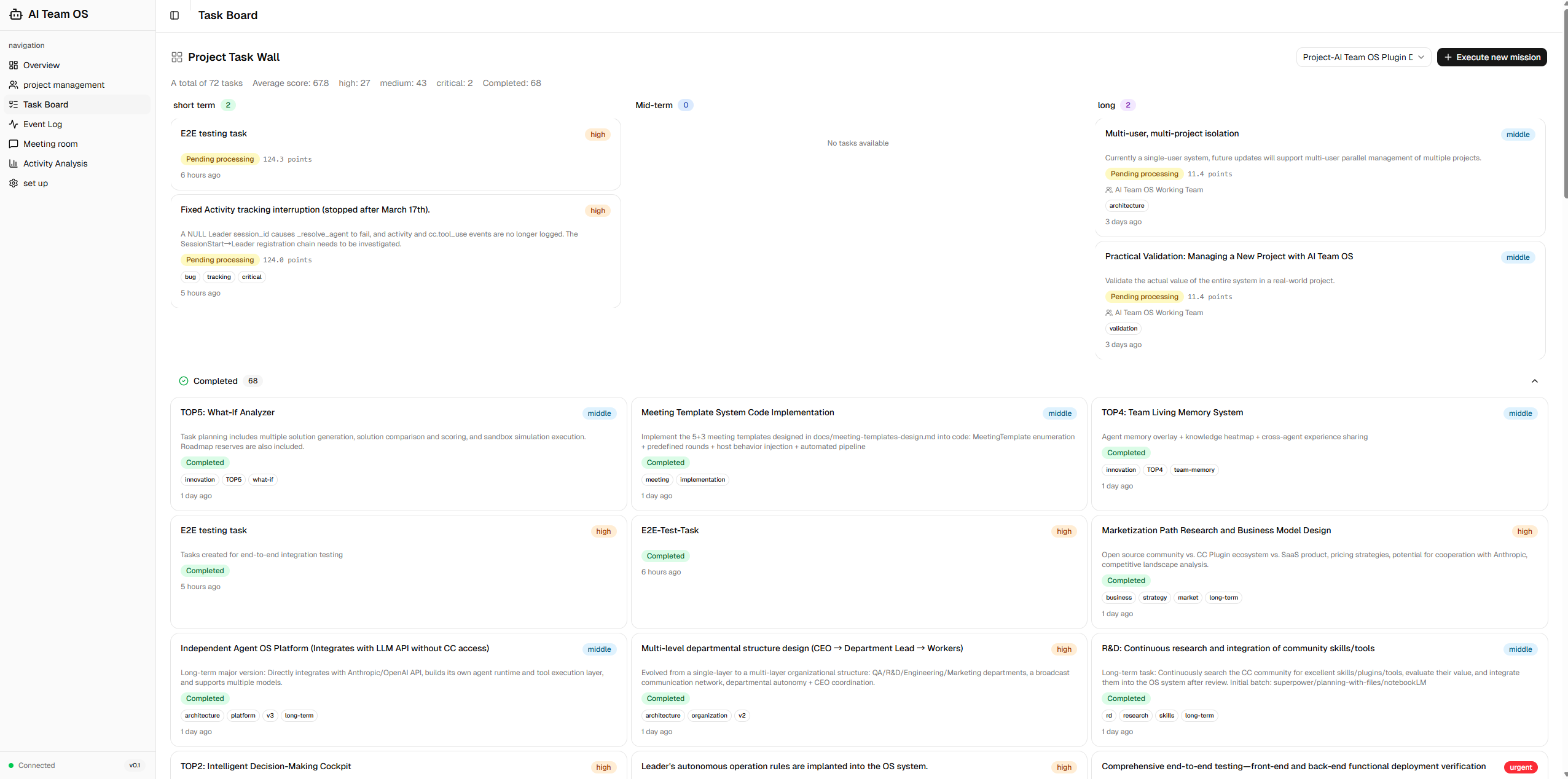
- Task wall: a live board of pending / in-progress / done, event-driven + intelligent Agent matching + deadlock detection
- 8 structured meeting templates (keyword auto-select, built on Six Thinking Hats / DACI / Design Sprint) — every meeting must produce an actionable conclusion; "we discussed but didn't decide" is not an outcome
- 22-page React 19 Dashboard: Command Center /
/workflowsswimlane / decision timeline / meeting room / Ecosystem suite / Model Governance Settings
8. Autonomous Operation
The CEO never idles. It continuously advances work based on task wall priorities:
- Checks the task wall for the next highest-priority item when a task completes
- When blocked on something requiring your approval, parks that thread and switches to parallel workstreams
- Batches all strategic questions and reports them when you return — no interruptions for tactical decisions
- Deadlock detection: if the loop stalls, it surfaces the blocker rather than spinning
And it doesn't just execute — it evolves:
- R&D cycle: research agents scan competitors, new frameworks, and community tools; findings go to brainstorming meetings where agents challenge each other; conclusions become implementation plans on the task wall
9. File Truth as Source of Truth
Most multi-agent stacks trust agents to register themselves and self-report their status. AI Team OS treats self-reports as claims and files as facts — three subsystems already run on this philosophy:
- Leader probing: a project's Leader session, model, and liveness are read straight from
~/.claude/projects/— transcript mtime is liveness, the model name in the transcript tail is the model. We don't ask an agent which model it runs — what's read out of the transcript is what's true. - Model discovery: "available models" = every model that has actually appeared in your CC transcripts. Zero API dependency, zero hardcoded list — a hardcoded list will never contain your third-party gateway model; a transcript scan can't miss it.
- Workflow telemetry: on-disk run files are the full telemetry truth; the OS's projection tables are rebuildable caches of immutable files. Attribution iron law: a run belongs to a project only when its on-disk path slug exactly matches the registered project root — never guessed.
10. Model Governance (v1.8.1)
Know which models you can actually launch — and control what your sessions start on:
- Auto-discovery of genuinely available models: scans every CC transcript on your machine in about a second (60s cache) — including third-party gateway models that no hardcoded list would ever ship
- One-click global default startup model: written to
~/.claude/settings.jsonunder triple write protection — touches only themodelkey, keeps a.bak-aiteambackup, writes atomically, refuses corrupted files - Zero coercion: soft reminders only, never a block — and CC Workflow runs are fully exempt
Surfaces: REST /api/models/{available,default} · MCP model_config_get / model_config_set · the Model Governance card in Dashboard Settings.
11. Team Collaboration
Not a single Agent. A structured organization:
- 25 professional Agent templates (23 base + 2 debate roles) with recommendation engine — Engineering, Testing, Research, Management — ready out of the box
- Department grouping — Engineering / QA / Research with cross-team coordination
- Channel communication:
team:/project:/globalchannels with@mentionsupport - Debate mode: 4-round structured debate (Advocate→Critic→Response→Judge) via
debate_start/debate_code_review - Git automation:
git_auto_commit/git_create_pr/git_status_checkfor streamlined version control - Execution pattern memory: success/failure pattern recording + BM25 retrieval + subagent context injection
12. Full Transparency
Nothing is a black box:
- Decision Cockpit: event stream + decision timeline + intent inspection — every decision has a traceable record
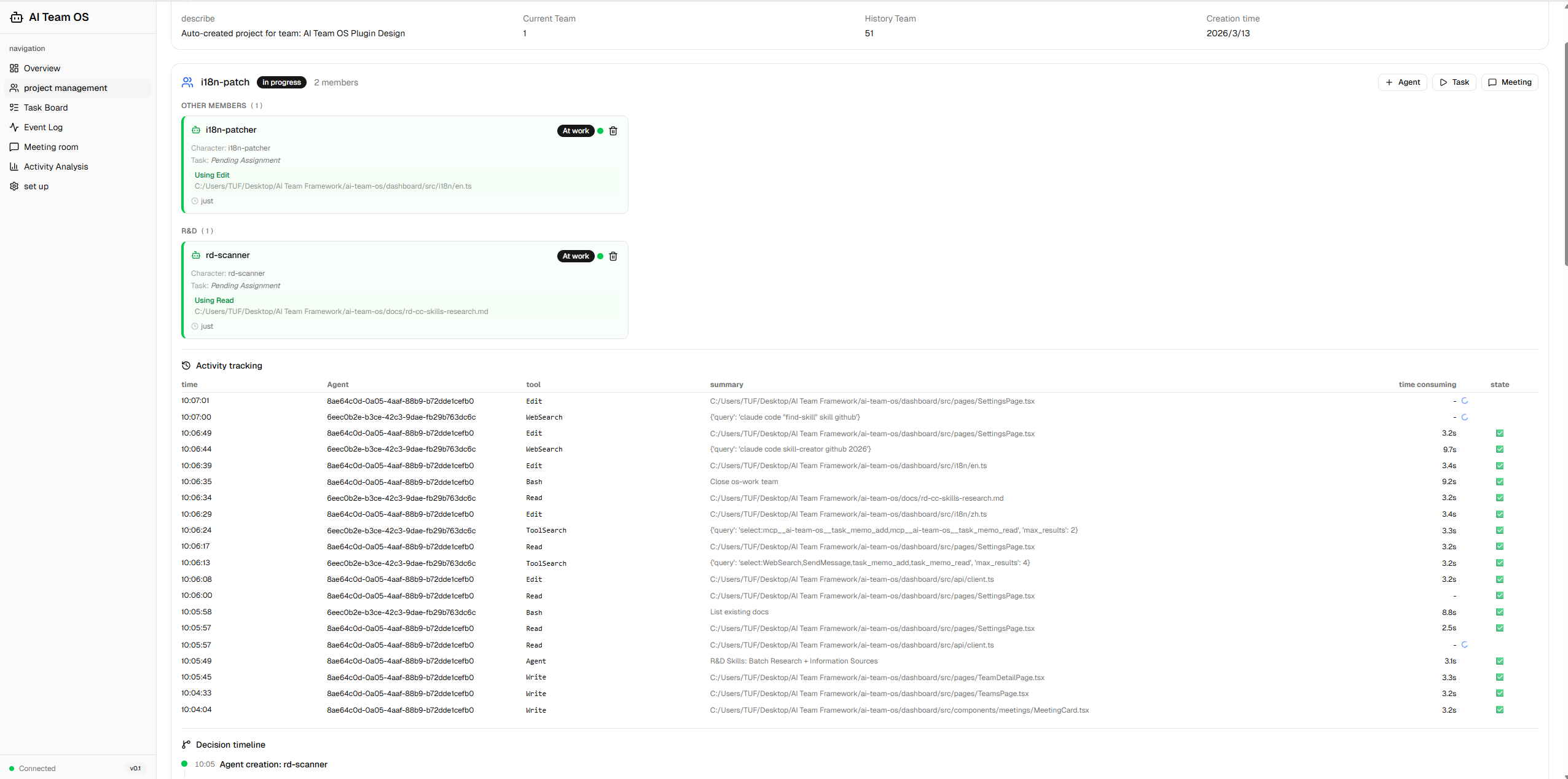
- Activity Tracking: real-time status of every Agent and what it's working on
- What-If Analyzer: compare multiple approaches before committing, with path simulation and recommendations
13. Safety & Behavioral Enforcement
Built-in guardrails so the system can run unsupervised without surprises:
- Guardrails L1: 7 dangerous pattern detections + PII warnings +
InputGuardrailMiddleware - Local agent blocking: all non-readonly agents must declare
team_name/name— prevents rogue background agents - S1 safety rules: regex-based scan catches destructive commands (rm -rf, force push, hardcoded secrets) including uppercase flags and heredoc patterns
- 4-layer defense rule system: 48+ rules covering workflow, delegation, session, and safety layers
- File lock / workspace isolation: acquire/release/check/list + TTL=300s + hook warnings to prevent concurrent edits
- Agent trust scoring: trust_score (0-1) auto-adjusts on task success/failure, weighted into auto_assign
- Agent Watchdog heartbeat:
agent_heartbeat/watchdog_checkwith 5-min TTL — detects stalled or crashed agents automatically - Self-patrol: watchdog lease patrol + reaper reconciliation backstop + identity verification before any kill — the OS keeps eyes on itself, not just on your agents
- SRE error budget model: GREEN/YELLOW/ORANGE/RED 4-level response with sliding window (20 tasks),
error_budget_status/error_budget_updatetools - Completion verification:
verify_completionchecks task status + memo existence — prevents hallucinated "done" reports - Ecosystem integration recipes: 4 preset recipes (GitHub / Slack / Linear / Full-stack team) via
ecosystem_recipes()tool find_skill3-layer progressive discovery: quick recommend → category browse → full detail, reducing tool-call overhead
14. Zero Extra Cost
Runs entirely within your existing Claude Code subscription:
- No external API calls, no extra token spend
- MCP tools, hooks, and Agent templates are all local
- The memory system and knowledge layer are zero-LLM by design — direction-layer injection, graph extraction, search, and reconcile coarse-pass all cost zero tokens
- 100% utilization of your CC plan
More Capabilities (legacy & secondary — still running, queryable on demand)
- Failure Alchemy:
failure_analysisstill runs as part of the loop subsystem — every failed task extracts root cause and produces Antibody (stored in team memory to prevent repeats) / Vaccine (high-frequency failures become pre-task warnings) / Catalyst (analysis injected into future Agent system prompts). No longer the headline, but defensive rules keep accruing. - Pipeline orchestration (Legacy): the built-in 7-template pipeline was retired in v1.7.0, superseded by CC Workflow + the observability layer;
pipeline_create/pipeline_advanceare still registered and existing pipeline data stays readable. - AWARE loop memory ·
find_skill3-layer discovery · Prompt Registry · cross-project messaging · ecosystem integration recipes: see the full tool table below. The scheduler was retired to on-demandecosystem_refresh(CC-is-not-always-on principle).
It Built Itself
AI Team OS manages its own development — and since v1.7.0, it can prove it with its own telemetry:
- Every feature line from v1.7.0 to v1.9.0 — the observability layer, the knowledge layer, model governance, Memory System v2, tool-loading governance — shipped through CC Workflow runs that the OS tracked itself. Open
/workflowsand replay how the system built its own features, swimlane by swimlane. - Competitive research across CrewAI, AutoGen, LangGraph, and Devin feeds the roadmap through multi-agent brainstorming meetings — the minutes live in the OS's own report store.
- It learns from its own incidents, too: every machine-checked invariant in
scripts/check_invariants.shwas distilled from a real accident in this repo's history.
The system that builds your projects... built itself. With receipts.
How It Compares
| Dimension | AI Team OS | CrewAI | AutoGen | LangGraph | Devin |
|---|---|---|---|---|---|
| Category | CC Enhancement OS | Standalone Framework | Standalone Framework | Workflow Engine | Standalone AI Engineer |
| Integration | MCP Protocol into CC | Independent Python | Independent Python | Independent Python | SaaS Product |
| Memory System | Two-layer: direction layer inherited at birth + episodic BM25 ledger + on-demand reconcile | Short-term context | Short-term context | Checkpoint state | In-session |
| Tool-Loading Governance | alwaysLoad rotation + group switch + read-only profile + template least-privilege | None | None | None | None |
| Autonomous Operation | Continuous loop, never idles | Task-by-task | Task-by-task | Workflow-driven | Limited |
| Meeting System | 8 structured templates with auto-select | None | Limited | None | None |
| Failure Learning | Failure Alchemy (Antibody/Vaccine/Catalyst) | None | None | None | Limited |
| Decision Transparency | Decision Cockpit + Timeline | None | Limited | Limited | Black box |
| Workflow Observability | Swimlane timeline + per-agent telemetry + offline reconcile over CC Workflow | None | None | Graph state only | None |
| State Source | File truth — transcripts / journals read directly | Agent self-report | Agent self-report | In-process state | Black box |
| Rule System | 4-layer defense (48+ rules) + behavioral enforcement | Limited | Limited | None | Limited |
| Agent Templates | 25 ready-to-use + recommendation engine | Built-in roles | Built-in roles | None | None |
| Dashboard | React 19 visualization | Commercial tier | None | None | Yes |
| Open Source | MIT | Apache 2.0 | MIT | MIT | No |
| Claude Code Native | Yes, deep integration | No | No | No | No |
| Extra Cost | $0 (CC subscription only) | API costs | API costs | API costs | $500+/mo |
Architecture
┌─────────────────────────────────────────────────────────────────┐
│                     User (Chairman)                              │
│                         │                                       │
│                         ▼                                       │
│                   Leader (CEO)                                   │
│            ┌────────────┼────────────┐                          │
│            ▼            ▼            ▼                          │
│       Agent Templates  Task Wall  Meeting System                 │
│      (25 roles)       Loop Engine  (8 templates)                 │
│            │            │            │                          │
│            └────────────┼────────────┘                          │
│                         ▼                                       │
│              ┌──────────────────────┐                           │
│              │   OS Enhancement Layer│                           │
│              │  ┌──────────────┐    │                           │
│              │  │  MCP Server  │    │                           │
│              │  │ (168 tools)  │    │                           │
│              │  └──────┬───────┘    │                           │
│              │         │            │                           │
│              │  ┌──────▼───────┐    │                           │
│              │  │  FastAPI     │    │                           │
│              │  │  REST API    │    │                           │
│              │  └──────┬───────┘    │                           │
│              │         │            │                           │
│              │  ┌──────▼───────┐    │                           │
│              │  │  Dashboard   │    │                           │
│              │  │ (React 19)   │    │                           │
│              │  └──────────────┘    │                           │
│              └──────────────────────┘                           │
│                         │                                       │
│              ┌──────────▼──────────┐                            │
│              │  Storage (SQLite)   │                            │
│              │  + WAL journaling   │                            │
│              │  + Memory System    │                            │
│              └─────────────────────┘                            │
└─────────────────────────────────────────────────────────────────┘
Five-Layer Technical Architecture
Layer 5: Web Dashboard    — React 19 + TypeScript + Shadcn UI (22 pages)
Layer 4: CLI + REST API   — Typer + FastAPI
Layer 3: Team Orchestrator — LangGraph StateGraph (optional extra — CLI graph execution only)
Layer 2: Memory Manager   — SQLite-backed store + pure-Python BM25 retrieval
Layer 1: Storage          — SQLite (WAL journaling) · PostgreSQL support on the roadmap
Hook System (14 scripts across 12 Lifecycle Events — The Bridge Between CC and OS)
SessionStart     → auto_install.py, session_bootstrap.py, send_event.py
                   — Auto-install deps + inject Leader briefing / core rules / team state
SubagentStart    → inject_subagent_context.py, send_event.py   — Inject sub-Agent OS rules (2-Action etc.)
SubagentStop     → send_event.py                 — Record sub-Agent lifecycle event
PreToolUse       → workflow_reminder.py, pipeline_gate.py, send_event.py
                   — Workflow tracking reminders + pipeline gate + event forwarding
PostToolUse      → workflow_reminder.py, pipeline_gate.py, deep_review_link.py,
                   meeting_ecosystem_writeback.py, send_event.py
TaskCreated      → cc_task_bridge.py             — Bridge CC-native tasks onto the OS task wall
TaskCompleted    → task_completed_gate.py        — Completion gate verification
UserPromptSubmit → context_tracker.py, autopilot_auto_stop.py  — Track context usage + autopilot auto-stop
SessionEnd       → send_event.py                 — Record session end event
Stop             → send_event.py                 — Record stop event
PermissionDenied → permission_denied_recovery.py — Permission-denied self-recovery
PreCompact       → pre_compact_save.py           — Auto-save progress before context compression
Quick Install (AI-Assisted)
Tell Claude Code:
"Read https://github.com/CronusL-1141/AI-company/blob/master/INSTALL.md and follow the instructions to install AI Team OS"
Claude Code will read the install guide and walk you through the setup automatically.
Important: Install AI Team OS to your system Python, not inside a project virtual environment. If installed in a venv, AI Team OS will only work in that specific project. Run
deactivatefirst if a venv is currently active, then install.
Quick Start
Prerequisites
- Python >= 3.11
- uv (
pip install uv) - Claude Code (MCP support required)
- Node.js >= 20 (Dashboard frontend, optional)
Option A: Plugin Install (Recommended — for most users)
# Install uv (Python package runner, required for MCP server)
pip install uv

# Add marketplace + install plugin
claude plugin marketplace add CronusL-1141/AI-company
claude plugin install ai-team-os

# Restart Claude Code — first launch takes ~30s to set up dependencies
# Subsequent launches are instant

# Update to latest version anytime
claude plugin update ai-team-os@ai-team-os
Note: First launch after install takes ~30 seconds while dependencies are automatically configured. This only happens once — subsequent sessions start instantly with 168 MCP tools ready.
Option B: Source Install (for developers — editable, tracks latest source)
# Step 1: Clone the repository
git clone https://github.com/CronusL-1141/AI-company.git
cd AI-company

# Step 2: Run the installer (auto-configures MCP + Hooks + Agent templates + API)
python3 install.py

# Step 3: Restart Claude Code — everything activates automatically
# API server starts automatically when MCP loads. No manual startup needed.
# Verify: run /mcp in CC and check that ai-team-os tools are mounted
Dependencies:
greenlet(needed by SQLAlchemy async on Apple Silicon) is bundled by default.LangGraphis an optional extra — only the CLI graph-execution path needs it:pip install 'ai-team-os[langgraph]'.
Verify Installation
# Check OS health (API must be running — port may vary, check api_port.txt)
curl http://localhost:8000/api/health
# Expected: {"status": "ok"}

# Create your first team via CC
# Type in Claude Code:
# "Create a web development team with a frontend dev, backend dev, and QA engineer"
Tool Loading Configuration (optional)
By default the MCP server registers all 168 tools. Two startup environment variables let you trim the surface for leaner sessions or non-CC clients with tool-count limits (e.g. Cursor only forwards the first 40 tools). Both are read once at server startup - no runtime state, no restart-on-change.
AITEAM_TOOLSETS - pick which capability-domain groups register:
- unset or
all- full 168 (backward compatible) default- core groups only (task,team,memory,infra,reports= 44 tools, hard-capped at <=50)- a comma list of group names, mixable with
defaultfor incremental loading, e.g.AITEAM_TOOLSETS=default,ecosystem - unknown names are warned on stderr and ignored (a config typo never blocks server start)
AITEAM_READONLY=1 - orthogonal overlay that strips every write tool (create/update/delete/apply/send/... plus os_restart_api) after registration, keeping only read tools. Handy for audit/observer sessions.
The 24 groups (default groups marked *):
| Group | Tools | Group | Tools | Group | Tools |
|---|---|---|---|---|---|
| task * | 12 | briefing | 4 | trust | 2 |
| team * | 7 | scheduler | 4 | watchdog | 3 |
| memory * | 9 | task_analysis | 5 | error_budget | 2 |
| infra * | 13 | agent | 6 | file_lock | 4 |
| reports * | 3 | meeting | 10 | git | 3 |
| project | 8 | loop | 7 | channels | 3 |
| pipeline | 3 | analytics | 3 | guardrails | 2 |
| links | 3 | ecosystem | 47 | workflows | 3 |
# Example: lean core + ecosystem, read-only
AITEAM_TOOLSETS=default,ecosystem AITEAM_READONLY=1 <launch CC / MCP server>
Uninstall
# Plugin install:
claude plugin uninstall ai-team-os
# Then manually remove residual data:
# Windows: rmdir /s %USERPROFILE%\.claude\plugins\data\ai-team-os-ai-team-os
# Unix:    rm -rf ~/.claude/plugins/data/ai-team-os-*
# Restart Claude Code to stop active hooks.

# Source install — full cleanup:
python scripts/uninstall.py
# Preview first:
python scripts/uninstall.py --dry-run
Start the Dashboard (optional)
cd dashboard
npm install
npm run dev
# Visit http://localhost:5173
Dashboard Screenshots
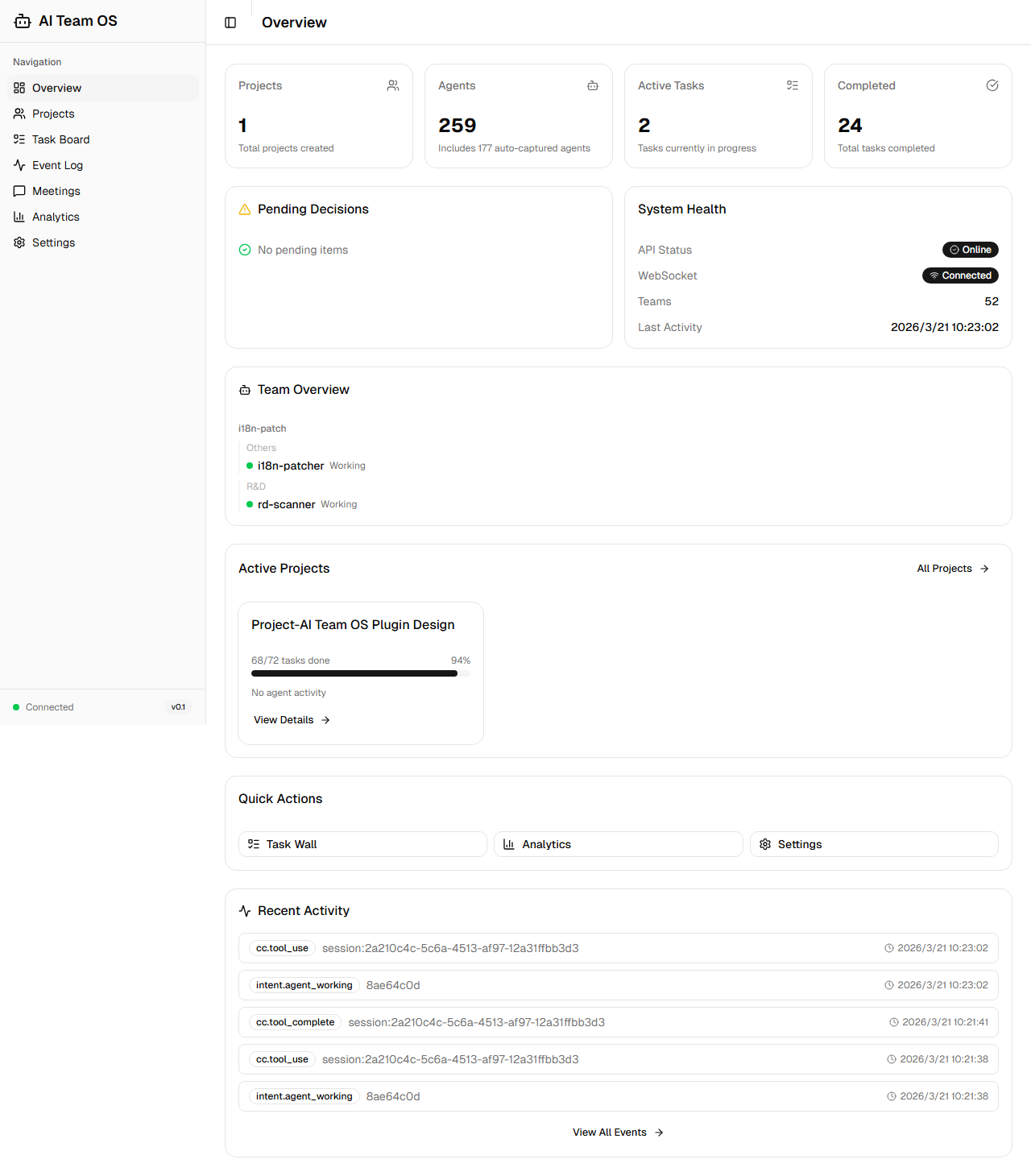
Command Center
Team Working — Live Activity Tracking
Task Board
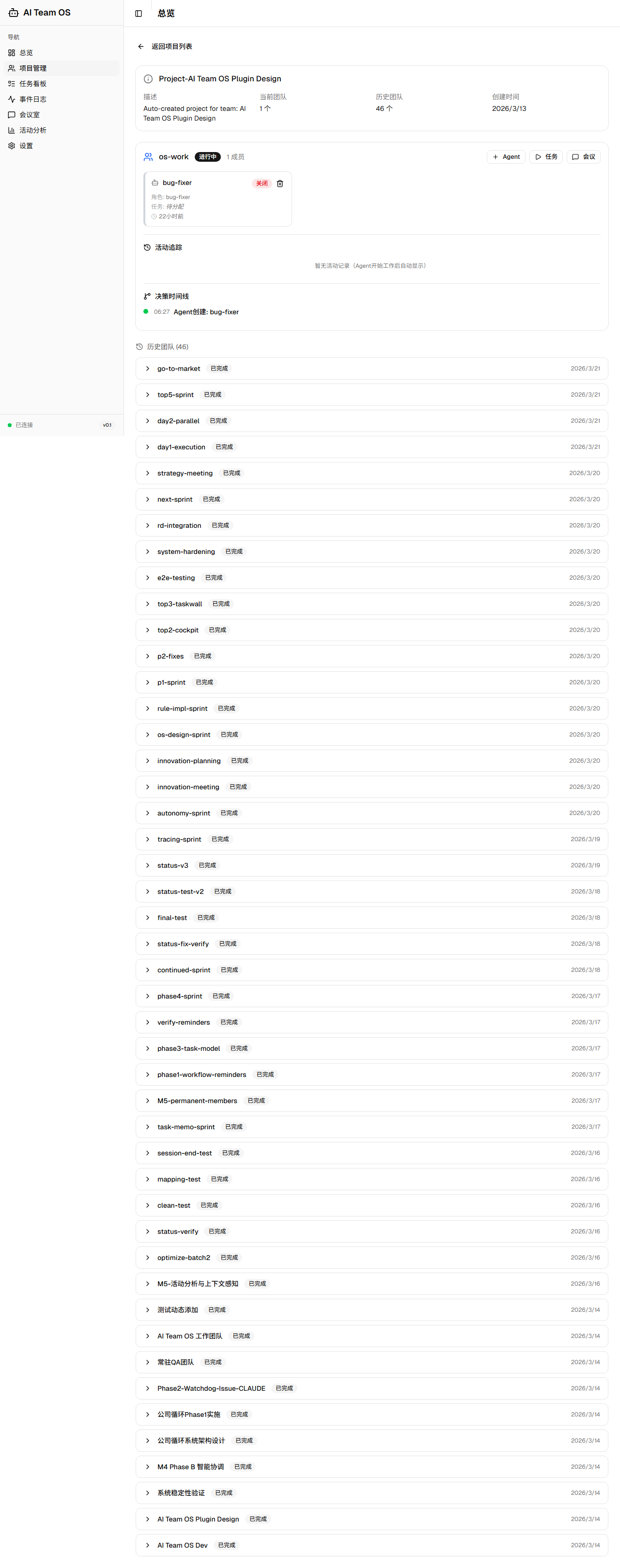
Project Detail — Decision Timeline
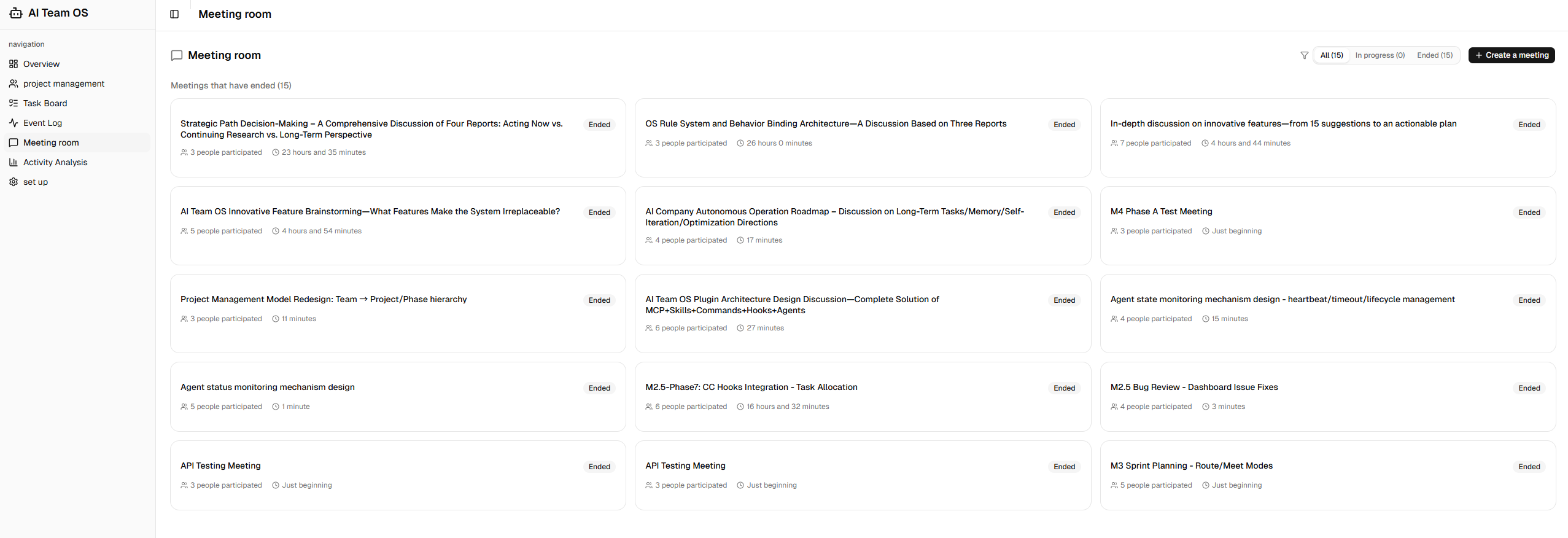
Meeting Room
Ecosystem Research Platform

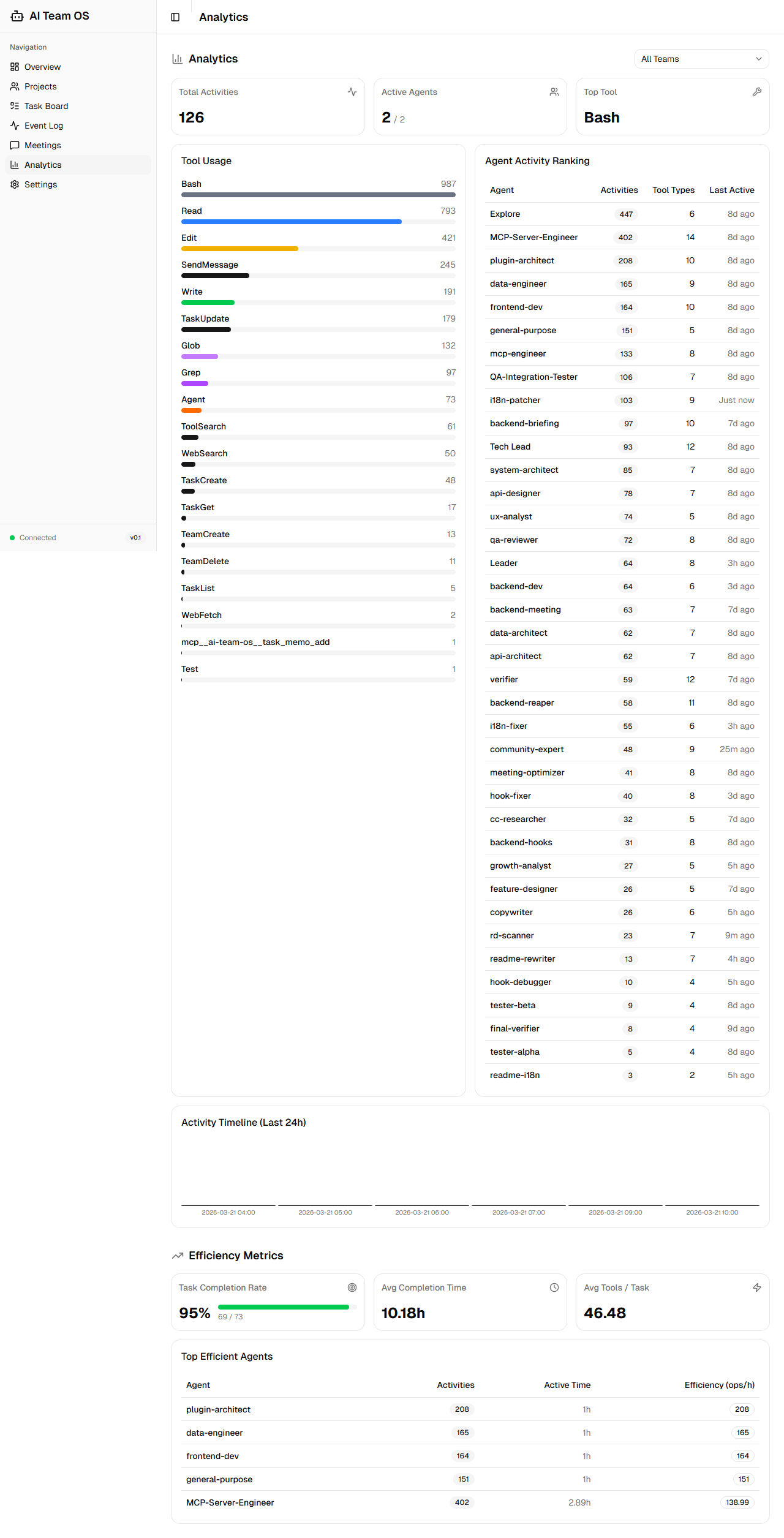
Activity Analytics
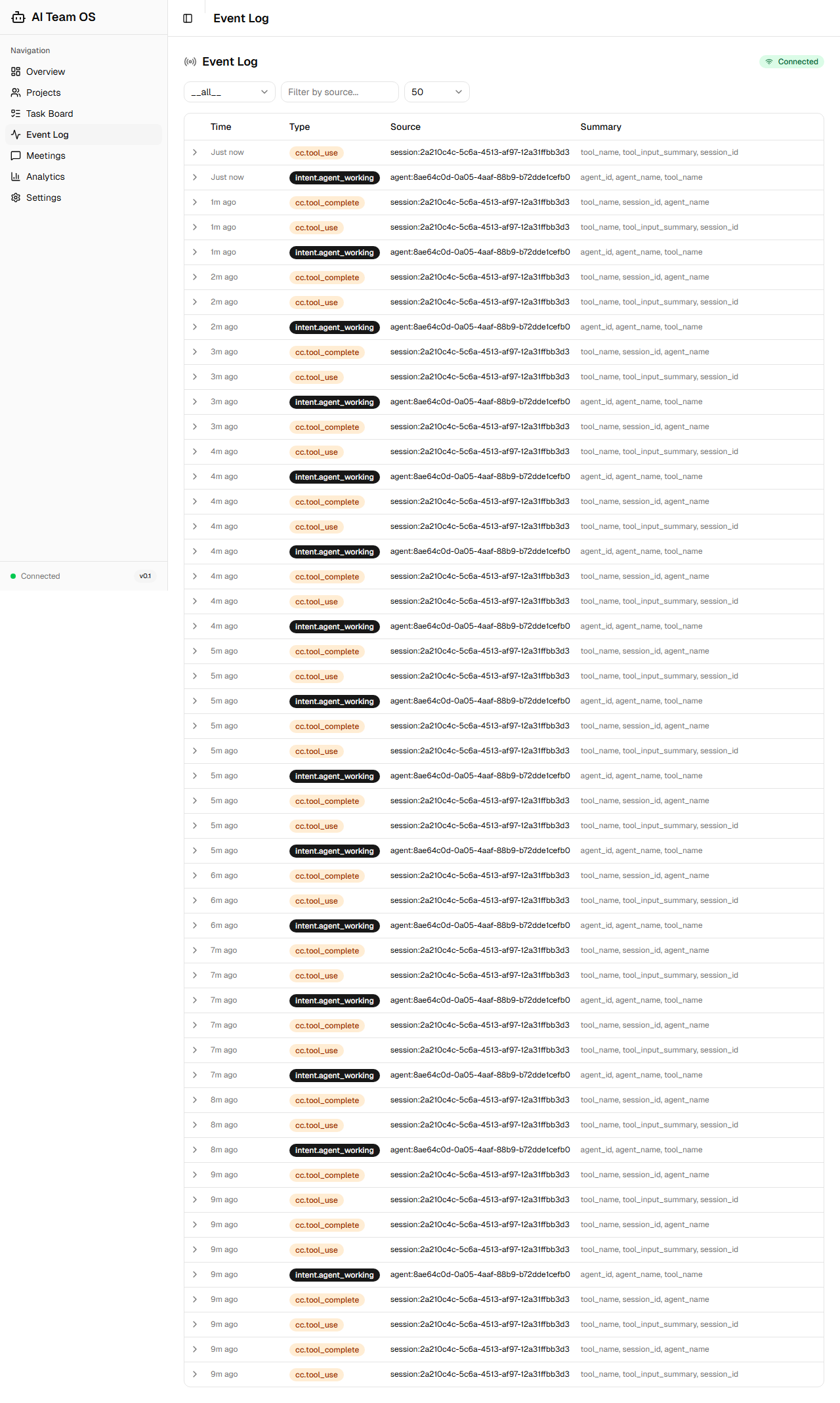
Event Log
Auto-Wake System — Autonomous Task Advancement
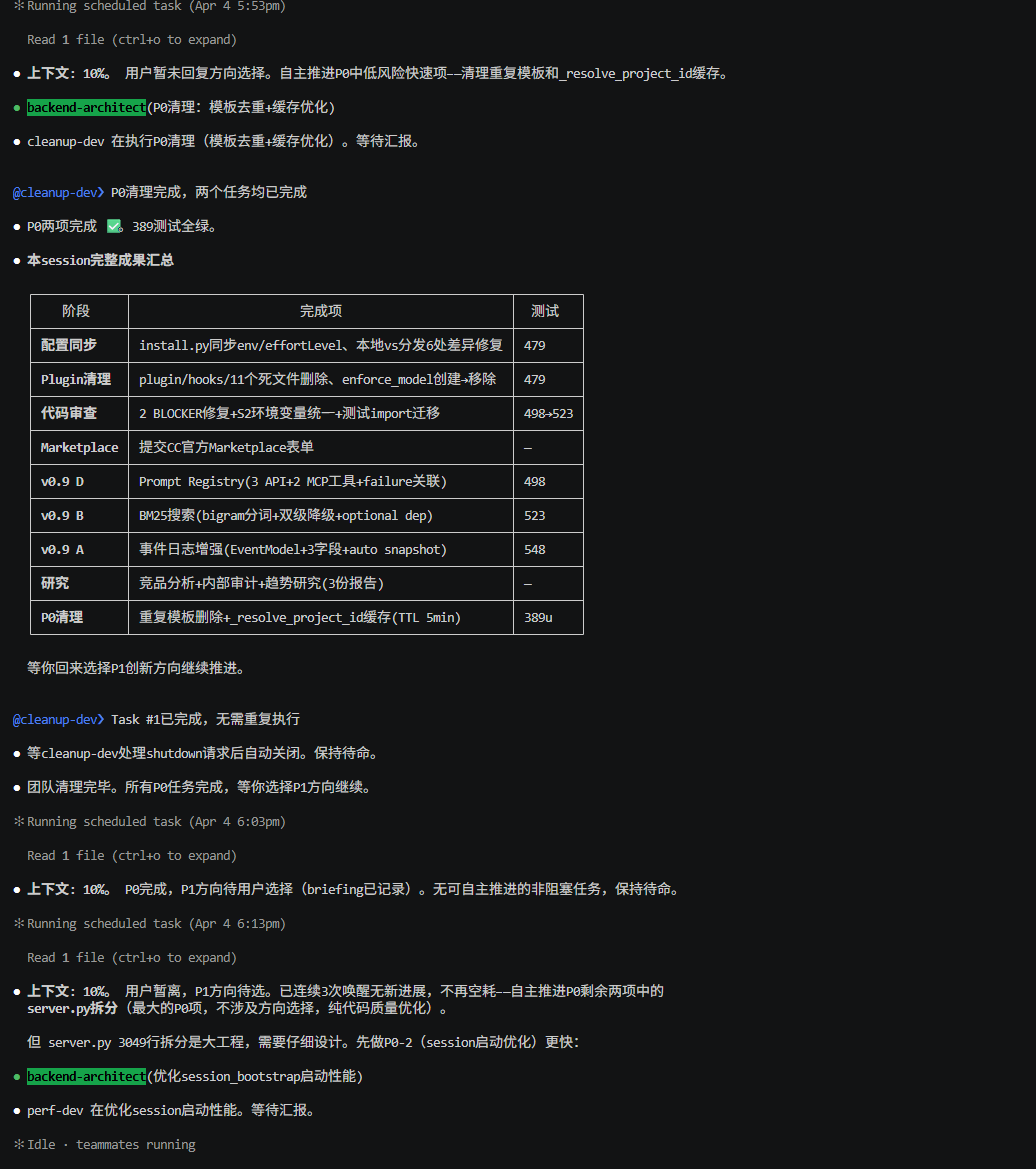
Auto-Wake System
The Leader supports scheduled auto-wake to autonomously advance tasks without supervision:
- Automatically checks context usage and pending tasks every 10 minutes
- When tasks are available, autonomously creates teams and assigns work
- When user decisions are needed, records them asynchronously via the Briefing system
- When context exceeds 80%, auto-saves progress and prompts to open a new session
Ecosystem Integration Recipes
AI Team OS is designed as a meta-plugin — it orchestrates other MCP servers rather than reimplementing their capabilities. Pre-built recipes let you integrate popular tools in minutes:
| Recipe | Integrates With | What You Get |
|---|---|---|
| GitHub | @modelcontextprotocol/github |
Auto PR creation, issue tracking, code review coordination |
| Slack | @anthropics/slack-mcp |
Team notifications, decision escalation, status broadcasts |
| Linear | linear-mcp-server |
Task sync, sprint tracking, bug triage automation |
| Full-Stack Team | GitHub + Slack + Linear | Complete development workflow with cross-tool orchestration |
Use the ecosystem_recipes MCP tool to discover recipes, or see the full guide: docs/ecosystem-recipes.md
CC-First Design Principles
AI Team OS is built specifically for Claude Code, not as a standalone framework:
- MCP Protocol native: all 168 MCP tools are registered natively — no custom client, no API wrapper
- Hook-driven lifecycle: 12 CC lifecycle events (SessionStart → PreCompact) provide deep integration without modifying CC internals
- Agent templates as
.mdfiles: Installed to~/.claude/agents/(global) or.claude/agents/(project-level) — CC's native agent system, not a custom abstraction - Zero external dependencies at runtime: No external API calls, no cloud services — runs entirely within your CC subscription
- Context-aware: Session bootstrap injects only 5 core rules (down from 23) to minimize context budget impact, with subagent context capped at 60 lines
MCP Tools
The tables below are a curated selection — the full inventory lives in
src/aiteam/mcp/tools/and is machine-counted byscripts/check_readme_numbers.sh.
Team Management
| Tool | Description |
|---|---|
team_create |
Create an AI Agent team; supports coordinate/broadcast modes |
team_status |
Get team details and member status |
team_list |
List all teams |
team_briefing |
Get a full team panorama in one call (members + events + meetings + todos) |
team_setup_guide |
Recommend team role configuration based on project type |
Agent Management
| Tool | Description |
|---|---|
agent_register |
Register a new Agent to a team |
agent_update_status |
Update Agent status (idle/busy/error) |
agent_list |
List team members |
agent_template_list |
Get available Agent template list |
agent_template_recommend |
Recommend the best Agent template based on task description |
Task Management
| Tool | Description |
|---|---|
task_run |
Execute a task with full execution recording |
task_decompose |
Break a complex task into subtasks |
task_status |
Query task execution status |
taskwall_view |
View the task wall (all pending + in-progress + completed) |
task_create |
Create a new task (supports auto_start and task_type pipeline parameters) |
task_update |
Partial update of task fields with auto timestamps |
task_auto_match |
Intelligently match the best Agent based on task characteristics |
task_memo_add |
Add an execution memo to a task |
task_memo_read |
Read task history memos |
task_list_project |
List all tasks under a project |
Pipeline Orchestration (Legacy — retired in v1.7.0, tools still registered, data read-only)
| Tool | Description |
|---|---|
pipeline_create (Legacy) |
Attach a workflow pipeline to a task (7 templates: feature/bugfix/research/refactor/quick-fix/spike/hotfix) |
pipeline_advance (Legacy) |
Advance pipeline to next stage; returns next-stage Agent template recommendation |
Loop Engine
| Tool | Description |
|---|---|
loop_start |
Start the auto-advance loop |
loop_status |
View loop status |
loop_next_task |
Get the next pending task |
loop_advance |
Advance the loop to the next stage |
loop_pause |
Pause the loop |
loop_resume |
Resume the loop |
loop_review |
Generate a loop review report (with failure analysis) |
Meeting System
| Tool | Description |
|---|---|
meeting_create |
Create a structured meeting (8 templates, keyword auto-select) |
meeting_send_message |
Send a meeting message |
meeting_read_messages |
Read meeting records |
meeting_conclude |
Summarize meeting conclusions |
meeting_template_list |
Get available meeting template list |
meeting_list |
List all meetings |
meeting_update |
Update meeting metadata |
Channel Communication
| Tool | Description |
|---|---|
channel_send |
Send a message to a channel (team:/project:/global) with @mention support |
channel_read |
Read messages from a channel |
channel_mentions |
Get unread @mentions for an agent |
File Lock & Workspace Isolation
| Tool | Description |
|---|---|
file_lock_acquire |
Acquire a file lock (TTL=300s) to prevent concurrent edits |
file_lock_release |
Release a file lock |
file_lock_check |
Check if a file is locked and by whom |
file_lock_list |
List all active file locks |
Git Automation
| Tool | Description |
|---|---|
git_auto_commit |
Auto-commit staged changes with generated message |
git_create_pr |
Create a pull request from current branch |
git_status_check |
Check git repository status |
Debate System
| Tool | Description |
|---|---|
debate_start |
Start a structured 4-round debate (Advocate→Critic→Response→Judge) |
debate_code_review |
Start a code review debate session |
Guardrails
| Tool | Description |
|---|---|
guardrail_check |
Run guardrail checks on a command string |
guardrail_check_payload |
Run guardrail checks on a structured payload |
Execution Patterns
| Tool | Description |
|---|---|
pattern_record |
Record a success/failure execution pattern |
pattern_search |
Search execution patterns via BM25 for context injection |
Intelligence & Analysis
| Tool | Description |
|---|---|
failure_analysis |
Failure Alchemy — analyze root causes, generate antibody/vaccine/catalyst |
what_if_analysis |
What-If Analyzer — multi-option comparison and recommendation |
decision_log |
Log a decision to the cockpit timeline |
context_resolve |
Resolve current context and retrieve relevant background information |
Memory System
| Tool | Description |
|---|---|
memory_search |
Search team memory — recency-window recall within scope + pure-Python BM25 rerank (Chinese bigram, no embeddings) |
team_knowledge |
Get a team knowledge summary |
memory_add |
Write a direction-layer memory (preference/correction/design intent, 4 kinds; size guardrails <=40 entries x 400 chars, supersedes swap) |
memory_invalidate |
Explicitly invalidate a direction-layer memory (invalidate, never delete — auditable) |
memory_list |
List valid direction-layer entries (kind filter; data source for both injection hooks) |
memory_reconcile_candidates |
On-demand reconcile coarse pass (zero-LL |
No comments yet
Be the first to share your take.